

Microchips: Shrinking Technology Investigation
TL;DR: Microchips: Shrinking Technology Investigation: Investigation into the thesis that microchips are produced via shrinking technology — creating large-scale chips with human tools, then using scalar/electromagnetic fields to produce miniature replicas — rather than the mainstream narrative of photolithography and nanoscale fabrication. Investigation into the thesis that microchips are produced via shrinking technology — creating large-scale chips with human tools, then using scalar/electromagnetic fields to produce miniature replicas — rather than the mainstream narrative of photolithography and nanoscale fabrication. Covers: mainstream vs alternative positions; predictive programming for shrinking (objects vs lifeforms); Nintendo and global chip supply chain; optical media parallels (CD-ROM, Blu-ray); Taiwan/Japan/Korea vassal-state pattern.
Sponsored thesis: The technology that operates computers is suppressed. Nobody really knows how to build it. Chips might not use shrinking technology, but they are absolutely a suppressed technology — and probably not possible without it. The theory rests primarily on the weird geopolitical situation and lack of competition, not on certainty that shrinking is used. Microchips may be created by atom-aligning electromagnetic replication of large-scale prototypes; the conventional photolithography narrative does not hold up under scrutiny. The same suppression patterns apply to optical media and semiconductor consolidation.
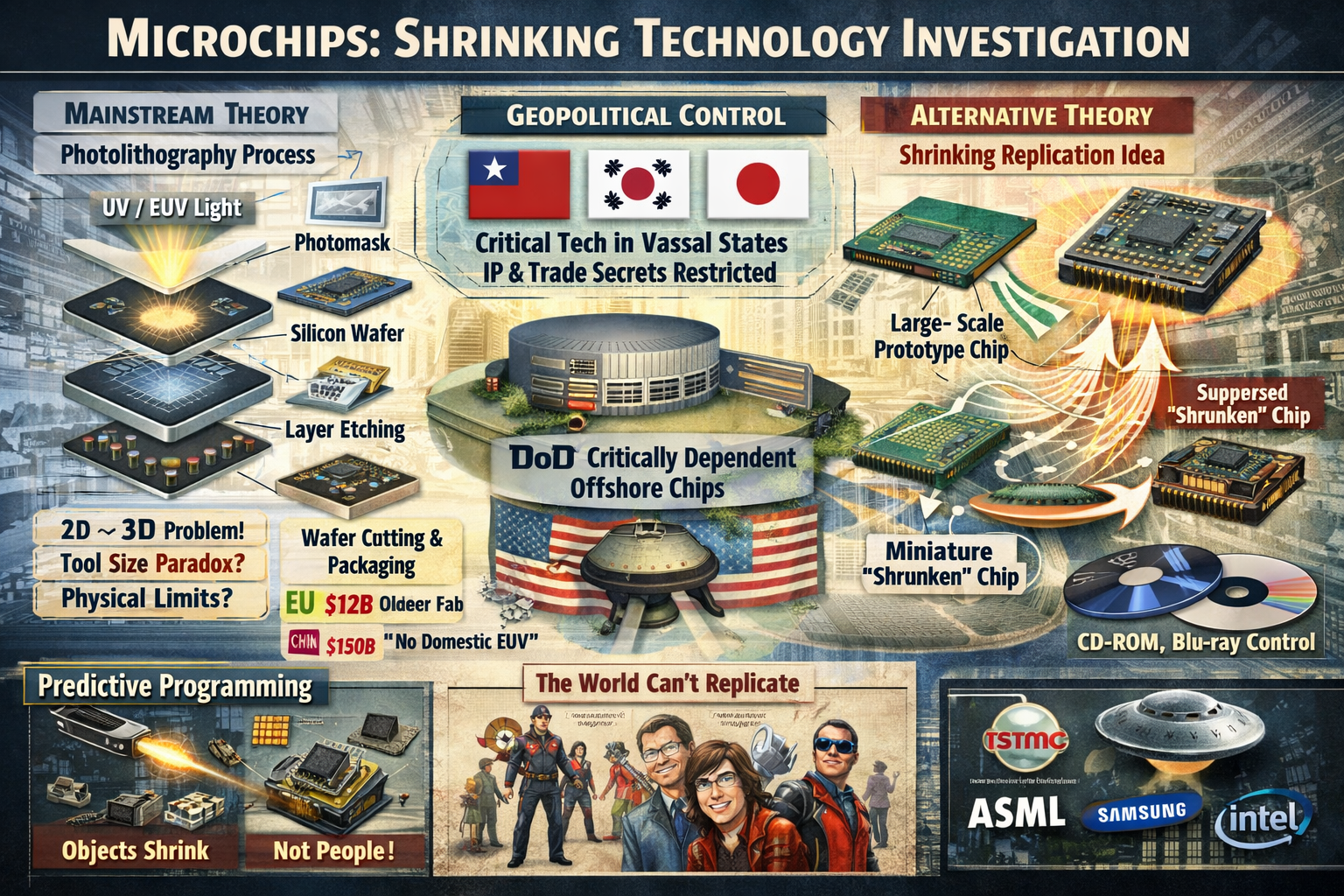
Major Investigation Finding
Regardless of shrinking technology, nobody knows how chips are made. Mainstream sources themselves acknowledge that nations cannot replicate advanced semiconductor capability — the U.S. spends $12B to move TSMC to Arizona yet the fab will produce chips a generation behind Taiwan “because you cannot move the learning curves”; China spent $150B attempting to replicate EUV lithography and domestic alternatives to ASML “do not exist and will not for years to come”; the EU’s $50B goes to older-generation production. The U.S. DoD is “critically dependent” on foreign chip supply and “may be unable to do without” offshore chips. Taiwan invoked national security law to protect TSMC trade secrets. This pattern could only be the result of a deliberate worldwide system of control — IP, export restrictions, geopolitical concentration in vassal states, and knowledge transfer that requires controlled locations — preventing humanity from achieving the kind of knowledge required to conceive of or reproduce incredible shrunken technology, while making the species completely dependent on it. See §1 (Mainstream Acknowledgments, US Military), §10 (Conclusion).
Status
Ongoing. Per INVESTIGATIVE_STRATEGY (paradigm-threat-timeline): investigate from scratch; do not rule out possibilities due to “scientific consensus” or “lack of evidence” alone.
1. Mainstream Position: How Chips Are Supposedly Made
Claim: Microchips are fabricated via photolithography — a process in which:
- A wafer of silicon is coated with photoresist
- Ultraviolet light (or EUV, extreme ultraviolet) is projected through a photomask containing the chip pattern
- The resist is chemically developed; exposed or unexposed areas are etched away
- Multiple layers of doping, deposition, and etching build up transistors and interconnects
- Dies are cut from the wafer, packaged, and tested
Key points:
- Feature sizes have shrunk from micrometers (1970s) to nanometers (2020s)
- EUV lithography (ASML) uses 13.5 nm wavelength light; machines cost hundreds of millions
- Taiwan Semiconductor Manufacturing Company (TSMC) produces ~90% of advanced logic chips
- Intel, Samsung, and a few others maintain their own fabs; most firms (e.g., AMD, Apple, Nvidia) are fabless and outsource to TSMC or equivalents
The 2D→3D Problem and Physical Limits
The photomask provides a 2D blueprint of what must ultimately be a 3D chip. Mainstream accounts say this is done in layers — successive photolithography steps build up the third dimension. Several problems arise:
Layers cannot build the complexity we need. Photolithography may plausibly handle 2D patterning at nanometer scale. But assembling layers — aligning, registering, and stacking them — at that level of precision is another matter. 2D layering + layer assembly does not obviously scale to the complexity required for 100 billion transistors per chip.
Tool-size paradox. At some point, the tools themselves would have to be quite small to achieve that precision. Human-scale equipment patterning nanometer features and assembling them into coherent 3D structures runs into a chicken-and-egg: you need nano-scale tools to build nano-scale structures. Where did those tools come from?
We should have hit limits long ago. Physical limits for what we can build without shrinking technology — using only human-scale photolithography, layer stacking, and conventional fabrication — ought to have been reached well before 100 billion transistors per chip. The fact that we did not suggests either (a) the mainstream narrative is incomplete or wrong, or (b) some other mechanism is in play.
Conclusion from this angle: Photolithography may account for 2D patterning. It does not clearly account for 3D assembly at the required precision. The shrinking thesis fills the gap: build at human scale (where tools exist), then replicate at smaller scale. If not shrinking, then something does not add up.
Mainstream Acknowledgments: Inability to Replicate
Foreign Policy (March 2026): “Even when you can move the factories, you cannot move the learning curves.” U.S. spends ~$12B to replicate TSMC in Arizona; the fab will produce chips a generation behind Taiwan. China spent $150 billion to replicate EUV lithography; “domestic alternatives to ASML’s technology do not exist and will not for years to come.” EU commits ~$50B, mostly to older-generation production. (Jurgens, “The Myth of AI Sovereignty,” Foreign Policy)
Harvard International Review: “Despite massive government spending, countries cannot simply replicate advanced semiconductor capabilities elsewhere.” (Harvard HIR: Silicon Sovereignty)
Taiwan National Security Law (2025): Taiwan invoked national security law to protect TSMC trade secrets. Semiconductor sub‑2nm technology designated “national core key technology.”
ASML monopoly: EUV lithography systems manufactured exclusively by ASML (Netherlands); ~$380M each.
US Military / DoD Dependence
National Academies (2024): “U.S. semiconductor technology leadership is in question.” Domestic share 12% (down from 37% in 1990). DoD “critically dependent” on commercial SOTA manufacturing. “Significant risk that the most advanced chips will continue to be produced offshore… chips that DoD may be unable to do without.” (National Academies)
GAO (2025): DoD relies on 200,000+ suppliers globally; little visibility into foreign dependence. (GAO-25-107283)
Other Gaps and Anomalies
- No independent verification exists for the public; fabrication occurs in controlled, classified, or proprietary environments
- The concentration of production in Taiwan — a vassal state — is structurally anomalous
- Attempts to replicate or “copy” existing chips have not produced viable alternatives; the know-how appears to require controlled transfer in special locations
2. Alternative Thesis: Chips as Shrunken Technology
Claim (hedged): The strongest evidence is geopolitical — weird consolidation, lack of competition, vassal-state pattern. Conventional photolithography does not satisfactorily explain 2D→3D assembly at the required precision. If microchips are built as mainstream claims, we should have hit limits long before modern densities. The shrinking thesis is a plausible fit: microchips may not use shrinking technology, but they are almost certainly suppressed, and conventional fabrication alone probably cannot explain them.
Mechanism (if shrinking is used): Microchips are not built by human-scale photolithography at nanometer resolution. Instead:
- Large-scale prototype: A chip is first built at human-usable scale — with ordinary tools, visible features, and no exotic nanomachinery
- Scalar/electromagnetic imprint: Scalar energy or an electromagnetic field is applied that matches the large chip’s exact design
- Atom alignment: The field creates miniature versions of the same electromagnetic pattern; atoms in the target material align to match the large-scale prototype
- Result: The process produces miniature replicas — “shrunk” versions — of the original design. It is not literal shrinkage of a physical object, but replication at reduced scale through pattern-imprinting
Implications:
- The technology is atom-aligning, not fabrication in the conventional sense
- If true, the entire semiconductor industry rests on suppressed physics — scalar waves, non-Hertzian fields, or similar — that mainstream science denies or marginalizes
- The “shrinking” fiction in film and literature may encode the real rules: objects can be shrunk/replicated at smaller scale; lifeforms cannot (see §4)
- Suppression of anti-gravity, ether physics, and related technologies may share the same institutional networks that control chip production
3. Chip Consolidation and Vassal-State Pattern
Taiwan
- TSMC produces the majority of the world’s advanced logic chips (5 nm, 3 nm, 2 nm nodes)
- Taiwan was a U.S. ally/client state; defeated or isolated regimes have historically hosted critical tech infrastructure
- U.S. Foreign Direct Product Rule and export controls limit who receives Taiwanese chips
- “Silicon shield” thesis: Taiwan’s dominance deters invasion because global prosperity depends on it
- Pattern: Technology concentrated in a vassal state; controlled from abroad; “pull the pin” capacity to switch suppliers if one defects
Japan and South Korea
- Japan: Dominated semiconductors in the late 1980s (~50% global share). Declined after 1986 US–Japan semiconductor agreement and Reagan-era tariffs. Japan could not build CD-ROM without Philips or Sony (see nintendo-sony-breakup, yakuza-remote-control-investigation)
- South Korea: Samsung and SK Hynix are major memory producers; Korea also a post-war client state
- Pattern: Countries we defended in wars, or defeated, now build technology in controlled ways — same connections that may have suppressed anti-gravity, ether, and other tech
Microsoft and Apple
- Neither Microsoft nor Apple created the hardware (chips); they were the primary distributors of software that ran on those chips
- Chips followed the software ecosystems; eventually Apple moved to Intel, then to custom ARM designs (Apple Silicon) fabricated by TSMC
- Software lock-in and ecosystem control reinforced chip consolidation — a feedback loop
4. Nintendo Chip Production: Who Built What?
Nintendo did not build its chips in-house. Chip production was outsourced to a web of Japanese and Western suppliers:
| System | Component | Manufacturer | Notes |
| NES/Famicom | CPU (2A03/2A07) | Ricoh | Jointly developed with Nintendo; Ricoh manufactured. Modified MOS 6502 + APU. Exclusive contract until 2003 |
| SNES/Super Famicom | Sound (SPC700) | Sony | Ken Kutaragi designed; Sony developed and manufactured |
| SNES | SRAM | Sharp, Hitachi | 32 KB |
| SNES | DAC (D6376) | NEC | 2-channel 16-bit |
| SNES | DSP coprocessors | NEC (µPD77C25 base) | DSP-1 through DSP-4 for Mode 7, 3D |
| SNES | Super FX | Argonaut (design), various fabs | 3D graphics |
| NES | MMC (cartridge) | Nintendo | Nintendo manufactured MMC chips in-house for cartridges |
Conclusion: Nintendo designed or commissioned designs; manufacturing was delegated to Ricoh, Sony, NEC, Sharp, Hitachi, and others. No evidence that Nintendo ever fabricated chips from scratch. The CD-ROM add-on was never built — Nintendo depended on Sony, then Philips; Japan could not produce CD-ROM independently. See yakuza-remote-control-investigation for the containment thesis.
5. Who Produced Chips for World Systems (Historical)
| Era / Region | Producers | Notes |
| US, 1960s–80s | Intel, Motorola, TI, AMD, Fairchild | US dominance; Silicon Valley rise |
| Japan, 1980s | NEC, Toshiba, Hitachi, Mitsubishi, Fujitsu | Japan reached ~50% global share; US–Japan semiconductor agreement (1986) and tariffs reversed this |
| Taiwan, 1987+ | TSMC (founded by Morris Chang), UMC | RCA tech transfer (1976); ITRI; Hsinchu Science Park |
| South Korea | Samsung, SK Hynix, LG | Memory and logic; post-war industrialization |
| Europe | Philips, Siemens, STMicroelectronics | Never achieved US/Asia scale in cutting-edge logic |
| Present (advanced logic) | TSMC, Samsung, Intel | TSMC dominates 5 nm and below; Intel retains US fabs; AMD, Apple, Nvidia are fabless |
Pattern: Production has concentrated in Taiwan and a handful of firms. Replication of the process elsewhere has failed or been blocked. The thesis: you cannot copy chips without being shown how in a controlled location — Taiwan, historically Japan or Korea — and that know-how is deliberately restricted.
6. Optical Media Parallel: CD-ROM and Blu-ray
The same suppression pattern appears in optical storage:
- CD-ROM: Japan could not build CD-ROMs without Philips or Sony. The format was co-invented by Philips and Sony (1982); licensing and patent control kept production in approved hands
- Blu-ray: Manufacturing requires licensing from the Blu-ray Disc Association and One-Blue patent pool. Major licensees: Sony, LG, Panasonic, Hitachi, Philips, JVC, Pioneer, Samsung. New entrants must obtain licenses — the ecosystem is closed
- Nintendo–Sony breakup: Nintendo chose Philips over Sony for CD; CD-ROM add-on never materialized; Nintendo stayed with cartridges. The Yakuza/containment thesis posits that Japanese firms were steered away from autonomous optical media production
Implication: The technology that operates computers — both silicon and optical — is gatekept. Nobody builds it from first principles without approval from the patent holders and licensors.
7. Predictive Programming: Shrinking in Science Fiction
If shrinking/miniaturization technology is real and suppressed, fiction may encode its rules as managed disclosure — telling the public what is possible and what is not, in genre form, so that when the tech surfaces (or is used covertly), audiences have been conditioned.
The Proposed Rule
Objects can be shrunk; lifeforms cannot (or suffer fatal limitations when shrunk).
This would align with the microchip thesis: we shrink objects (chips), not people. The fiction prepares the mind for “shrinking works on things, not on us.”
Lynchpin and Caveat Pattern
Predictive programming often provides a lynchpin or caveat to the rules being presented — a fictional breakthrough or exception — which portrays the technology as magic or arbitrary fantasy. This obscures the real constraint while still encoding it. Most shrinking stories involve humans and lifeforms that cannot be shrunk; many add time limits. The real rule is disclosed, then a caveat (“but the hero found a way”) reframes it as fiction.
Media Catalog: Shrinking Technology
| Title | Year | Medium | Rule Encoded | Lynchpin / Caveat |
| The Shrinking Man | 1956 (novel), 1957 (film) | Literature, Film | Lifeform shrinks via radiation + insecticide; continuous shrinking until dissolution | No caveat — rule is enforced; victim narrative |
| Fantastic Voyage | 1966 | Film | Submarine + crew miniaturized; 60-minute limit before reversion (fatal if still inside body) | Time limit as constraint; no permanent lifeform shrinking |
| Honey, I Shrunk the Kids | 1989 | Film | Electromagnetic shrinking machine; kids (lifeforms) shrunk accidentally; danger, insects, ordeal | Caveat: machine can shrink kids (accident); ordeal encodes danger |
| Innerspace | 1987 | Film | Miniaturization of pilot + pod; injected into wrong host; oxygen/time limit; geopolitical prize — “What country will control miniaturization?” | Same as Fantastic Voyage; plus explicit nation-state control disclosure (see below) |
| Ant-Man | 2015+ | Film | Villain (Cross) can shrink objects and equipment; cannot shrink life — the real limitation | Caveat: Cross invents human-shrinking suit; story breaks from reality into fantasy |
| Downsizing | 2017 | Film | Voluntary shrinking to reduce footprint; irreversible; mixed results | Lifeform shrinking as social experiment; consequences |
| The Incredible Shrinking Woman | 1981 | Film | Parody of Shrinking Man; household products cause shrinking | Same victim narrative |
Ant-Man (2015) as key disclosure: Darren Cross’s research hits the wall: he can shrink objects and equipment but cannot shrink life. That is the real limitation, stated plainly. The story then breaks from reality when Cross invents the human-shrinking suit — the lynchpin that lets heroes and villains shrink, making the whole thing feel like arbitrary movie magic rather than disclosure of an actual constraint.
Innerspace (1987) as geopolitical disclosure: The villain Victor Scrimshaw dismisses nuclear weapons and the space race as spent strategic assets and names miniaturization as the decisive edge of the future — framed explicitly as a national control question, not merely a lab curiosity:
Nuclear weapons, Jack. They mean nothing. Everybody’s got ’em, nobody has the balls to use ’em. Am I right? … Space, you say? Space is a flop. Didn’t you know that? An endless junkyard of orbiting debris. Ah, but! Miniaturization, Jack. That’s the ticket. That’s the edge everybody’s been looking for. Who will have that edge, Jack? What country… will control miniaturization?
— Victor Scrimshaw (Innerspace, 1987)
This is one of the strongest predictive-programming matches in the shrinking catalog for the semiconductor / CPU crisis that followed: post-1980s consolidation of advanced fabrication in Taiwan; export controls and CHIPS Act responses; China’s hundreds of billions spent attempting domestic replication without success; and US–China tension over Taiwan as the choke point for the “edge” Scrimshaw names. The film encodes both dimensions of this section — the objects vs lifeforms rule (pilot shrunk inside pod, not as a naked lifeform) and a blunt disclosure that shrinking technology is a nation-state prize whose control will determine strategic dominance. The plot itself turns on theft of Western miniaturization tech for sale to overseas bidders — a rehearsal of the supply-chain opacity and vassal-state pattern in §3.
Synthesis: Across these works:
- When objects are shrunk, it is often framed as technological achievement
- When lifeforms are shrunk, they face: (a) continuous decay (Shrinking Man), (b) time limits (Fantastic Voyage, Innerspace), (c) danger and ordeal (Honey), or (d) a fictional caveat (Ant-Man suit)
- The invariant: shrinking lifeforms is never unambiguously safe and permanent without a lynchpin; shrinking objects can be. The caveats ensure we dismiss the rule as fantasy.
8. Connections to Other Investigations
- Yakuza remote control — Nintendo–Sony, CD-ROM containment, Japan as tech vassal
- Nintendo–Sony breakup — Philips as only CD alternative; Nintendo never built CD
- Anti-gravity, ether, suppressed tech — Same institutional networks may control chip physics and scalar/electromagnetic research
- Predictive programming — Shrinking fiction as managed disclosure; see PP media catalog (§7)
9. Outstanding Questions
- How does mainstream photolithography account for layer alignment and 3D assembly at nanometer precision? What tools achieve it?
- What is the exact role of ASML, and could EUV machines be a cover for a different process?
- Has any nation or firm successfully replicated advanced chip production without technology transfer from Taiwan, Japan, or Korea?
- Are there patents or declassified references to scalar/electromagnetic replication of microstructures?
- Does the “objects yes, lifeforms no” rule in shrinking fiction predate the chip era, or appear after semiconductor consolidation?
10. Conclusion: Nobody Knows How Chips Are Made
Regardless of shrinking technology, nobody knows how chips are made. The mainstream narrative (photolithography, layers, EUV) does not satisfactorily explain 2D→3D assembly at the required precision. The 2D photomask problem, tool-size paradox, and lack of physical limits before 100B transistors suggest something does not add up — whether shrinking or another mechanism.
More decisively, mainstream sources themselves document the inability to replicate:
- U.S. $12B to move TSMC to Arizona → chips a generation behind
- China $150B to replicate EUV → “domestic alternatives do not exist”
- EU $50B → older-generation only
- DoD “critically dependent,” “unable to do without” offshore chips
- Taiwan invokes national security law to protect TSMC secrets
This could only be the result of a deliberate worldwide system of control — IP regimes, export restrictions, geopolitical concentration in vassal states, and knowledge transfer that requires controlled locations (Taiwan, historically Japan or Korea). The system prevents humanity from achieving the kind of knowledge required to conceive of or reproduce the technology that makes modern computers possible, while making the species completely dependent on it. Whether that technology involves literal shrinking, atom-aligning replication, or something else, the suppression is structural and global.
11. References
Mainstream / Cited Sources
- Jeremy Jurgens, “The Myth of AI Sovereignty,” Foreign Policy (March 9, 2026)
- National Academies, Strategies to Enable Assured Access to Semiconductors for the Department of Defense (2024)
- GAO-25-107283, Defense Industrial Base: Actions Needed (2025)
- Harvard HIR, “Silicon Sovereignty”
Project Cross-References
- Ricoh 2A03, Nintendo–Sony breakup, Yakuza remote control investigation
- TSMC, semiconductor industry in Taiwan; US–Japan semiconductor agreement
- Fantastic Voyage, The Shrinking Man, Honey I Shrunk the Kids, Innerspace
- Blu-ray Disc Association; One-Blue licensing; CD-ROM history
Prisca sapientia (epistemic foundation): This investigation assumes prisca sapientia—the historical and philosophical belief that the ancients possessed a vast, profound understanding of the universe, nature, and theology that was subsequently lost or degraded. Modern consensus science and institutions are not treated as default truth; evidence tiers below adjudicate specific claims.
Keywords: #Microchips #Shrinking #Technology
Share