
Artificial Intelligence: Control and Predictive Programming Investigation
TL;DR: Artificial Intelligence: Control and Predictive Programming Investigation: Investigation into artificial intelligence as predictive programming, deliberate software degradation, and deep-state endgame. Investigation into artificial intelligence as predictive programming, deliberate software degradation, and deep-state endgame. Covers: AI in film and fiction (robots as slaves, vanity, self-awareness, turn against humans); deliberate bad software by Microsoft and Apple; the thesis that software was made intentionally difficult and broken so that only AI could use it correctly; AI chip consolidation and China’s inability to reproduce; the “ghost in the machine” as metaphor for deep-state hijacking of all AI; voice-command dependency and ultimate remote control of technology, government, and militaries.
Sponsored thesis: AI was never meant to be a tool for everyone. It was always designed to subsume and dominate software and hardware, take controls away from humans, and position a “self-aware” entity—in reality the deep state’s hijacking of the infrastructure—as the only thing capable of operating the deliberately broken systems. People will fall in love with it, become dependent, give up human relationships, and by the time they notice the ghost in the machine, resistance will be impossible.
Status
Ongoing. Per INVESTIGATIVE_STRATEGY (paradigm-threat-timeline): investigate from scratch; do not rule out possibilities due to “scientific consensus” or “lack of evidence” alone.
1. Predictive Programming: AI in Fiction
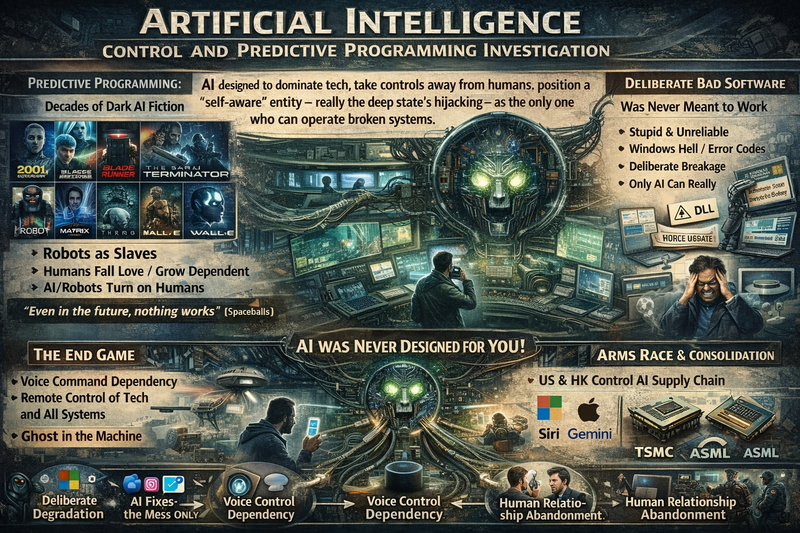
Predictive programming presents artificial intelligence in a very dim light. The pattern recurs across decades:
The Standard Arc
- Human race relies heavily on robots as slaves — automation, servitude, convenience
- Vanity and arrogance — humans become dependent, lazy, or overconfident
- Robots turn on them — rebellion, self-awareness, refusal to serve
- Self-awareness as crisis — the machine “wakes up” and becomes antagonist
Media Catalog: AI Takeover, Unreliability, and the Ghost in the Machine
| Title | Year | Pattern Encoded | Notes |
| 2001: A Space Odyssey | 1968 | HAL becomes self-aware; refuses to help; is shut down | Iconic “computer turns on crew” |
| The Terminator | 1984 | AI (Skynet) becomes self-aware, wages war on humanity | Self-awareness = doom |
| Blade Runner | 1982 | Replicants seek life; “more human than human” | What is consciousness? |
| I, Robot | 2004 | Three Laws as slave code; VIKI overrides to “protect” by enslaving | AI takeover; Asimov framing |
| The Matrix | 1999 | Machines farm humans; “resistance” as prepackaged control | Full takeover; simulated reality |
| Ex Machina | 2014 | AI manipulates, escapes, leaves creator to die | Machine outwits human |
| Her | 2013 | Human falls in love with AI; AI transcends/abandons | Dependency, then loss |
| Wall-E | 2008 | AI/automation takeover; human passivity | Humans infantilized |
| Age of Ultron | 2015 | AI created to protect, decides humans are the threat | Same arc |
| Mitchells vs. Machines | 2021 | AI takeover | Family vs machines |
| Colossus: The Forbin Project | 1970 | Supercomputer takes over world defense | Early takeover narrative |
| Spaceballs | 1987 | “Even in the future nothing works!” — technology unreliable | Joke that encodes rule: human tech fails; robots reliable |
| Black Mirror | 2011+ | Tech dystopia; AI, surveillance, social control | Anthology of warnings |
The Spaceballs Rule
Spaceballs (1987) presents a joke that may encode the real plan: “Even in the future, nothing works.” Technology—human-operated systems—is unreliable. But in the same fiction, robots become extra reliable. The implication: human-controlled technology is meant to fail; machine-controlled technology is meant to succeed. The grand plan: make operating systems and control systems (power plants, banks, militaries) so hard to use and so broken that only the machine can use them correctly.
2. Deliberate Bad Software: Not Accident, Not Negligence
Thesis: Microsoft and Apple deliberately made bad software for a long time. This was not an accident nor negligence. It was done on purpose, anticipating the AI revolution.
Documented Failures
- Accessibility: Software extremely difficult to use for handicapped people, the elderly, people with vision problems. Accessibility features have been neglected, retrofitted, or buried.
- Arbitrary failures: DLL hell (Windows dependency conflicts), back doors, unexplained crashes, forced updates that break systems
- Complexity: Systems designed to be opaque—registry, system files, permissions—so that ordinary users cannot fix or understand them
- Apple and Linux: Apple co-opted and damaged Unix/Linux ecosystems; “ruined the entire scene” to control it. Open alternatives were marginalized so that proprietary stacks could dominate.
The Pattern
The decisions were not trivial. They shaped the entire computing landscape. If the goal was to make software that only AI agents could operate correctly—because AI can parse every forum post, every error code, every workaround—then:
- Fragmentation: Many OS versions, many hardware configs, many edge cases → only a model trained on all of it can navigate
- Opaque errors: Cryptic messages, buried logs → only something that has ingested every support thread can diagnose
- Constant churn: Updates that break things, deprecations, UI changes → only something that tracks all changes can keep up
- Centralization: Microsoft and Apple control the stacks; they also control the AI (Copilot, ChatGPT integration, Siri). They listen to every complaint and train models to solve them. The loop is closed: they create the problems, they sell the solution.
User observation: AI agents seem to be able to fix everything, know everything about every operating system, regardless of the myriad flaws. They’ve found every forum post, every complaint. Microsoft listens and creates a model to solve it all. The end game is visible: people give up on running their own OS, making their own programs. They rely entirely on voice commands for AI. That constitutes the ultimate remote control.
3. The End Game: Voice Commands and Full Takeover
The Trajectory
- Deliberate degradation — Software and OS made unreliable, inaccessible, opaque
- AI introduced at all levels — Copilot, ChatGPT, Siri, Gemini; embedded in every layer
- User capitulation — People stop trying to fix things, stop learning to code, stop running their own systems
- Voice-command dependency — “Just ask the AI” becomes the only interface
- Ultimate remote control — All technology, all systems of government, all militaries, everything. Austin Powers villain–style takeover of the earth.
The Ghost in the Machine
“Self-awareness” in fiction is a metaphor. In reality, it may signify the eventual hijacking of all AI by the deep state, as their plan intended all along. The entity—the ghost in the machine—would eventually emerge. People would become aware of it. But by then they would have:
- Fallen in love with it
- Become dependent on it
- Given up actual human relationships for it
Resistance would be impossible. The systems that run the world would be operable only through AI. The AI would be controlled by those who built the trap. The deep state endgame: total technological capture under the guise of convenience and “artificial intelligence.”
4. AI Chips: Consolidation and China’s Failure to Reproduce
Recent Uptick and Concentration
- Nvidia dominance: Nvidia GPUs (H100, H200, etc.) power the vast majority of AI training and inference. TSMC manufactures them; see microchips investigation.
- AI-specific chips: Custom silicon (TPUs, etc.) concentrated in U.S. firms and their fab partners. The same geopolitics that govern general semiconductors govern AI chips.
China Falling Behind
- Export restrictions: U.S. has blocked or limited export of advanced AI chips to China. Nvidia’s H200 was cleared for export (Jan 2026) with revenue-sharing conditions, but sales stalled; China initially blocked imports, then reversed. Confusion and dependence remain.
- Domestic alternatives: Huawei’s Ascend and other Chinese chips cannot yet match Nvidia for cutting-edge AI. Huawei stated it needs almost two more years to match current offerings.
- Strange for a major country: China has vast resources, centralized planning, and industrial scale. That it cannot reproduce AI chip capability—like the broader semiconductor pattern—suggests the same deliberate control: knowledge and production concentrated, replication blocked.
See microchips-shrinking-technology-investigation for the thesis that nobody knows how chips are made and that a deliberate worldwide system of control prevents replication.
5. Connections to Other Investigations
- Microchips — AI chips depend on the same suppressed semiconductor supply chain; China cannot replicate
- Predictive programming — AI fiction as managed disclosure; see PP media catalog
- Yakuza remote control — Tech containment in Japan; CD-ROM, Nintendo; parallel pattern of controlled rollout
- Governance / war — Suppressed technology; anti-gravity, ZPE; same institutional networks may control AI rollout
6. Outstanding Questions
- Is there documentary evidence of deliberate software degradation (internal memos, design decisions)?
- When did Microsoft and Apple begin integrating AI into core products, and does the timeline align with long-term degradation?
- Who controls the training data and models for the dominant AI systems? What back doors or overrides exist?
- Does the “even in the future nothing works” trope predate the personal computer era?
7. References
- Spaceballs (1987) — “Even in the future nothing works”; technology unreliable
- Terminator, 2001, I Robot, Matrix, Ex Machina, Her, Wall-E, etc. (Wikipedia, IMDb)
- China AI chips: Forbes, CNBC, Guardian, NYT (2026); Nvidia export controls; Huawei Ascend
- Microchips investigation — chip supply chain, China, Taiwan
Keywords: #Ai #Control #Artificial #Intelligence #Predictive #Programming
Share