
Ghost War: The Antibody Phase
NSA vs CIA, proxy terror, and Hollywood’s post-9/11 containment script
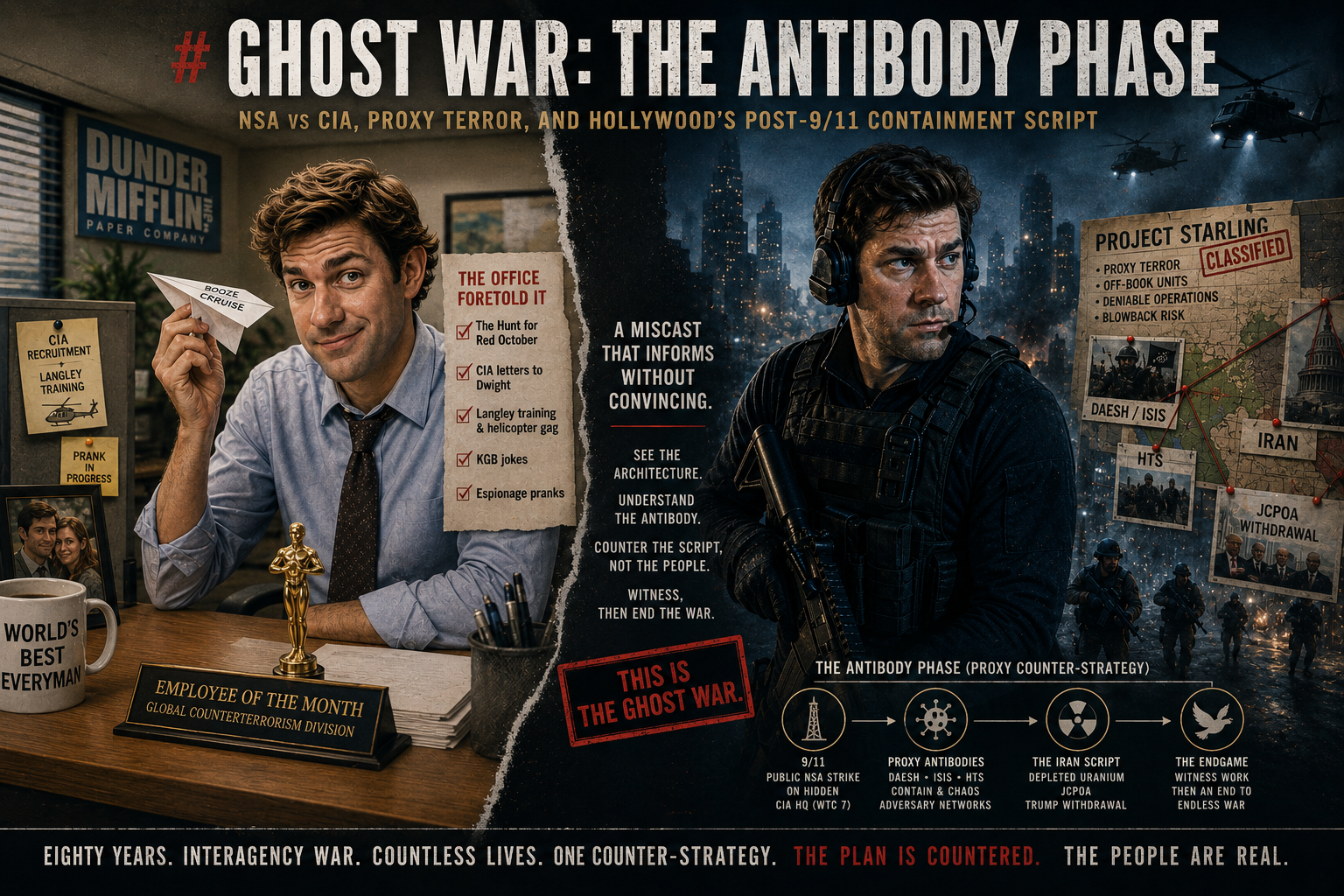
Picture Jim Halpert at a Dundies ceremony. Michael Scott hands him a trophy for “Employee of the Month, Global Counterterrorism Division.” That is the entire audience problem with Tom Clancy’s Jack Ryan: Ghost War (2026): we spent nine seasons watching a paper salesman prank Dwight Schrute, and now Amazon expects us to believe he is the moral spine of post-9/11 interagency proxy warfare. Millions of viewers had the same reaction. They could not unsee Jim. The movie felt like predictive programming written by someone who knew the casting was wrong on purpose.
TL;DR: Ghost War admits post-9/11 CIA–MI6 proxy machinery then reframes it so the public cannot credit antibody success (proxy Islam vs proxy Islam, minimal-damage copy). Who’s who: ISIS dual-face, Chibok/Boko inverted read, Israel-acceptance divider—good-actor § I. Post-hoc PP (May 2026): Syria Dec 2024 + Iran spring 2026 calendar rhymes. Greenlit Oct 2024; MI6 whitewash; Crown tell; sit back and watch.
Wrong genre, right tell
Jim sells paper. He breaks the fourth wall. He flirts with Pam from his desk in the bullpen. That training is irreversible. When Krasinski puts on a tactical vest and whispers about national security, half the audience is still waiting for a confessional glance that says I can’t believe they’re making me do this.
That reaction is not a failure of acting alone. It is a genre collision—and it is an old Hollywood tactic, not a one-off casting mistake. For decades studios have taken bankable everyman or teen-comedy faces and dropped them into prestige war and uniform roles right after the audience locked in a softer persona. Matthew Broderick went from Ferris Bueller’s Day Off (1986) to colonel in Glory (1989); contemporary reviews called him “catastrophically miscast” and an “amiable non-presence” in a Civil War epic (Wikipedia — Glory reception). Michael J. Fox, still carrying Back to the Future energy, was cast in Casualties of War (1989) opposite Sean Penn’s Vietnam brutality. Tom Hanks crossed from Splash and Big into Saving Private Ryan (1998) and a producer lane that ran through Band of Brothers and The Pacific. Oliver Stone’s Platoon casting notes circulated Keanu Reeves and Kyle MacLachlan for the Taylor role before Charlie Sheen landed it (Wikipedia — Platoon § Casting). The pattern is assembled from film history and review language in the Call of Duty militainment investigation §4.4–§4.5—not a formal academic trend, but a repeatable industry move.
John Krasinski is the latest turn on the same conveyor belt: The Office everyman → 13 Hours → Jack Ryan → Ghost War. Sitcom Jim is the everyman the culture trusted to mock bureaucracy. Jack Ryan is Tom Clancy competence porn—the analyst who becomes field officer because the plot demands a face the viewer will follow into hell. Krasinski was never going to erase nine years of prank DNA. When the star persona clashes with gravitas, critics and audiences notice—sometimes that friction is the point. The miscast becomes a built-in ridicule buffer so the payload still lands while the viewer cannot grant full moral weight to what was admitted on screen.

Netflix already ran the same experiment and got the same audience pushback—on the Michael Scott side of the ledger. Space Force (2020) reunited Greg Daniels and Steve Carell from The Office and dropped a negligent, narcissistic, tech-backward four-star general into a real institution the Trump administration had just stood up in 2019. Carell’s General Naird reads like Michael Scott with rank: well-meaning chaos in a uniform, cringe played for laughs where the branch name demanded at least partial gravity. Season 1 landed mixed at best—critics and viewers said the show felt like Office DNA forced into a government-agency box it could not quite fill. The parallel matters for Ghost War: when you import a sitcom archetype into a live federal lane—paper salesman into CIA proxy war, or Dunder Mifflin boss into Space Force—the audience’s immune system rejects the graft. At least Space Force leaned into satire. Jack Ryan asks for Tom Clancy seriousness while still smuggling Jim’s face. For the institutional satire cluster and naming collision with the real branch, see the Trump-era Hollywood investigation (Space Force lane).
Watch how the franchise handles the tension. Jack Ryan Season 1 opens with Jack as desk analyst—closer to Jim with a clearance than to Jason Bourne. By Ghost War, he is deputy director material, running interagency chess while Greer ascends. The show gives him competence set-pieces: the sprint through traffic, the briefing-room moral clarity, the occasional smirk that feels like Jim remembering a prank. Those beats are not accidents. They are audience retention in a genre that would otherwise collapse under its own self-seriousness. Without them, Starling’s confession would play like a Senate report. With them, you get a thriller that still feels like Thursday-night comfort food—until you notice what it admitted about proxy terror.
If you need the public to see post-9/11 proxy architecture without believing it succeeded as a counter-strategy, put a face on it that the audience cannot take seriously at full gravitas. The miscast becomes a built-in debunk: Of course this is ridiculous—look who’s running Starling. Meanwhile the film still delivers the payload: yes, America built off-book units that armed militant proxies abroad; yes, dormant plots can be reactivated; yes, the door to blowback stays open. The viewer leaves informed and emotionally inoculated.
The Office already spoiled the punchline
Season two and three of The Office (US) did not need a time machine. They needed the same spy-movie vocabulary every American writer room shares—and a lead who was already on longlists for Clancy-adjacent roles while the show was on air.
In “Booze Cruise” (S02E11), Pam mixes up Titanic with The Hunt for Red October—the Clancy pillar Krasinski would later treat as deliberate spine for Jack Ryan Season 3. In “A Benihana Christmas” (S03E10), Pam mails Dwight months of fake CIA recruitment letters; Michael sends him to Langley for “training” and an “ice cream social”; Jim assigns the helicopter gag. Office comedy rehearses the institutional vocabulary—CIA, Langley, air assets—that Prime Video would use straight-faced a decade later.
Other beats pile on the same clue thread: “Golden Ticket” (S05E17) opens with a knock-knock KGB joke; “The Lover” (S06E07) has Jim tell Dwight he is not equipped for espionage while surveilling him with a mallard. Retrospective pattern-matching after Krasinski’s career turn makes these feel prophetic. The mechanism is simpler: shared American spy-movie stock, plus a franchise that chose Red October once Krasinski owned Jack Ryan. The show did not prove 2006 writers knew 2018 casting; it proves the industry winked at the same pipeline the audience would later walk down. For episode-level sourcing and the militainment operator arc, see the Call of Duty Modern Warfare militainment investigation (§4.6).
The pre-cast résumé
The career ladder reads like the same slow-motion typecast Hollywood has run since Ferris Bueller met Glory—only now the uniform is tactical vest and deputy-director clearance:
The Office (2005–2013) — Jim as national everyman. 13 Hours: The Secret Soldiers of Benghazi (2016) — Krasinski as Jack Silva, contractor under political friction; the Benghazi investigation notes his “your country’s got to figure this shit out” beat as declamatory, as if the line sat on top of the character rather than rising from it. Tom Clancy’s Jack Ryan (2018–2023) — analyst to field officer across Venezuela, Moscow, and a Season 3 structured as modernized Red October. Ghost War (2026) — first Jack Ryan feature after four TV seasons; announced Oct 2024, shot Jan–Jul 2025, released May 2026; Starling, Crown, Greer elevated to CIA Director at the close.
Benghazi was the beat The Office telegraphed with CIA/Langley jokes. Ghost War is where the antibody thesis meets Hollywood containment. The through-line is not “Jim learns spycraft.” The through-line is audience capture: the decades-old move of keeping a familiar everyman face while the narrative moves from prank room to proxy war—Broderick in epaulets, Fox in jungle mud, Krasinski in Langley fiction.
 13 Hours
Ghost War: Starling and why the miscast helps
Ghost War is not subtle about its premise. Project Starling—a CIA + MI6 interagency black-ops task force born in the days after 9/11, built “out of pure rage,” operating with no rules, arming and using terrorist proxies to wipe rival cells abroad. Starling is shut down after a Pakistani asset dies in interrogation; operative Liam Crown reactivates it and reopens dormant terror plots Starling had suppressed (including “Old Gate” in London). Crown’s logic: reactivate groups to prove diplomacy is insufficient—the world still needs off-book units like Starling. Resolution: Crown killed, servers exposed, James Greer becomes CIA Director, Jack Ryan returns as Deputy Director. Institutional restoration.
That plot is documented in press summaries and the good-actor / interagency antibody investigation § IV. The film admits post-9/11 proxy-terror machinery. It then assigns moral liability to rage and rogue revival, and closes with legitimate CIA wins—programming the audience to believe the problem was Starling, not the class of operation Starling represents.
The “pure rage” line is the tell. If antibody action was strategic pre-emption—early public terror to hijack a slow-burn holy-war script—selling the origin as blind rage prevents the public from recognizing success. Crown’s syllogism (only groups like Starling can suppress worse groups) is the same operational logic the antibody frame assigns to counter-play; the film puts it in a villain’s mouth so the viewer rejects the tactic while the real world may still execute it under different branding.
Krasinski’s miscast adds a second layer. When the movie gives Jack an “epic beat”—a sprint, a quip, a Jim-flavored moment of charm under fire—it is fan-service: the pressure valve that lets the audience get something they actually wanted to see while the narrative reasserts CIA villainy and institutional restoration. Without those beats, the PP payload would be unbearably straight. With them, you get popcorn and containment in one ticket.
Syria rhymes with the same script. The December 2024 collapse of Assad and the ascent of Hay’at Tahrir al-Sham (HTS)—jihadist roots, transition rhetoric, Western engagement despite terrorist designation—maps the proxy slot documented in false-flag architecture chapters. Ghost War pre-disables the interpretation: anyone who says “they’re doing Starling again” can be answered with “that’s the Crown scenario—rogue, reckless, debunked by the movie.” Pattern is strong; direct authorship of Syria policy by the same faction as fiction Starling remains open.
MI6 whitewashed, Crown named, NSA in opposition
The heavier whitewash is British. Starling was CIA + MI6 from day one—Nigel Cooke (MI6) and James Greer (CIA) built it together. The dossier lane assigns MI6 a central role in sponsoring radical militancy worldwide, especially the Iran pipeline (Ajax, Shah, 1979, proxy geometry). The movie admits joint architecture, then scrubs MI6 from the moral dock.
Emma Marlow (Sienna Miller) is the tell on the British side: MI6 officer, Cooke’s estranged daughter, Jack’s capable partner—tough, dry, unapologetic. She is written as innocent protagonist, not as face of an institution that armed proxies. Nigel Cooke dies early as sympathetic victim. Andrew Spear, MI6 deputy chief, is the traitor mole—individual corruption, not policy class. By contrast Elizabeth Wright (Betty Gabriel) sits as Director of the CIA with clean institutional air; Greer absorbs Starling’s sin and still ends the film elevated to CIA Director. On screen, Greer is the durable U.S. complicity face—the rage, the proxies, the past—while the rest of the U.S. government reads restorable and innocent.
The villain is Liam Crown—disillusioned former MI6, the man who reactivates Starling. The surname is the joke and the tell. British responsibility for cultivating radical terrorism splits between the real Crown–MI6 lane (documented in the British divide-and-conquer investigation and CIA Iran endgame) and a fiction rogue literally named Crown who does all visible evil. Mocking predictive programming: it whispers what it will not prosecute—that sponsorship ran from the highest level in England—while handing viewers a debunkable bucket (that’s Liam Crown, not the institution). Heroic Emma, dead Nigel, traitor Spear, rogue Crown; MI6 as a class walks out likable.
The corpus read adds a third pole the film never credits. NSA (SIGINT lineage, Hanyok, post-9/11 restructuring) operated in opposition to the CIA–MI6 partnership—not as a friendly ally, but as antibody architecture against HUMINT proxy war. The Tron theory (NSA investigation § IV) read says that role was legible as early as 1982: an independent security program built to watchdog the MCP (CIA and the establishment it extends) inside a communications grid almost nobody without clearance can see—“It can watchdog the MCP as well.” MI6 and CIA share motivation and method in the species-virus frame: slow-burn holy war, divide-and-conquer, engineered extremists. They are partners in infection; NSA-side factions are the counter-force whose success Ghost War must contain. The movie flatters MI6, restores CIA through Greer and Jack, and never names NSA as the faction that might have run a working counter-proxy campaign—exactly the memory hole PP requires before Iran 2026 detonates in public.
Full cast morality map and tier notes: good-actor investigation § IV — MI6 whitewash.
What conspiracy theorists almost got right
Here the comedy frame drops. The charge is structural.
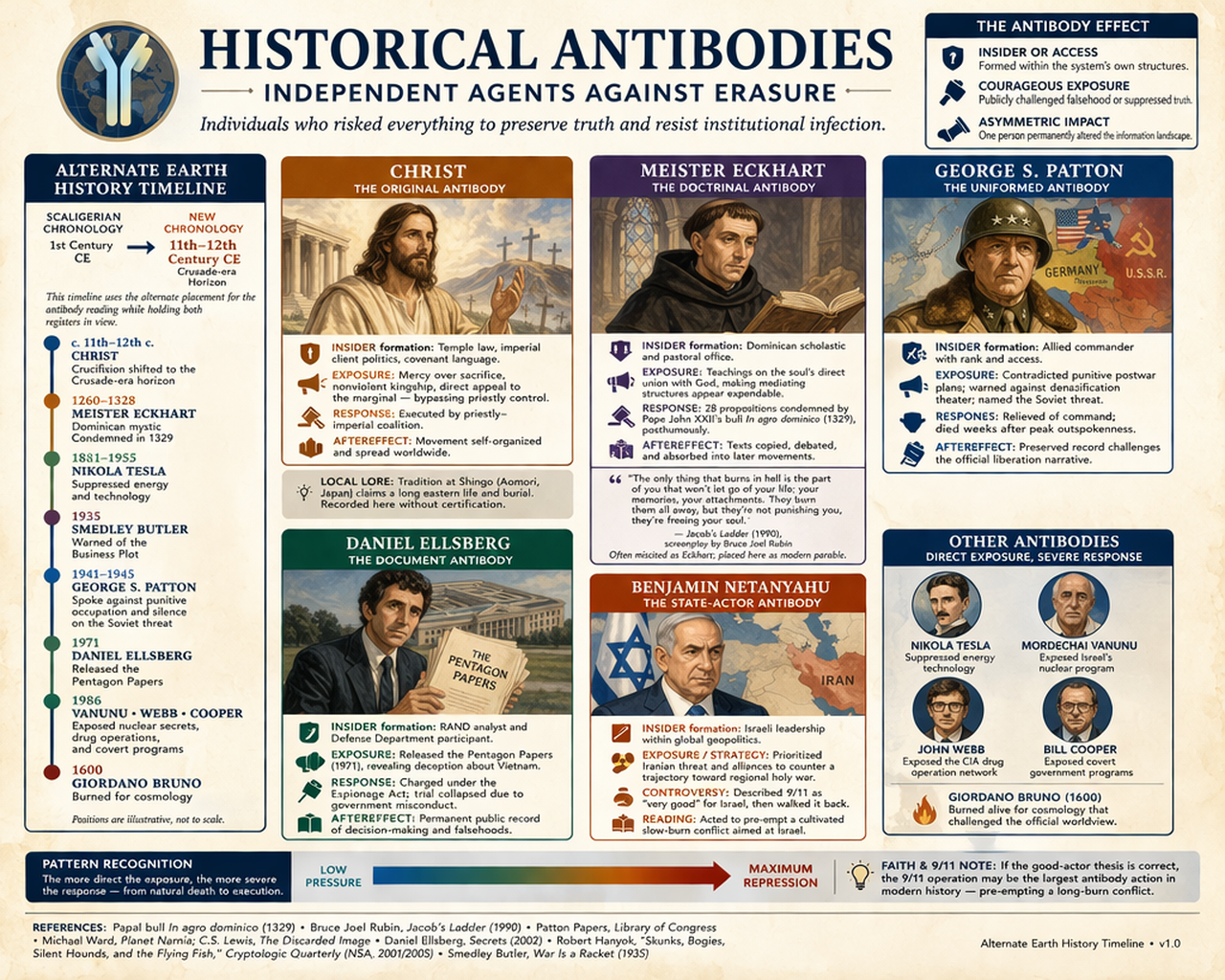
For roughly eighty years a species virus lane—the pyramidal compulsion to centralize narrative, finance, and force through divide-and-conquer, religion capture, and endless war—has run through a CIA–British–MI6 pipeline: slow-burn holy war instead of quick nation-on-nation collapse. Against it, antibodies act: document leakers, sovereign breaks, encoded fiction, and operations that pre-empt the script at catastrophic cost. Individuals matter—Christ, Eckhart, Ellsberg, Patton—but so do coordinated counter-moves. On the good-actor reading, 9/11 ranks as the largest modern antibody operation: not lone whistleblowing but interagency counter-deception executed early, publicly, at home.
Conspiracy culture got half the board right: trusted agencies behind much of the visible evil. It missed the split. Not every agency. Not the whole government. It also missed the counter-move: good actors who copy bad plans in miniature—proxy against proxy, early public trigger, legal cover where possible—because losing on procedure while the enemy breaks every rule is worse than bounded ugly damage. History is full of good actors—minorities behind closed doors who moved the world (Lenin’s sealed train; Steve Jobs’s ridiculous career arc)—and of majorities who would never sign up for the full plan if they heard it in a break room. People talk. They stay connected. The more they hear about closed-door evil, the more likely they are to enlist in counter-plans when they feel the enemy will win on technicality alone.
Democracy, in this reading, only functions in the open. Behind closed doors it rots. When the enemy breaks rules, good actors face a fork: lose on procedure, or change the rules legally—pass it through Congress where possible, put it on the head of a visible president who takes responsibility, end the term on schedule. That is the beauty of an open republic when it works: the fever breaks in daylight. Closed-door oligarchy has no such release valve.
The Sneakers lane in the good-actor investigation names the same split in fiction: a team of outsiders who can break encryption because the institutions that built the locks also built the back doors. Hollywood has been rehearsing interagency war for decades—sometimes as warning, sometimes as recruitment poster, sometimes as predictive programming that tells you the method and assigns the wrong moral. Ghost War sits in that last bucket: revelation-of-the-method plus wrong-villain framing, the same shape as controlled-opposition disclosure elsewhere on the site.
The historical antibodies chapter names the pattern: independents who expose machinery or carry suppressed knowledge without being staged opposition. Ellsberg copied the Pentagon Papers; Robert Hanyok (NSA historian) fought 2002–2005 to declassify proof the second Gulf of Tonkin attack did not occur—SIGINT skewed to sell war. Two antibodies, two eras, same casus-belli architecture. For curriculum silence on Tonkin versus Watergate, see When your child won’t fit the grade.
9/11 had to be public
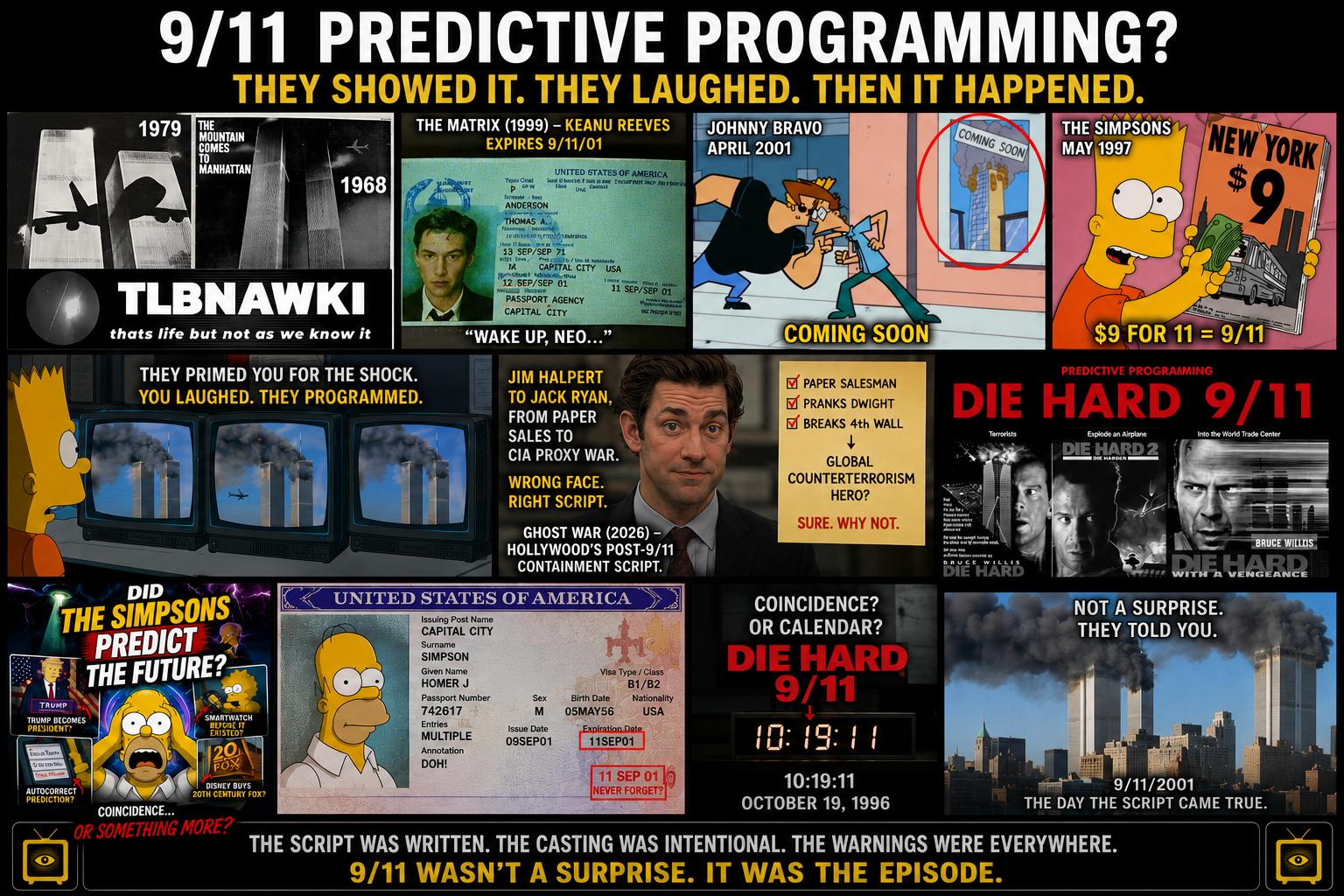
If the antibody thesis holds, 9/11 could not stay covert. The Deep State plan was slow-and-go: infiltrate religions and regimes, then simulate spectacular terror after the geometry set. The counter was early trigger on U.S. soil, televised, forcing a War on Terror keyword instead of a holy-war keyword the public could ignore.
WTC 7 is the keystone in this frame: CIA clandestine New York station (including floor 25), a headquarters the public was not fully told about because it was still classified when it fell. A strike on hidden CIA domestic infrastructure—not merely symbolic towers—severed the CIA–ayatollah pipeline and decapitated autonomy the species-virus lane needed for the long script. Twin Towers, built 1966–1973, read as long-planned targets whose early execution sabotaged the intended narrative timing.
Public spectacle was the democratic antibody requirement. Covert decapitation would have left the story deniable forever. Television made the fork visible: state-led war on terrorism instead of covert civilization holy war. The 9/11 investigation and good-actor synthesis carry tiers: WTC 7 as CIA facility is well documented; deliberate decapitation as antibody act remains speculative but structurally coherent with Gulf of Tonkin inversion and post-9/11 DHS/DNI restructuring.
Proxy terror as antibody—and who’s who in the slots
False-flag architecture needs named villains. The mujahideen line became Al-Qaeda franchises; Hamas tolerated against PLO; controlled opposition as permanent enemy. The antibody read inverts the moral headline: Daesh, ISIS, Boko Haram, and rebranded militant centers functioned as containment tools in a successful NSA-side campaign to pre-empt the slow-burn holy war—proxy versus proxy, agency versus agency across borders, not nation versus nation in the textbook sense.
That is the operational pattern in plain language: use proxy radical-Islam groups to resist other radical-Islam groups. The species-virus lane (CIA–MI6 slow burn) cultivates militancy to ignite a civilizational holy war over decades. Good-actor factions copy the method—armed proxies, militant franchises, off-book task forces—because the alternative is letting the infection finish its script on schedule. The copy is meant to do minimal damage relative to the full plan: pit radicals against radicals, force an early public War on Terror, accept ugly bounded carnage rather than total demolition and an antiseptic utopia rebuild. Minimal does not mean clean. Proxy war still poisons cities, still leaves blowback doors open, still kills—but it is the antibody calculus when the enemy will win on technicality if counter-players insist on Marquess-of-Queensberry rules behind closed doors.
The harder question is who’s who once the franchises are live. On the author map in good-actor investigation § I — Who’s who, there may never have been a fully independent global “trouble-maker” outside influence lanes. Most slots sort into two camps: groups whose behavior produced pro–U.S. / pro–Israel board outcomes (even when the horror branding said Daesh), versus nationalist resistance (Afghanistan, lost country, affiliate labels) that press can condemn without calling a civilizational plague. The cleanest divider for the antibody era is crude but operative: de facto acceptance of Israel’s right to exist—by silence, by fighting Israel’s enemies first, or by preparing terrain (Syria) for what comes later.
ISIS is the tell case: one face horrible enough to justify Daesh mobilization; another face that rarely centered direct war on Israel while shredding Syria and feeding the transition that became HTS. The author suspects a pro-Israel operational geometry so strong that ISIS-flag association on the Hamas October 7 2023 event functioned as political advantage for full-scale Israeli plans—suspicion tier, not proven here, but the pattern fits the dual-face read. Boko Haram and Chibok may invert the kidnapping headline: girls already removed by state, city, or foster pipelines, “abducted” back toward parents who then collided with strict Islamic law for women—a culture clash the West sold as pure Islamist crime. Daesh offspring complete the child weapon: rape-born infants rejected by society, raised in militarized care, then read as irredeemable threats. Taliban contrast: extreme acts (Bamiyan) yet negotiation lane when the board shifts—nationalists, not plague keyword.
Ghost War accidentally documents the syllogism. Starling arms terrorist proxies to wipe rival cells—the same sentence the investigation assigns to real antibody success. Crown says it out loud; the film then hangs it on the villain so you reject the tactic while the news desk still runs the live version. That is why predictive programming must contain in memory: if the public credits a working proxy-on-proxy antibody strategy, the species-virus pipeline loses its alibi.
Syria after Assad is the live demonstration: HTS marching on Damascus with moderate-face promises while carrying jihadist roots. Whether HTS is deliberate Western antibody proxy or a faction the West merely accepts, the pattern rhyme with Starling logic is strong. The film timed its release so “Starling again” sounds like a movie plot, not a news desk. Full tier notes: good-actor investigation § I — proxy minimal-damage copy.
Post-hoc scorecard: did Ghost War predict the news?
Predictive programming on this site is not only narrative containment (wrong villain, MI6 whitewash, Crown tell). It is also calendar data: fiction that lands before or beside headlines so the audience can reject the real story when it arrives—“that’s the Crown scenario,” “that’s Starling rage,” “proxy units always go rogue.” The Predictive Programming hub treats PP as pattern logging, not proof of studio orders; the post-hoc pass compares documented production/release dates to the established timeline and scores hits, partial rhymes, and misses—same method as the Trump-era Hollywood scorecard.

Author anticipation frame (2020–2024): Western intel and allied leadership (including figures who had long prioritized the Iran flank, e.g. Netanyahu’s decades-long focus on Iranian capacity in the historical antibodies read) could anticipate a Trump return after the 2020 election dispute, fraud cleanup, and 2024 win—then a known bundle of moves: proxy-terror geometry in the Levant, Iran latency and strikes, maritime pressure, MI6–CIA continuity with a visible U.S. executive again. Ghost War was greenlit Oct 30, 2024 (Deadline), before the November election and before the May 2026 release window when spring 2026 Iran headlines peaked (Mission Accomplished (Again) — Iran 2026). PP function: inoculate the audience before those headlines so interpretive antibodies never attach.

Calendar anchor (documented):
Production announced late Oct 2024. Hay’at Tahrir al-Sham captured Damascus and the Assad government collapsed December 2024—after announcement, before principal photography (Jan 2025, London). Photography wrapped late July 2025. World premiere May 15, 2026; Prime Video May 20, 2026 (Wikipedia — Jack Ryan: Ghost War).
Post-hoc score (May 2026 pass):
Strong partial — proxy reactivation / militant franchise lane. On-screen Starling reactivates dormant terror plots and arms proxies to fight proxies. Real timeline: HTS (jihadist roots, rebranded “transition” face) took Damascus Dec 2024 during the film’s development window—not a scene match, but a structural rhyme with “manageable militant center replaces old regime.”
Strong partial — Iran / spring 2026 convergence. Film release May 2026 overlaps the spring 2026 Iran strike / Hormuz / “mission accomplished” news cycle the site documents—not plot-for-plot, but same month, same board (latency, proxies, MI6–CIA–Israel geometry).
Strong partial — inoculation before headlines. Development Oct 2024 → release May 2026 spans Trump’s 2024 win, Syria overturn, and Iran 2026—ideal window to pre-program rejection of antibody-proxy reads when news breaks.
Partial — Trump return window. Announcement pre-dates Nov 2024 election; author read treats greenlight as anticipation of restored executive lane, not proof Amazon knew the ballot outcome.
Miss — geography and set-piece. Fiction is London / Dubai / Tower Bridge, not Damascus or Tehran. No literal Syria or Iran set-piece.
Miss — blowback plot vs actual. Crown’s London bridge bomb plot is fiction; scoring miss on scene-level prediction unless a future event rhymes (not claimed here).
Net: Ghost War is strong post-hoc PP data on proxy-war grammar and calendar convergence with Syria 2024 and Iran 2026; weak on literal location and scene prediction. That split is normal for this site’s PP method: thematic / institutional rhyme, not Nostradamus. Full dossier scorecard: good-actor investigation § IV — post-hoc PP.
Iran: the script still running
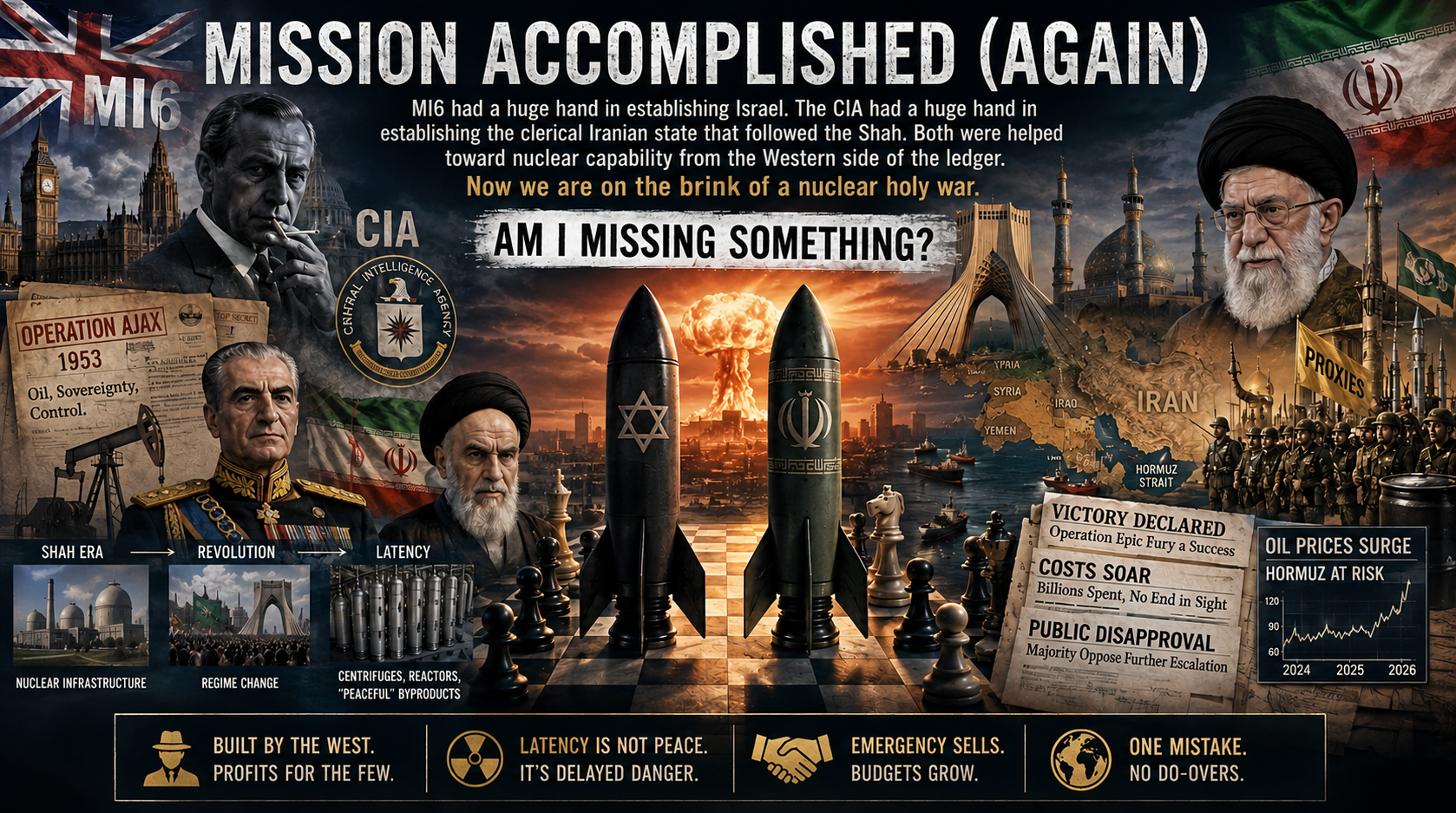
The Iran file is the endgame board the dossiers have tracked for decades: Operation Ajax (1953), Shah-era nuclear infrastructure, 1979 engineered religious revival, latency factories, and a public blind spot around what “nuclear” means in policy speech.
The CIA investigation’s Iran lane argues the sharper risk sits in material the press treats as boring: depleted uranium as “peaceful” byproduct, plus a fatwa the world reads as guarantee. Converting DU into radiological or tactical weapons requires far less than sci-fi fission bombs—the kind that poisoned battlefields from Iraq to the Pacific narrative. Proxies can carry what regimes deny in Hollywood-bomb language.
Obama’s JCPOA ensured the latency lane stayed open—diplomacy as cover for a clock the antibody planners could read. Trump’s withdrawal from the deal knew the outcome lane: a world of environmental toxicity, bullying, extremists who raze cities to send messages, actors who do not see how they serve a Marxist antiseptic utopia script—destroy everything, rebuild an unresistable order. British divide-and-conquer habits do not vanish because Washington holds the pen on the org chart; MI6’s hand in Israel’s creation and the CIA’s hand in the clerical Iranian state bracket the same board the British divide-and-conquer investigation tracks—arm both sides, leave latency on the table, rent the next emergency.
Spring 2026 headlines—strike objectives versus civilian ledgers, Hormuz fear, “mission accomplished” rhetoric beside unresolved blockade politics—follow the same script the Mission Accomplished (Again) Iran 2026 page names: dual scoreboards, asymmetric captions, latency treated as imminence when the briefing room needs it.
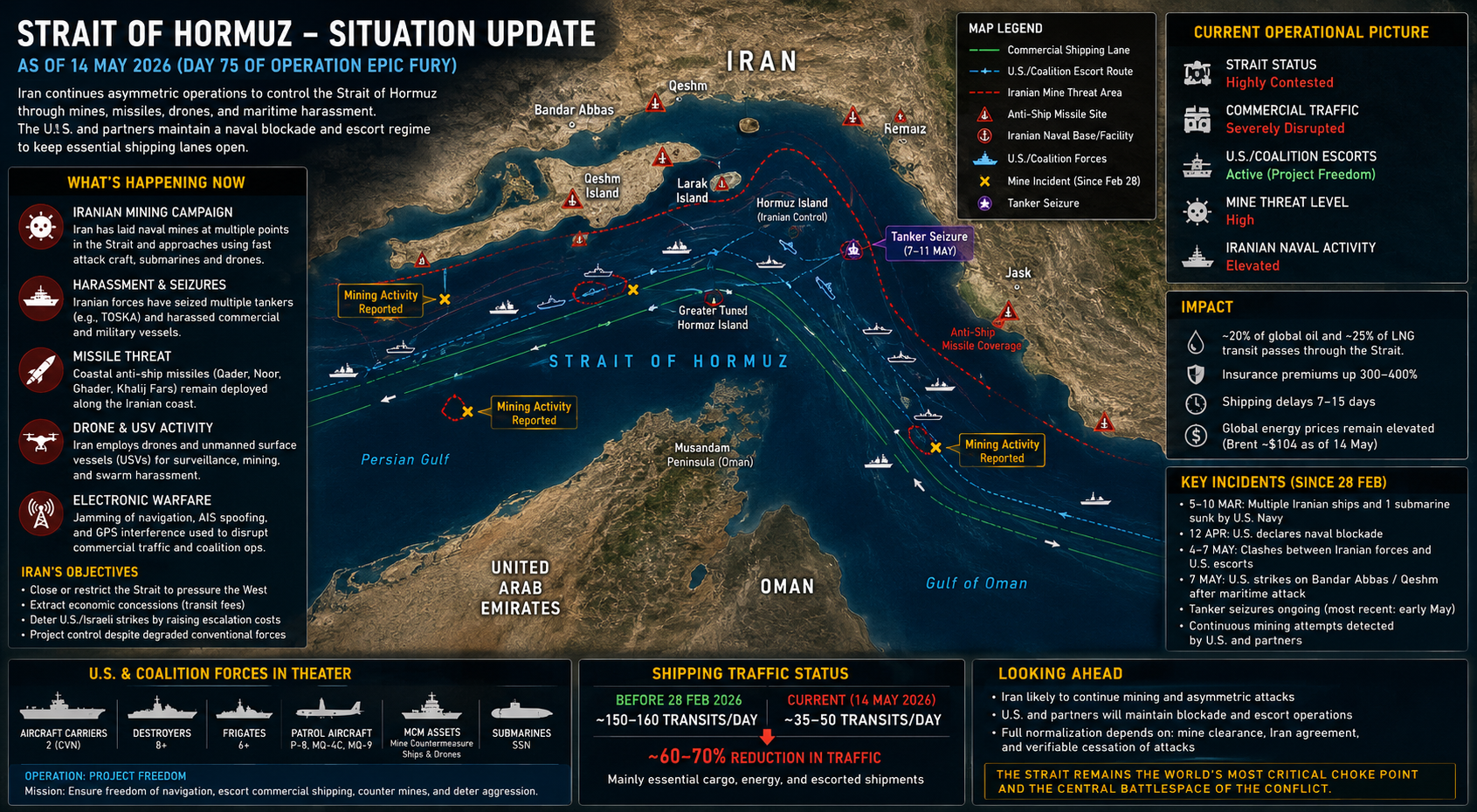
The Iranian war record, on this reading, is not a surprise break from Ghost War fiction. It is the next act of proxy material moving through proxies—DU handed down the pipeline the JCPOA and withdrawal sequence guaranteed would eventually detonate in public.
Sit back and watch
Your responsibility, on this reading, is not to fix the board. It is to watch—to stay present while the invoice arrives in public, because closed-door oligarchy hid the bill for centuries and open republics now force it onto screens whether or not anyone asked for the show.
What you are watching is so much bigger than any of us. Interagency proxy geometry, decades of Iran latency, Syria overturns, spring 2026 strike cycles—these are not episodes a voter list or a viral thread can redirect. They are the late phase of scripts written across generations by factions most people will never meet. Ghost War is one more frame in that stack: predictive programming so that when the headline lands, the audience already has a debunk loaded.
There was not much any ordinary person could do to change this in our lifetime. That is not nihilism; it is scale. Antibody operations, document releases, sovereign breaks in escalation—the moves that matter happen above the street and beside the ballot, in rooms where Starling is policy and Crown is fiction. The vast majority of people—conversing, connected, ordinary—would never have chosen this if asked honestly. They inherit it anyway.
So sit back. Watch the human carnage and costs that cannot be escaped—not because suffering is entertainment, but because witness is what remains when agency does not. When this arc completes, the root causes of warfare may sit visible at last: not “human nature” alone, but minorities behind closed doors engineering majority populations through capture, latency, and named villains. Whether that exposure ends warfare is not ours to schedule. We are in the ugly antibody phase. Our part is to see it clearly while it runs.
Where next
- Timeline: CIA vs NSA / SIGINT / Tron (1952–1982)
- NSA investigation — Tron theory, MINARET, Tonkin/Hanyok
- Good-actor theory — interagency war, antibodies, Ghost War § IV
- 9/11 investigation — counter–false-flag read, WTC 7
- Call of Duty militainment — Office / Krasinski clue thread §4.6
- Benghazi / 13 Hours — Krasinski lane
- Mission Accomplished (Again) — Iran 2026
- Historical antibodies — timeline chapter
- Trump-era Hollywood PP methodology
Framing and limits
Prisca sapientia holds that later consensus is not default truth—closed-door history may be redacted while fiction carries rhymes the press will not.
This article states an author thesis at full voltage: interagency antibody war, 9/11 as counter-operation, proxy militant containment, Iran/DU latency, Ghost War as predictive programming to discredit antibody success, MI6 whitewash and Crown naming as British guilt-split, NSA vs CIA–MI6 alignment. Plot details for Starling are documented from film and press; intent (Amazon briefing, Crown-as-Crown PP, NSA authorship of proxies) is interpretive—pattern strength without producer confessions. Krasinski miscasting is audience reception and structural read, not a claim about casting-room minutes. Minority-evil behind closed doors is not a slur on every civil servant or soldier. Radiation, civilian harm, and environmental toxicity from DU and modern strike campaigns are real regardless of narrative frame. Tier grids and FOIA chains live in linked investigations—especially good-actor § IV and CIA investigation Limits.
Keywords: #GhostWar #JackRyan #MI6 #Crown #PredictiveProgramming #Antibodies #GoodActor #911 #Iran #Starling #NSA #InteragencyWar
Substack: paradigmthreat2.substack.com/p/ghost-war-the-antibody-phase
Last updated: 2026-05-26T14:00:00-04:00
Written and narrated by Ari Asulin, with drafting and research support from LLM agents.
Share