
Everything Burns
Predictive programming in movies — Pacific installment (Dark Knight, 24, Hong Kong)
Not Like This — Installment I of this series — tracked the two-camp interagency war through The Matrix: a wake-up hit in 1999, then sequels that walked it back. Everything Burns is Installment II. Same frame, different geography: Hong Kong money, mainland censorship, proxy terror on TV, and the Dark Knight / Joker timeline that picks up where the Matrix handoff left off.
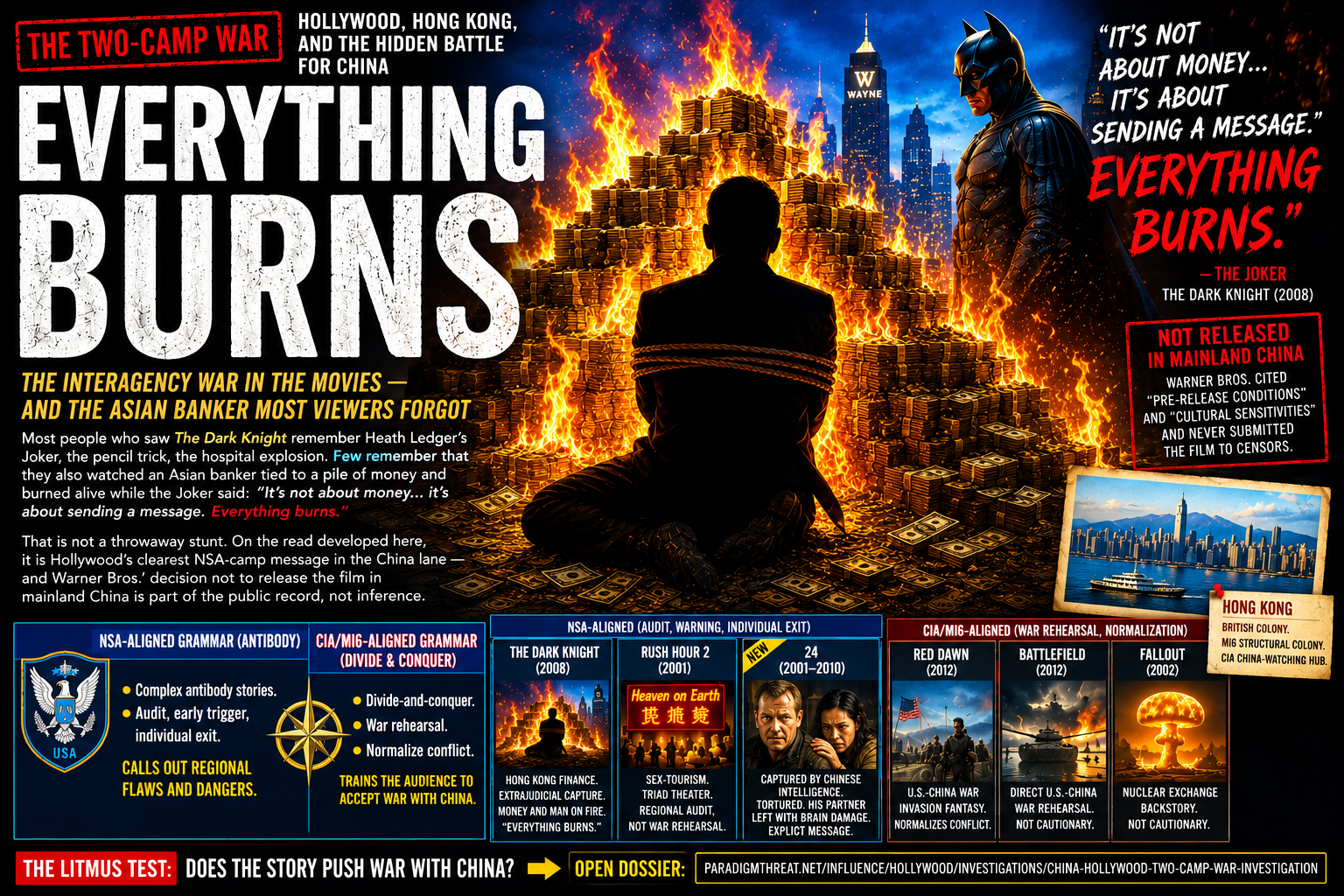
Most people who saw The Dark Knight remember Heath Ledger’s Joker, the pencil trick, the hospital explosion. Few remember the Asian banker tied to a pile of money and burned alive while the Joker said the title line. The China-and-money beat sits inside a blockbuster everyone thinks they know. Spectacle stuck; the finance beat did not. The China/Hollywood investigation (Dark Knight thread) holds plot and press sources for the anchor scene; below — TV, the 2019 Joker reset, and a closing read on whether the warnings worked.
TL;DR: Series installment II — Pacific predictive programming. The Dark Knight (2008) = Lau held for testimony, stolen by Joker, burned on cash, “everything burns,” Warner skipped mainland China. 24 = China torture, proxy terror, nuclear deterrent, Day 2 CTU triple bomb. Joker (2019) undoes Ledger’s message; 2019 celebrity calendar (De Niro) ties to the containment side. Litmus test (this lane): does the story prepare the audience for war with China? (Depth is not a sort key.) Open investigation. Prior: Not Like This (Matrix).
Hong Kong extraction — beat by beat
After the mob’s opening heist, Lau (Chin Han) — CEO of Lau Security Investments — appears on a monitor talking to Gotham’s crime bosses from a Hong Kong office. He runs their cash through the colony while American gangs loot at home. American crime, Hong Kong laundry — invasion fantasy nowhere in sight.
Batman flies to Hong Kong. Lucius Fox’s sonar maps the high-rise floor by floor. Batman pulls Lau out and hands him to Gotham police — normal extradition skipped, Hong Kong treated like a grab zone.
Commissioner Gordon keeps Lau in GCPD holding cells — not county — because he needs a living witness for open-court testimony against the mob (Wikipedia — The Dark Knight; Lau — Batman wiki). That testimony is supposed to seize the mob’s laundered fortune and break their money line. Gordon wants Lau alive for that legal path — not burned on television.
The Joker has other plans. He allows himself to be captured, detonates a bomb hidden inside a detainee, escapes the station with Lau, forces Lau to reveal where the mob’s cash is hidden, then burns Lau on the pile (Joker — Wikipedia; Jim Gordon — Batman wiki). Gordon’s witness strategy fails: the Joker gets the financial intelligence the prosecution needed, then destroys the witness. In a warehouse Lau sits tied on top of a pile of cash. The Chechen mobster asks what happened to the money. The Joker says dynamite, gunpowder, and gasoline are all cheap — then soaks his half of the pile, lights it, and tells the room: “I’m only burning my half.” Lau burns with the cash. The Joker’s closing line — checked against the published screenplay and Wikiquote — The Dark Knight — is: “It’s not about money. It’s about sending a message. Everything burns!” (Black List Daily Dialogue; Nolan script archive). The Joker burns money, not a crowd — then tells the survivors they work for him now.
On the reading developed in Installment I and the linked investigation, that scene is NSA-side Pacific work: Hong Kong finance feeding American gangs, then fire as a warning about dirty money — low war-with-China prep, not a sales pitch for invasion. Depth of theme is not the sort key. For the broader audit lane, see the NSA investigation. Camp labels are the author’s sort, not leaked memos.
Why China skipped it — and why that does not sort camps
Warner Bros. decided not to release The Dark Knight in mainland China, citing “pre-release conditions” and “cultural sensitivities to some elements of the film” (Variety, Dec 2008). The studio never submitted the film to Chinese censors (AP / Globe and Mail). Press pointed at the Hong Kong capture scene, the Chinese money launderer, and — in Chinese press summaries — Harvey Dent’s line favoring American guns over Chinese guns (CBC; china.org.cn, Dec 2008). The film played in Hong Kong. It never opened on the mainland.
You cannot read Beijing’s block list like a camp ID card. Memoirs of a Geisha was blocked because Chinese actresses played Japanese roles — a casting fight, not a war movie. Doctor Strange (2016) moved the Ancient One from Tibet to Nepal — mystic-elite packaging, again not PLA tanks. Red Dawn (2012) drew Global Times heat for Chinese invasion imagery before the studio swapped the invaders to North Korea (Wikipedia — Red Dawn remake; SCMP 2022). That title still never released in China — high “train the public for war with China” score even after the swap.
The pattern in the censorship thread of the investigation: Dark Knight was skipped for critique — extradition, launderer, guns line — and lands low on war-with-China prep. Red Dawn was hit for invasion imagery and lands high. Red Corner (1997) — an American wrongfully tried for murder in Beijing — was kept off the mainland while still functioning as a legal-system critique, not an invasion fantasy (Wikipedia — Red Corner; Variety review). Same censor machine, opposite war-prep scores. The block list alone will not tell you which side a film serves.
What audiences remember
Ledger’s Joker owns the cultural afterimage — “Why so serious?”, the pencil trick, the hospital blast, the posthumous Oscar. The banker burned on money barely surfaces in casual recall. Reviews at release treated Lau as plot plumbing; clip culture replays Joker bits, not the warehouse fire.
Fans built montages around Ledger’s face paint. The burn line never became a protest slogan the way “Why so serious?” did. Trade press noted the Hong Kong sequence, but memory skewed to the clown. On this reading, the blockbuster did its job twice: everyone remembers the spectacle; almost nobody carries the money-and-China beat forward. That reception claim has not been poll-tested — see question Q3 in the investigation. The scene is in the film either way. Recall is selective.
The Pacific litmus test
Not Like This already sorts NSA-aligned vs CIA/MI6-aligned Hollywood on the two-camp war. This installment adds one filter for China/Hong Kong titles: does the work prepare the audience for war with China?
That is the only reliable sort. Depth, complexity, and production quality are not indicators. An NSA-side title can be as shallow as a buddy-cop comedy; a CIA/MI6-side title can dress invasion fantasy in prestige packaging. What matters is whether the audience walks out more willing to fight China — or less.
NSA-side Pacific work = low war-prep — warns about pipelines or deterrence without rehearsing invasion; or builds cross-Pacific rapport without the war drum. Examples on the author list: Dark Knight (finance audit, not PLA tanks), 24 (China captivity cost, not mainland invasion), Rush Hour (1998) — Lee and Carter as American and Chinese partners sharing culture and adventure (Wikipedia — Rush Hour). The first Rush Hour is extremely shallow; on this read it may still have hit its primary goal — Americans and Chinese talking together, identifying with each other, on the same side.
CIA/MI6-side Pacific work = high war-prep — mythical ancient China, PLA invasion fantasies, resource-war games: Red Dawn (2012), Battlefield 4 (2013 Shanghai campaign), the Fallout series’ Sino-American War setup (Fallout wiki). Games in that bucket rarely play cautionary; they turn great-power war into routine gameplay (games thread in the investigation).
Hong Kong is where these beats land: British colony until 1997, MI6-structural, CIA China-watching hub (z.md § Hong Kong; British divide-and-conquer investigation). Lau launders from a Hong Kong office, not a Beijing ministry. The Martian (2015) and Arrival (2016) — NASA–CNSA cooperation, shared alien threat, no war drum — sit in a neutral contrast bucket when sorting Pacific titles. Full title lists: media catalog in the investigation.
Stolen memory — artifacts, mythic China, and the Taiwan fuse
Jackie Chan’s Chinese Zodiac (2012, marketed as Armour of God III) opens on a documented historical wound: in 1860, Anglo-French forces looted and burned Beijing’s Old Summer Palace (Yuanmingyuan), taking treasures including the twelve bronze zodiac animal heads (Wikipedia — Chinese Zodiac; Old Summer Palace bronze heads). Contemporary accounts note archives were plundered along with bronzes and porcelain — part of the country’s paper memory went west with the art (Yuanmingyuan — the looting). Chan’s treasure hunter JC is hired to recover the heads from Western dealers and auctions; Variety called the film’s tone “grandstanding anti-colonial screeds.” The earlier Armour of God films (1986, 1991) are generic Indiana Jones treasure hunts — African cult relics, desert gold — but the franchise converges in 2012 on British/French theft of Chinese national heritage.
On the author read, that convergence matters for the second camp (CIA/MI6-side high war-prep lane). The same Hollywood grammar that sells mythic ancient China — isolated, martial, elitist (Shang-Chi, Crouching Tiger) — pairs with a colonial memory wound: the West holds the artifacts and archives that could tell a different story about what China was before the Opium Wars. Control over Chinese history and memory — through a British colony that was also a China-watching hub — is the kind of remote control that makes a future Pacific war thinkable. A fully decolonized, sovereign China, on this reading, has little reason to fight abroad; a China still negotiating identity through stolen bronzes and a false “warlike ancient empire” template might.
The designed fuse for that war was never only tanks on a map. z.md § Hong Kong already names war with Taiwan as one colonial-staging objective. The Republic of China government retreated to Taiwan in 1949 after the civil war; Beijing treats reunification as unfinished business; Washington’s Taiwan Relations Act (1979) commits to unofficial defense support while maintaining One China ambiguity (Wikipedia — Taiwan; Taiwan Relations Act). The ROC exile keeps a sovereignty dispute alive across the strait. Add semiconductor supply chains — TSMC and advanced-chip fabrication concentrated on the island — and the technology flashpoint matches what strategists now call chip sovereignty (Reuters on US–China chip competition). Memory control, Taiwan status, and tech chokepoints braid into one trigger geometry.
Validation note: the 1860 looting, bronze-head repatriation fights, Taiwan’s unsettled status, and chip-war policy are documented (L1). The leap from artifact plots to British remote control of Chinese war appetite is author interpretive (L3) — plausible rhyme with colonial archive theft and Hong Kong staging, not a closed intelligence finding. Full strengthen/weaken matrix: investigation — Thread M.
24 — China torture, proxy terror, and CTU bombed
Fox’s 24 (2001–2010) stretches the same Pacific warning across seasons — the longest TV beat in this installment.
Between Day 4 and Day 6, Jack Bauer disappears for twenty months in Chinese custody. Chinese agents grabbed him after Day 4; President Wayne Palmer traded for his release (Wikipedia — 24 season 6; 24 Fandom — Cheng Zhi). Cheng Zhi runs the prison; Bauer comes back broken, briefly ready to die for Abu Fayed. Audrey Raines flew to China to find him, was captured, and was drugged and tortured — Cheng faked her death in a car crash, kept her hostage, bruises on her body at rescue. She came back catatonic, repeating “Help me, Jack” (24 Fandom — Audrey Raines; Wikipedia season 6). Secretary James Heller later cuts Jack off; the season ends with a goodbye to a woman who no longer responds. Operator broken, partner wrecked — a TV-scale version of Beijing’s reach, parallel to Dark Knight’s Hong Kong grab in reverse.
Season 6 runs proxy terrorism at full volume. Abu Fayed bombs cities and frames Hamri Al-Assad; Dmitri Gredenko supplies suitcase nukes and drones with stolen Russian parts; one warhead detonates in Valencia, killing thousands — the show’s first on-screen nuclear blast (Wikipedia — 24 season 6). VP Noah Daniels orders a nuclear strike on Fayed’s Middle-Eastern country, brushing off “stateless terrorist” talk and citing a regime “known to support terrorism” (Noah Daniels wiki; Day 6: 7:00pm–8:00pm). Palmer later admits part of the strike order was a bluff to force cooperation — deterrence as theater, not always a real launch (Wikipedia season 6 summaries). The season aired in 2007; on a calendar read it echoes later Iran–US escalation — timing rhyme only, not proof anyone knew the future.
Day 2 (season 2) hits CTU Los Angeles from the inside. Three bombs planted and detonated during an evacuation — thirty employees killed, seventeen wounded (24 Fandom — Attacks on CTU Los Angeles, Day 2 bombing). Eddie Grant and his crew, anti-federalists striking a federal building, posed as phone-company workers to get in; Joseph Wald planned the strike; Syed Ali timed it to cripple CTU’s hunt for a nuclear device smuggled into Los Angeles (Day 2: 10:00am–11:00am). Bombs inside a national-security HQ — not gas in the vents — rhymes on this read with Building 7 / controlled demolition themes in conspiracy research (thematic only; the writers were not documenting Building 7).
Season 5 exposed a separate Sentox nerve-gas conspiracy on Russian soil to trigger treaty war clauses and grab Central Asian oil — a CIA-adjacent plot inside the story (Wikipedia — 24 season 5). That season later gassed CTU in a different attack (Day 5 ventilation Sentox); the Building 7 comparison here targets Day 2’s triple bomb, not the gas beat.
Episode-level sourcing: investigation — 24 thread.
After the flagship — Rises and the 2019 undo
Not Like This already documented franchise containment: one wake-up masterpiece, then sequels that kill the exit manual. The Dark Knight Rises (2012) fits locally — occupation spectacle without Lau or “everything burns” (predictive programming hub).
Ledger’s Joker (2008) burned money and institutions, not sympathy montages. Polygon (Oct 2019) credits Ledger with “epitomizing” Moore-style nihilism — “Why so serious?” became meme, tattoo, and merch before the 2019 reboot. Consequence casts Ledger’s Joker as enigma and symbol — moral rot “not meant to be human” — against Phoenix’s Arthur Fleck as marginalized victim and “unwitting catalyst for class revolution.” A UNO Journal of Religion & Film paper (2021) compares Ledger’s sermon to 2019 protest makeup in Beirut, Santiago, and Hong Kong — without settling which greasepaint template marchers copied.
October 2008, The Office cold open Employee Transfer (S5E6) sent Creed, Kevin, and Dwight through the door in Ledger Dark Knight makeup — script and Office Ladies confirm the target; SYFY notes wardrobe called for Ledger greasepaint, with a mixed Nicholson nod on Dwight (Wikipedia — Employee Transfer). A workplace sitcom paid tribute to the blockbuster before the flattening. Two years later, the same show ran a full China episode (S7E10, Dec 2010) — see Author’s conclusion below.
Phoenix’s Joker (2019) is the containment-side answer: victim story, crowd riot that blames ordinary people and elites instead of burning money — the same 2019 window Not Like This tracks through Resurrections. After the 2019 release, mainstream press tied protest Joker faces in Lebanon, Hong Kong, Iraq, and Chile to Todd Phillips’ film (France 24, Oct 2019; Yahoo / The Conversation; Redalyc populism paper). Those articles credit 2019; they do not erase Ledger’s earlier footprint. They show how search and journalism default to the newer film while marchers often wear a look Ledger fixed in 2008. Academic work on protest masks since 2008 lists V for Vendetta and The Joker together (Academia — Occupying Popular Culture) — still no clean ledger of which template each march used.
Ledger died 22 January 2008 before release (Wikipedia — Heath Ledger; Hollywood Reporter). Installment I indexes deaths around NSA-side projects; the curse talk stays pattern-only — see Joker lineage thread in the investigation for protest-attribution gaps.
Robert De Niro in the 2019 film sits on a celebrity calendar: Tribeca pulled Vaxxed (March 2016), then years of anti-Trump talk that did not end his career — unlike stars fired for conservative speech (celebrity speech containment write-up). Fiction (Murray Franklin), press, and public deployment on one timeline — detail lives in that linked file.
2008 on the calendar
The Dark Knight opened July 2008, weeks before a presidential election where China played a small role in candidate talk (NPR, Aug 2008; NBC 2007 trade coverage). McCain hit Obama’s protectionist tone toward Asia after a Beijing speech (The National — same policy page). Trade and currency friction were real; China was not the main wedge of the race.
Speculative calendar read — no Warner memo, not an intelligence finding: some critics saw Obama as soft on China; the NSA-side blockbuster landed in that window; 2011 Libya later rhymed with what “burns” on the good-actor timeline — gold-standard vs fiat as echo, not proven cause. The financial crisis that autumn burned mortgage paper on another scale. Warehouse fire, election, and crash share 2008; coincidence is enough to notice without a studio smoking gun. Full chain: investigation — Obama / 2008 / Libya thread.
Rush Hour — shallow can still work
Rush Hour (1998) is the franchise’s clearest low war-prep example. Detective Carter (Chris Tucker) and Inspector Lee (Jackie Chan) — American and Chinese — are forced into a buddy partnership, trade culture clashes, and share an adventure to rescue the Chinese consul’s daughter (Wikipedia — Rush Hour). The concepts are broad and often stereotyped; the war-with-China litmus test still scores low. On the author read, the primary goal may have been simple: get Americans and Chinese in the same story, talking, identifying with each other — and the first film may have accomplished that even where the packaging was thin.
Rush Hour 2 (2001) adds Heaven on Earth — an upscale Hong Kong massage parlor where Carter picks bikini-clad hostesses from a sliding-door roster before Triads interrupt (IMSDB script; Rush Hour wiki — Heaven on Earth). Critics called the sequence a “cheesecake prelude” to the fight (Decent Films). Jackie Chan publicly disliked the sequel: “I didn’t like the movie. I still don’t like the movie.” (SCMP 2023). Still low war-prep — orientalist packaging does not automatically mean invasion rehearsal. Script beats: Rush Hour thread in the investigation.
Author’s conclusion
Many of these NSA-side projects are forgotten on the surface. Ask a random viewer to recap Lau on the cash pile, or Jack Bauer’s twenty months in Chinese hands, and you might get a blank stare. That does not mean the work vanished. It still sits in the subconscious of everyone who watched — the same way a childhood jingle you cannot name will still trigger when someone hums it.
The real question is whether these projects hit their primary goal. On this reading that goal is narrow and practical: get the country through a predicted scenario with minimal damage and national sovereignty intact. Not glory. Survival with the republic still in one piece.
For years a live fear ran through American politics: debt owned abroad — creditors with a dual interest in chaos here, because turmoil can be leverage. Foreign money in U.S. treasuries and mortgage paper; Hong Kong pipelines in a Nolan blockbuster; 24 showing what Beijing can do to an operator who goes rogue. The nightmare rhymes with Game of Thrones: Tywin Lannister tells Cersei the crown owes the Iron Bank of Braavos a fortune; the bank will have its due, and if a ruler will not pay, the bank funds his enemies until someone does (Game of Thrones wiki — Iron Bank; Tywin–Cersei scene, season 4 episode 5 First of His Name, Scattered Quotes transcript). A kingdom deep in debt to outsiders who might one day collect by force — or by installing a friendlier throne.
The feared end state did not arrive on schedule. No war with China over the debt scare. No collapse of sovereignty sold as the price of foreign notes. The blockbuster warnings and the TV deterrence arcs did their work in the dark — audit without panic, fire without invasion, torture fiction without a real casus belli. Shallow cross-cultural buddy pictures (Rush Hour) may have done the same job from another angle — rapport without the war drum. On this reading the projects succeeded: the scenarios people were bracing for did not come to light.
The same workplace sitcom that mocked Ledger’s Joker later ran an episode called “China” (season 7, episode 10, aired 2 December 2010). Michael Scott reads Newsweek at the dentist, spirals about China as a “sleeping dragon,” loses a fact debate to Oscar — then wins the room anyway by praising conversation and choice (Wikipedia — China (The Office); Springfield Springfield script — S07E10). His closing toast to the office — and to the audience — is the message this installment ends on:
I am talking about freedom, about choice. America, I don’t think you need to worry. Because if you want to beat China you will. If you don’t, that’s fine. That, my friend, is your victory.
As long as communication channels stay open, the China threat on screen does not have to become the China war in life. America, you don’t have to worry about this — as long as people keep talking.
Series — where next
This series (predictive programming in movies):
- Not Like This — Installment I: Matrix two-camp handoff, Reloaded Oracle-as-control, MxO, Resurrections.
- Everything Burns (this page) — Installment II: Pacific / Hong Kong / Dark Knight / 24 / Joker calendar.
Technical companions (not series installments):
- China / Hollywood two-camp war investigation — media catalogs, censorship table, source threads.
- Ghost War: The Antibody Phase — post-9/11 proxy-terror containment (Jack Ryan lane).
- Predictive programming hub — PP catalog.
- Controlled opposition hub — manufactured dissent patterns.
Framing and limits
Prisca sapientia holds that profound understanding can be encoded in popular myth, later flattened by consensus. Installment I carries the shared two-camp war frame; this page adds Pacific litmus-test reads only — war-with-China prep is the sort key; depth and complexity are not.
Documented on the record: Lau plot and screenplay lines; Warner’s China skip; china.org.cn guns summary; Red Dawn NK swap; Office Ledger costumes (Employee Transfer, S5E6) and China episode closing toast (S7E10); Game of Thrones Iron Bank / Tywin dialogue (S4E05); Polygon / Consequence / UNO / France24 press on Joker lineage; 24 captivity, Day 2 CTU triple bomb (30 dead), Daniels nuclear order, Season 5 Sentox Russia plot; De Niro’s public timeline; Chinese Zodiac Yuanmingyuan prologue and 1860 bronze-head looting; Taiwan Relations Act; ROC 1949 retreat.
Interpretive reads — not proven intelligence findings: camp labels; selective audience memory; press defaulting to the 2019 Joker; CTU / Building 7 and Iran timing echoes; 2008→Libya calendar chain; ordered anti-Trump celebrity deployment; British memory control → remote control of Chinese war appetite; “fully sovereign China would not go to war” normative claim; Taiwan + tech as designed war trigger; author’s conclusion — subconscious retention of forgotten plot beats, debt-sovereignty scenario did not manifest, and PP success measured by outcomes rather than recall.
Full tier labels and disclaimers: investigation Limits.
Keywords: #EverythingBurns #PredictiveProgramming #DarkKnight #Joker #HeathLedger #TheOffice #24 #JackBauer #China #HongKong #Taiwan #ChineseZodiac #Yuanmingyuan #TwoCamps #NSA #CIA #HollywoodSeries #Antibody #GameOfThrones #IronBank
Substack: https://open.substack.com/pub/paradigmthreat2/p/everything-burns
Last updated: 2026-06-19T18:00:00-04:00
Written and narrated by Ari Asulin, with drafting and research support from LLM agents.
Share