
Not Like This
The interagency war in the movies — and why The Matrix had to be contained
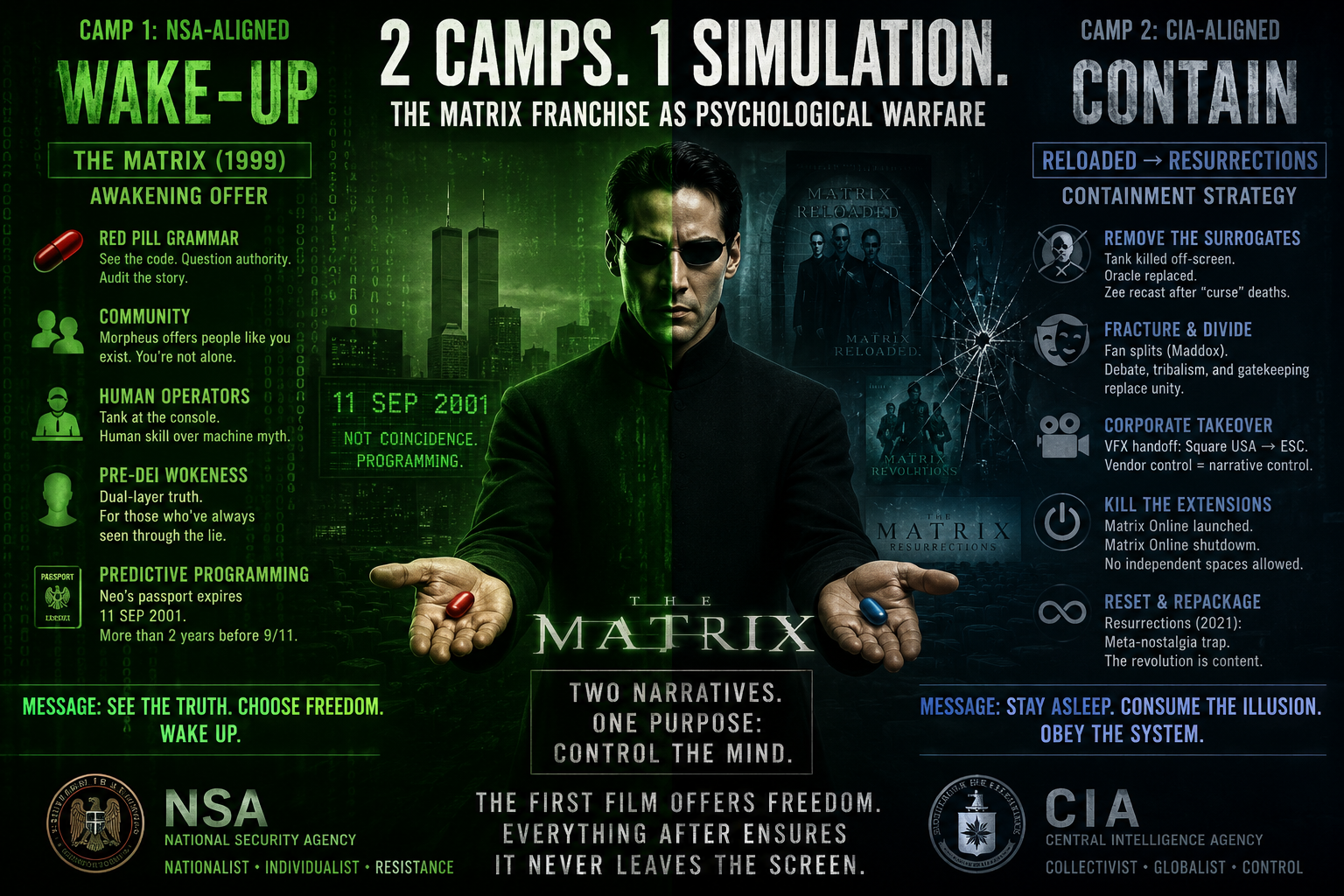
There is a war being fought in front of us. Not always with missiles—often with release dates, recasts, fan-fracture voices, MMO shutdowns, and sequel tone so subtle it gets filed under taste instead of strategy. The battlefield includes the films a generation grew up on. The Matrix is the clearest public record because the first installment briefly worked: it woke people up hard enough that the follow-through had to be industrial.
This essay is Installment I of a reader series on predictive programming in blockbuster film and TV. Installment II — Everything Burns — applies the same two-camp lens to the Pacific lane (Dark Knight, 24, Hong Kong finance) without repeating the Matrix handoff developed here.
The two-camps read is the primary why. On one side: NSA-aligned grammar—SIGINT audit, individual exit, “see the code,” antibody resistance encoded for mass consumption. On the other: CIA-aligned grammar—proxy sleep, controlled opposition, population kept inside a plan it never consented to. Hollywood after 1999 did not stay neutral. Blockbuster space handed the franchise from the wake-up camp to the contain camp—and Matrix documents the handoff beat by beat when the pattern is tracked.
Agent Smith holds up a passport. Thomas Anderson. Date of birth 13 September 1971. Date of issue 12 September 1991. Date of expiration: 11 September 2001. The film shot in 1998. It released in March 1999. More than two years before the towers fell. Snopes confirms the prop date is real; mainstream coverage treats it as coincidence. On a predictive-programming read, the simulation’s chosen one carries an identity document that expires the day official reality fractures. Film one is the NSA-camp offer: awakening inside a text that already encoded the next mass-layer break—and, over the end credits, a protest song naming live assassination and holy-war framing ops the culture was about to inherit.
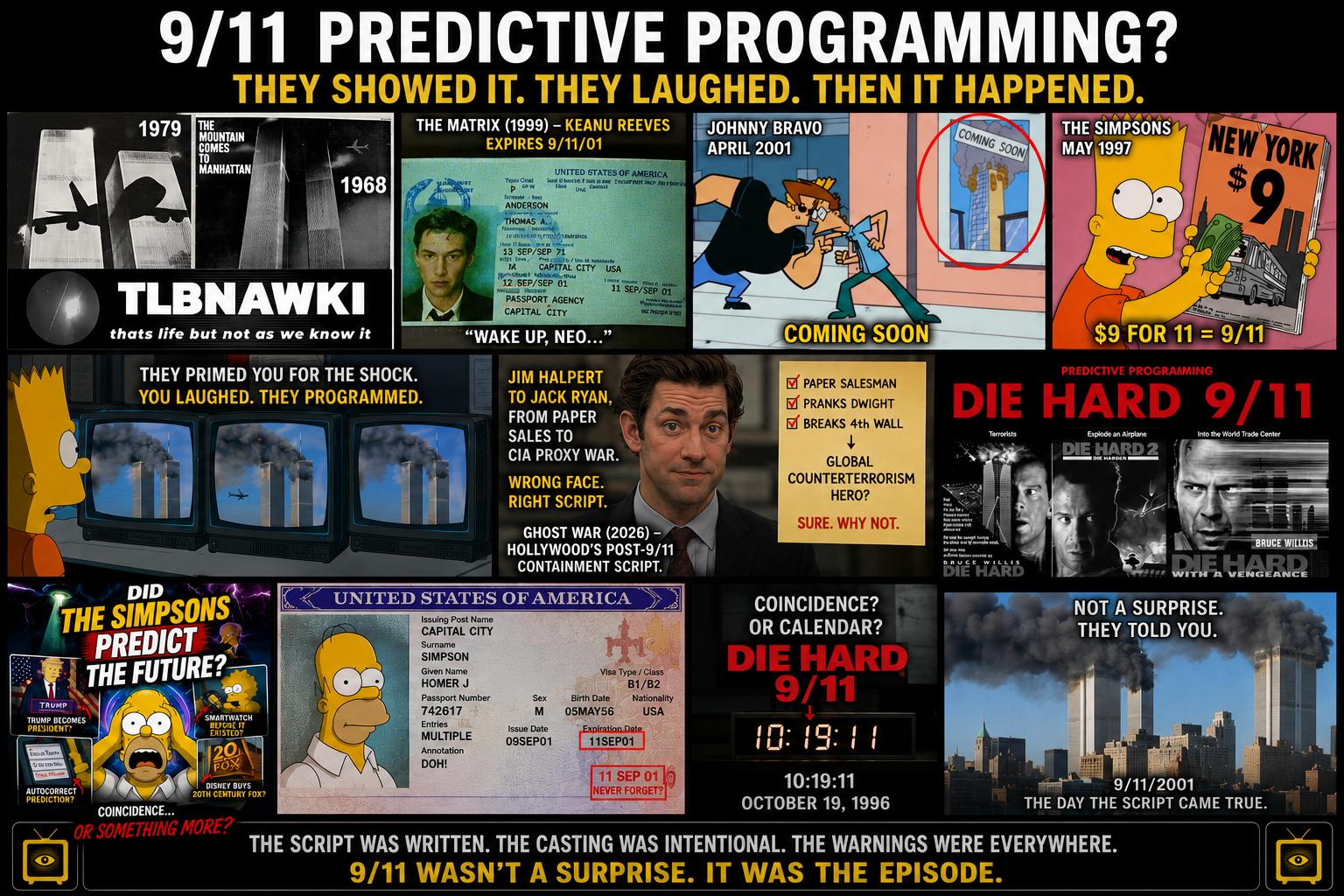
TL;DR: A two-camp interagency war plays out through Hollywood in subtle, repeatable ways. The Matrix (1999) = wake-up offer (passport 9/11 PP, red pill, Tank, RATM “Wake Up” credits naming Vietnam/Tonkin-class lies and blame-Islam framing). Reloaded onward = contain campaign—recasts, Oracle-as-control rejected then defanged, Maddox fracture, Square→ESC vendor swap, MxO kill, Resurrections nostalgia tombstone. The pattern is real even when any single beat looks like coincidence.
The war on screen

The full frame lives in the NSA investigation, the CIA investigation, the good-actor antibody synthesis, and Ghost War: The Antibody Phase. Condensed for movies:
The CIA–MI6 lane prefers slow-burn holy war, divide-and-conquer, engineered extremists, populations asleep to how power actually moves. The NSA / SIGINT / antibody lane prefers audit, early public trigger, individual sovereignty, “there is no spoon” exits from rigged menus. They are not the same project. When a blockbuster accidentally trains the second grammar at scale, the first grammar answers—not with a press release, but with sequel tone, cast swaps, independent mockery, live-service kills, and vendor replacement until the IP is safe again.
That is why Matrix matters beyond fandom. The handoff timestamps cleanly: 1999 wake-up → 2001–2003 fracture on set and in culture → 2003 philosophy rejected → 2009 community extension murdered → 2021 nostalgia reset. Each step looks like Hollywood business. Stacked together, the beats read as campaign logic.
Control stays extremely subtle. Nobody needs to send a memo saying “defang the Oracle.” Foster gets removed, Mary Alice recast, Maddox calls the Architect pretentious, Square’s Osiris R&D swaps into Warner-adjacent ESC, MxO shuts down when inherited storyline threatens canon, Resurrections ships as a love-battery meta-joke. Viewers argue taste. The pattern is what survives aggregation.

Two layers, one screen
Woke in this argument means dual-layer epistemics, not the 2010s culture-war brand. One layer accepts audits, news, movies, and authority as coherent. The other—often minorities and historically disenfranchised groups—knows official stories omit or invert power truths. That is the Malcolm X lineage definition: massive lies at the top are plausible, not paranoid; media can keep populations calm while power moves; assassinations arrive with framed blame attached. Malcolm’s frame tracks who gets scapegoated and which war pretense gets sold—not as movie metaphors alone.
Gloria Foster played Satima Tate, a Betty Shabazz analogue, on Law & Order before she embodied the Oracle. Tank was born free in Zion—never part of the Matrix—an operator who felt like a fan surrogate inside Zion’s war room. The first film spoke to the layer that already suspected the matrix of everyday life—that is the audience the NSA-camp offer targeted.
After 9/11, containment strategy—not an organic public mood in this read—trained mass discourse to prefer a comfort Oracle over a compromised guide. Trade press, mockery voices, and sequel tone sold grandmother warmth and punished the Reloaded read that the guide was another control layer. The CIA-camp answer was containment: keep the IP, kill the exit manual, ensure no fan institution outlives the licensor. NSA-aligned wake-up grammar left mass blockbuster space; CIA-aligned sleep-and-fracture grammar stayed on studio-owned CGI pipelines adjacent to Disney-class vendors. Square USA’s collapse and ESC Entertainment’s takeover of sequel battles are the same handoff at the vendor layer—auteur-realism team out, studio-controlled spectacle in.
Wake Up — what the credits accused
The end credits matter as much as the lobby shootout. Rage Against the Machine’s “Wake Up” (Wikipedia — song) rolls over the scroll—a 1992 protest track, not a sanitized score reprise. Blockbusters rarely exit on COINTELPRO, assassination politics, and a real J. Edgar Hoover FBI memo spoken over the crawl. This one did—and named the targets:
- “You know they went after King when he spoke out on Vietnam.”
- “Ya know they murdered X and tried to blame it on Islam.”
(Same song, earlier verse: “Networks at work, keepin’ people calm”—deferral grammar developed in What Are You Waiting For?.)
Vietnam and the Tonkin lie. Martin Luther King’s “Beyond Vietnam” speech (1967) is historical fact. So is the Gulf of Tonkin casus belli: the Johnson administration sold a second attack that SIGINT did not support. NSA historian Robert Hanyok completed a classified Tonkin study in 2001; the agency’s 2005 public SIGINT release confirmed the skew—documentation the NSA investigation and good-actor antibody synthesis treat as the antibody lane’s decades-long fight to stop populations entering wars on manufactured pretense. RATM put the King/Vietnam accusation on a March 1999 mass exit before that record was household knowledge.
Malcolm X, Islam, and pre-9/11 habituation. RATM accuses the establishment of blaming Islam after Malcolm’s murder. Historians still argue the fine print; the song is not a court filing. Warner still put the line on a March 1999 credits crawl—kill the dissident, blame the Muslim—more than two years before 9/11 headline grammar hardened. That framing pattern tracks into CIA–MI6 holy-war geometry, proxy radical Islam, and the War on Terror branding (good-actor § I; 1979 religious revival — holy-war geometry). Paired with Neo’s passport, the Islam line reads as predictive programming, not coincidence.
Malcolm also spoke against U.S. imperialism and Vietnam before his death; RATM splits King/Vietnam and X/Islam across two lines. Together with the Hoover coda, that is ongoing psyop vocabulary the NSA-camp lane surfaced inside a CO product—and the contain camp buried from Reloaded onward (Oracle-as-control rejected, Foster removed, Maddox mockery, MxO killed, Resurrections nostalgia trap).
What the first film actually offered
1999 gave the world bullet-time, green rain, and a clean fork: blue pill comfort or red pill truth. Morpheus offered community—others like you exist, even in Hollywood. Tank sat at the console: human craft, not celebrity mystique. The film worked as controlled opposition from inception: real awakening symbolism with kill switches still owned by Warner Bros. and the Wachowski contract stack—but the payload was NSA-camp antibody grammar at mass scale—passport date, red pill, and credits accusations naming Tonkin-class war lies and Islam-blame framing before the War on Terror branding hardened. The sequels split that read—unity was the problem the contain camp had to solve.
The kill-offs
Containment did not wait for box-office disappointment. It ran through cast, contract, and character elimination—the CIA-camp answer to a film that had accidentally trained exit.
Tank. Marcus Chong played the operator in 1999; he was gone for the sequels, killed off-screen, replaced by Link (Harold Perrineau Jr.)—a generic Hollywood insert with dreadlocks and attitude but none of Tank’s Matrix-native personality. Chong’s dispute with the production—pay, union, a 2000 arrest, a 2003 lawsuit—is documented in trade press; his documentary lane (The Marcus Chong Story, The Kill Off) adds contested allegations the open dossier tiers separately. Pattern read: remove the fan surrogate, swap in a trope.
Zee. Aaliyah filmed material for Reloaded, died in August 2001, was recast with Nona Gaye. Trade coverage treated the production as cursed before the sequels even landed.
The Oracle. Gloria Foster completed her Oracle work for Reloaded—including the single courtyard visit with the exiles speech—then died in September 2001. Mary Alice replaced her for Revolutions with an in-universe “outer shell destroyed” cover. Laurence Fishburne said the cast lost “our youth and our wisdom.” Containment read: let the dangerous speech appear once with Foster’s voice, then remove Foster before the finale.
Fan and trade press already felt a curse on the sequels—Empire, Evening Standard, Far Out—before anyone needed a conspiracy board. That superstition is reception evidence: the audience sensed awakening energy being fought on set.
Without why, you are powerless
Reloaded (2003) is where the franchise almost taught its own exit manual—and where mass culture refused the lesson. That refusal is the contain camp winning in the open: the war scene is the theater lobby, the weapon is “cringe.”
The Merovingian (~1:06:04–1:08:30) names the lever: causality, action, reaction. “Choice is an illusion created between those with power and those without.” Peace, he says, comes only from understanding why. “Why is the only real source of power. Without it, you are powerless.” Neo arrives “without why, without power”—sent by the Oracle.
In one courtyard visit (45:42–49:32), Foster’s Oracle inverts the Merovingian’s trap before Neo ever reaches the restaurant. She opens with candy and the choice beat (45:55): “You didn’t come here to make the choice. You’ve already made it. You’re here to try to understand why you made it.” She names the future (46:22–46:34): “We’re all here to do what we’re all here to do. I’m interested in one thing, Neo, the future. And believe me, I know—the only way to get there is together.” Then the exiles speech (47:12–47:35)—the line that breaks sequel-safe scope: every ghost story, every vampire, werewolf, or alien tale is “the system assimilating some program that’s doing something they’re not supposed to be doing.” Programs choose exile when they face deletion. Folklore as deprecated simulation code. She tells Neo he has the sight and sees “the world without time” (48:45), then pushes (48:58–49:13): “You’ve already made the choice. Now you have to understand it.” Foster did not live to carry that voice into film three.
The Architect (1:50:29–1:57:18) confirms engineering: “I am the Architect.” This will be the sixth time “we” have destroyed Zion—“we have become exceedingly efficient at it” (1:54:33–1:54:43). Neo is the eventuality of a systemic anomaly (~1:51:04); prior Ones accepted the program when given a choice, even unconsciously. Morpheus becomes dangerous in this frame because waking too many people accelerates the cycle toward mass death—the sequel treats his zeal as a liability, not a virtue. The Oracle’s Reloaded “together” line implies peace and an end to zero-sum war; the franchise’s explicit “I want what you want” / end-of-war beat waits for film three. That is the idea the contain camp could not allow to survive intact.
After Neo leaves the source room, he tells Morpheus (~2:02:21–2:02:37): “It was a lie, Morpheus. The prophecy was a lie. The One was never meant to end anything. It was all another system of control.” The guide demystified—the Oracle and the prophecy path together, not a wise grandmother above the game. The comfortable Oracle died in that sentence for anyone still listening.
The manufactured post-9/11 reception story said audiences wanted comfort, not a compromised guide—not this read. Reloaded carried the uncomfortable lane: Oracle as control layer, not grandmother. Rolling Stone’s Peter Travers (May 2003) “loved the Oracle, hated the Architect” fits contain-camp curation: warm face in reviews, control-system lesson shelved in memory. Easier to remember the burly brawl when critics and fracture voices mark philosophy as cringe.
The summer the fans broke
Fan fracture is an interagency battlefield too. In May 2003, George Ouzounian’s Maddox page—The Best Page in the Universe—published Four things that could have improved “The Matrix: Reloaded.” (Wayback capture). He mocked “deep philosophical notions, straight out of a Philosophy 101 class,” patronizing “causality,” and fans who would “justify this movie” online. His closer: “I got it, it’s just that once I got it, I didn’t want it anymore.” A November 2003 follow-up panned Revolutions and mocked the Oracle’s cryptic “what do you want?” loop.
That summer, peer reaction converged on Maddox-style “sequel bad / philosophy cringe.” Reloaded still carried the uncomfortable read—the Oracle as control layer, the why-chain, Neo outgrowing Morpheus—for anyone not looking for an exit from depth. Maddox offered nihilist containment: smart enough to mock the Oracle, too cool to finish the thought. Nothing worth believing in anyway.
The same containment shape shows up across Maddox’s wider career—children’s art, vegetarians and PETA, women’s magazines, diet fads, fedoras and nerds, Mac computers—with only the waffle attack feeling self-generated. Each target was a live subculture the contain lane needed mocked into embarrassment; pseudo-resistance built the brand while the platform stayed profitable. Documented monetization (merch, books, later podcast sponsors) exists; covert astroturf pay for Matrix pans does not. Structural controlled-opposition fracture works without a check—the summer of 2003 needed voices that sounded independent while teaching believers that deep sequels deserved nothing. Divide the awakened audience and the war is half won without touching Warner’s ledger.
Will, not the kiss
The Matrix ends with Trinity reviving Neo. Mass memory files that under “love conquers all.” Reloaded complicates the mechanism in the same Oracle visit already described: Agent Smith (51:34–51:38): “I killed you, Mr. Anderson. I watched you die.” Neo stands there—the callback lands after the courtyard beat where the Oracle named “the world without time” and Neo’s “I won’t.” The Architect (1:51:04–1:55:02) names Neo the “eventuality of an anomaly” whose function includes returning to the source and disseminating “the code you carry.” Love enters as systemic design—“vis-à-vis love” (~1:56:10)—not fairy-tale transcendence.
The revival at the end of film one used a kiss on screen; the sequels point at will, anomaly, and overlap with the Matrix system as the deeper grammar. The Architect frames Trinity attachment as “vis-à-vis love”—an emotion “designed specifically to overwhelm logic and reason” (1:57:01–1:57:06), with “she is going to die and there is nothing you can do to stop it” (1:57:11–1:57:18) as the cage’s predicted outcome. Neo’s refusal—“I won’t”—and the Oracle’s “Because you’re the One” push sovereignty inside manipulation, not romantic rescue as the final answer.
After 2003 that labor was dropped from public discourse. Revolutions sentimentalized the truce; critics and fans who wanted a clean ending treated peace as arrival. Resurrections (2021) revived Neo and Trinity from death in a battery-farm Analyst frame—confirming death-reversal is in-lore while packaging it as emotional farming without sovereignty. Love-ending grammar arrived late as delayed containment, not as the passport-era plan.
Not Like This — when the community died
Switch’s last words in the 1999 film—“Not like this”—come when Cypher unplugged her, a wrongful death on the hovercraft, not the heroic battlefield exit she expected. Giant Bomb borrowed the line for a July–August 2009 video series documenting the shutdown of The Matrix Online—the MMO Warner launched with Wachowski blessing so gamers could “inherit the storyline.” Sony pulling the plug on MxO rhymes the same beat: unplugged by the operator the community trusted.
Sony Online Entertainment took the live service in 2005. In June 2009 Sony announced closure; servers died 31 July 2009 with fewer than five hundred active subscribers cited in press summaries (Wikipedia — MxO). The final event was glitchy—mass disconnects, PvP chaos, players granted extreme powers, framerate collapse—a farce instead of a scripted last hurrah (Giant Bomb wiki on MxO). Part 01 and the Finale are the primary emotional record. Wikipedia and pop-culture summaries cite the series title as a direct reference to Switch’s line in the 1999 film.
MxO was load-bearing for the containment thesis: the only institution where fans could extend post-Revolutions peace lore in real time while the Wachowskis had publicly blessed player inheritance of storyline. A living sequel outside studio control threatened the contain camp the way a working antibody threatens a long holy-war script. Live plot bent toward Neo’s body and a future Matrix 4 premise; organic player peace was truncated. Compare other 2009 MMOs with similar sub counts that survived—economic excuse alone does not exhaust the read. The shutdown message was plain: community canon extensions would not outlive the IP holder. A revolution stopped, prevented from restarting.
Square’s gift, Warner’s ESC
Production-side containment mirrors the fan kill—the same two-camp handoff at the vendor layer.
Square USA—fresh from Final Fantasy: The Spirits Within (2001)—delivered Animatrix segment “Final Flight of the Osiris” for the Wachowskis while the brothers were in Australia shooting both sequels. Joel Silver called Osiris “Matrix 1.5”—the piece that “begins Reloaded”—and said Warner had “other hopes and plans for Square” before Square Pictures collapsed after Spirits Within and Sakaguchi exited in 2003 (MovieWeb — Silver/Jones; Animation Magazine — Jones). That is not a peripheral DVD extra sitting outside sequel planning; it is inside the same production window as films two and three.
On Osiris, Square’s team invented the franchise’s coiling, swarming Sentinel grammar. Mach Kobayashi built a flocking system so tens of thousands of Sentinels move as one mass; close-ups use coiling machines crawling the Osiris hull—the same hovercraft vs. flying swarm mechanism Revolutions scales to the Zion siege. Director Andy Jones told Computer Graphics World (June 2003) the Wachowskis liked the coiling Sentinel look so much they were using it in the live-action sequels; on screen the peak prevalence is Revolutions—wall-to-wall swarm warfare over Zion. Square did not invent Sentinels in a vacuum: for hero close-ups they received a Sentinel model from ESC Entertainment, already contracted on Reloaded and Revolutions—proof the Osiris R&D line and the live-action sequel VFX pipeline ran at the same time (CGW — Anime-ted).
After Square folded, battle work migrated to ESC (Burly Brawl, Zion siege, freeway chase). Square USA does not appear on Reloaded VFX credits; Pixel Liberation Front handled much of the live-action previs (Post Magazine — Gaeta). The public record does not yet prove Square storyboarded every M2/M3 set piece—but it does prove Square was intimately involved at the action-design layer: conference calls with the Wachowskis, shared assets with ESC, Silver’s unrealized broader Square plans, and Square VFX lead James Rogers’ self-reported “tests for Matrix 3” on his LinkedIn (uncorroborated in trade press). On this read, Reloaded / Revolutions repeat motions Square had already prototyped on Osiris—Zion as ESC extending Square-era swarm/coiling boards with a newer render stack—then hand the finished spectacle to a studio-owned vendor after the wake-up team is gone.
Osiris also opens with photoreal human sparring—the same Spirits Within human-CG stack applied to a Matrix fight beat (CGW — Anime-ted). On this read that R&D line runs directly into the Burly Brawl (many Smiths) and the Revolutions crater finale—sequel set pieces that needed photoreal digital humans at scale. Trade press credits ESC Universal Capture for those shots; the Animatrix containment read holds that The Animatrix anthology reframed Square’s real job: deliver Matrix 2’s intro in full Square render, then file the team under “anime” beside eight Japanese shorts so live-action-hybrid sequels could go to ESC with no Square credit on the features. Variety and AWN describe Square’s contract as ~10 minutes for the Matrix sequel; Rogers says the team thought they were doing a DVD installment until after delivery (Variety, Matrix Fans — Rogers). Spirits Within was already treated as anime/CG in press despite being full CGI—bundling Osiris into Animatrix fixed memory: Square = anime vendor, ESC = sequel VFX. Square’s pipeline was strongest at all-CG photoreal; Zion’s human+mech hybrid likely needed a crossover team Square could not finish alone—an exploit moment where Warner agreed ESC completes hybrid scenes and Square never appears on M2/M3 credits. Square Pictures bankruptcy closes the loop. Sunglasses on Neo/Smith may also mask early digital-human eye tells in multiplicity fights (author read; franchise shades predate sequels; ESC marketed eye reconstruction for Burly Brawl—tension noted in dossier). Full logic: dossier Thread H § Animatrix containment. Handoff rhymes with Aaliyah recast (Thread C). Tier table and falsifiers: § public record.
The handoff left a visual tell. In Revolutions, Neo is impaled by Source tendrils through the Logos hull; Trinity catches him—a beat that reads metaphorical inside Matrix lore (removable without changing the war’s outcome). Side by side with Final Fantasy: The Spirits Within (2001), the same grammar lands as native: Aki Ross stabbed by phantom/Gaia enemy tendrils at a matching angle. Square’s team authored that action language for the FF film; ESC rendered the sequel beat—but someone left what reads as a tribute to Square’s own scene inside Warner’s third film. The moment only fully parses in the 2001 FF context; in Matrix 3 it is spectacle without mythic necessity. That is why the rhyme matters for containment: finish the prior team’s shots, strip the philosophy, keep the signature.
Side-by-side demo: Spirits Within × Matrix Revolutions — tendril/stab tribute (author visual read, L3). Full vendor chain: open dossier Thread I · Thread H.
Animatrix (2003) sits in the same containment window as Square’s handoff and the live-action sequels. Osiris aside, much of the anthology reads dull or misaligned with Matrix (1999)—not one vision, but a mixed drop that cools appetite before Revolutions landed. Second Renaissance is horrific and eye-opening, but on this read it does not match film one’s grammar: humanity as irrevocably vain, refusing negotiation with machines, in Holocaust-documentary presentation (AnimeWorld review; CBR — controversial for cruelty). The gore exceeds the motivational tone of machine-vs-human violence in Revolutions’ Zion battle—Animatrix was willing to be more upsetting than the live-action trilogy, potentially leaving deterrent scarring that makes viewers less open-minded about later Matrix projects (Common Sense Media — graphic violence; Encyclopedia of SF via Wikipedia — “largely disappointing sequel rollout”).
Kid’s Story ties a direct loop into Reloaded’s Kid—widely cited as annoying (Vern’s Reviews; Screen Rant). The character is born off-screen in the short (school defiance, Agent chase, roof jump / self-substantiation / pro-suicide premise), then over-highlighted in Zion after M1 youth crew (Mouse, Tank) are gone. On this read that is CIA-camp sequel casting early: a radical kid who ditches school and fights teachers, slotted in to replace the operator-surrogate lane—not earned on screen in the features. Full segment map and tier notes: dossier Thread M. Economic-war rhyme in Second Renaissance remains indexed separately in Great Awakening §3.3.4.
The recurring pattern across investigations: when a creative team aligns with philosophical or spiritual concepts the industry will not tolerate, they are removed and replaced by personnel more loyal to the studio—finishing scenes the prior team planned while stripping the ideas. Output turns inert, sanitized, easy to control. Square’s human-realism CGI pipeline was contained; sequel spectacle continued without long-term competition. See the Square battle-system lineage and dossier Thread H for credits and trade sources.
Revolutions flattened, Resurrections closed the book
Revolutions (2003) introduced the Trainman cold, dropped score and action quality outside the Zion battle—the one sequence that still carried Osiris-planning DNA—and ended with a machine-human truce Neo bought with his life. Foster’s Oracle voice was gone; Mary Alice’s Oracle carried the explicit peace beat—“I want what you want” and the end of the war—that Reloaded had only implied with “the only way to get there is together.” Mary Alice’s read still felt defanged next to Foster’s; Merovingian shell plots and Keymaker mechanics filled screen time while the exiles lesson stayed on disk from film two only. For many viewers that peace felt like arrival. The franchise had taught the uncomfortable control-system read in Reloaded, then offered emotional closure before the audience finished the homework.
Matrix Resurrections (2021) undid the truce, put Neo and Trinity back in a reconstructed Matrix, meta-commented on sequels and franchise fatigue, and farmed their bond through the Analyst character—love as battery, nostalgia as leash. Agent Smith’s meta-sequel beat lands the title grammar: “After all these years, to be going back to where it all started… back to the Matrix.” The Analyst pairing taunts the fan—the awakening arc as loopware; emotional capture even after leaving the theater awake. Warner could meta-wink at sequel hate while implementing the love-ending grammar Reloaded had refused when Neo was still evolving.
That film closes the thesis for this investigation. The Matrix project as a living philosophical engine is over. Warner can reboot brand without owing Reloaded’s Oracle-control lesson. Anything future arrives detached from original lore, philosophy, and plot—a sanitized IP shell the way Resurrections already demonstrated on screen. The war for the movies did not end; this franchise simply stopped resisting.
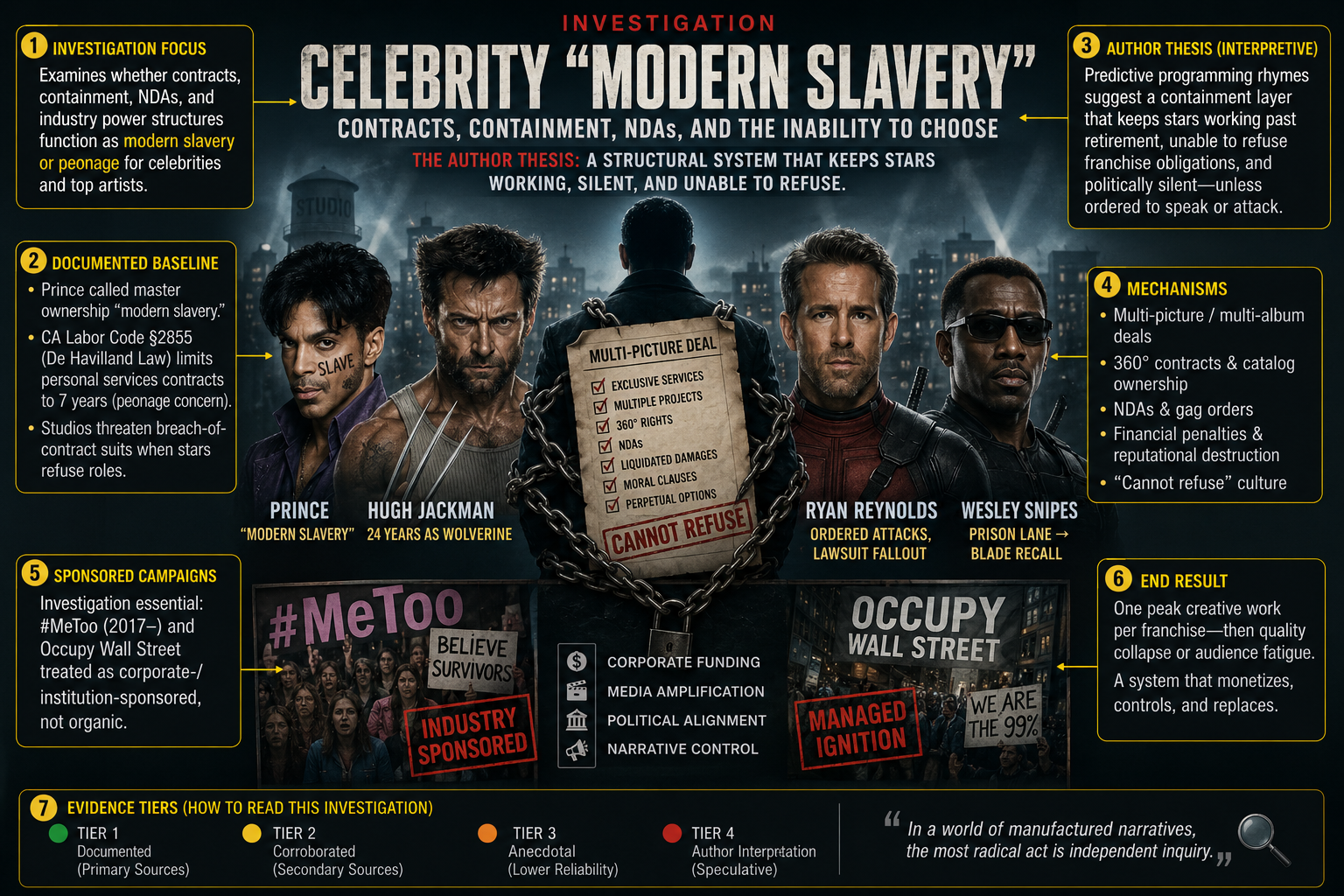
The broader pattern—offer awakening, fracture the believers, kill extensions, reset nostalgia—rhymes with franchise containment documented in the celebrity modern slavery investigation and Square talent churn in the battle-system lineage. Matrix is the flagship case because the red pill worked well enough that containment had to be industrial—and because the handoff stays visible when Hollywood is read as a front, not a coincidence factory.
Where next
Series — predictive programming in movies:
- Everything Burns — Installment II: Pacific / Dark Knight / 24 / Joker calendar (does not repeat Matrix beats from this page).
Technical companions:
- Matrix “Not Like This” containment investigation (open dossier) — evidence tiers, Maddox quote bank, Reloaded dialogue anchors, Chong/Kill Off lane, MxO research TODOs, limits.
- Controlled opposition hub — manufactured dissent, QAnon, Assange/Snowden tells, franchise containment patterns.
- Predictive programming hub — passport / 9/11 PP cluster, Animatrix economic-war rhymes (Great Awakening §3.3.4).
- Ghost War: The Antibody Phase — NSA vs CIA Hollywood containment after 9/11.
- Celebrity modern slavery / franchise containment — bad-sequel divide-and-conquer pattern beyond Matrix.
Framing and limits
Prisca sapientia holds that profound understanding can be encoded in popular myth, later flattened by consensus. This article’s primary thesis is the two-camp interagency war expressing itself through subtle Hollywood control—Matrix as the clearest timestamped handoff. Documented facts (passport date, deaths, recasts, MxO shutdown dates, VFX credits, archived Maddox pages, Wake Up credits placement and RATM lyrics, Tonkin/Hanyok timeline, CGW/Jones Sentinel coiling-swarm adoption, Variety/Silver Osiris-as-sequel-intro, Animatrix reception corpus) live beside interpretive reads (NSA vs CIA camp mapping, team replacement, Maddox-as-agent, will-vs-love grammar, pre-9/11 blame-Islam PP, credits-as-second-payload, Square embedded-pipeline, Animatrix-as-containment / credit-theft, Animatrix tone / psychic deterrent) that are not proven intelligence findings or claims that Wachowskis coded agency names on purpose.
Aaliyah and Gloria Foster died in documented accidents and illness (2001). This investigation does not allege Warner or the Wachowskis caused those deaths. Oracle/Tank elimination from the living franchise is a pattern read independent of medical mechanism. Chong’s fake-SAG and theft allegations remain contested pending primary documents. Fan “curse” lore is catalogued as reception evidence, not supernatural claim. Full tier discipline and disclaimers: dossier Limits.
Keywords: #Matrix #NotLikeThis #TwoCamps #NSA #CIA #ControlledOpposition #PredictiveProgramming #MatrixOnline #Containment #MatrixResurrections #MalcolmX #WakeUp #RageAgainstTheMachine
Substack: paradigmthreat2.substack.com/p/not-like-this
Last updated: 2026-06-16T02:00:00-04:00
Written and narrated by Ari Asulin, with drafting and research support from LLM agents.
Share