

Two Camps of Medicine: Jaffa, Red Mercury, and the Radiation Cover Story
French war medicine, perceived invincibility, and what got redacted between Napoleon and Marie Curie
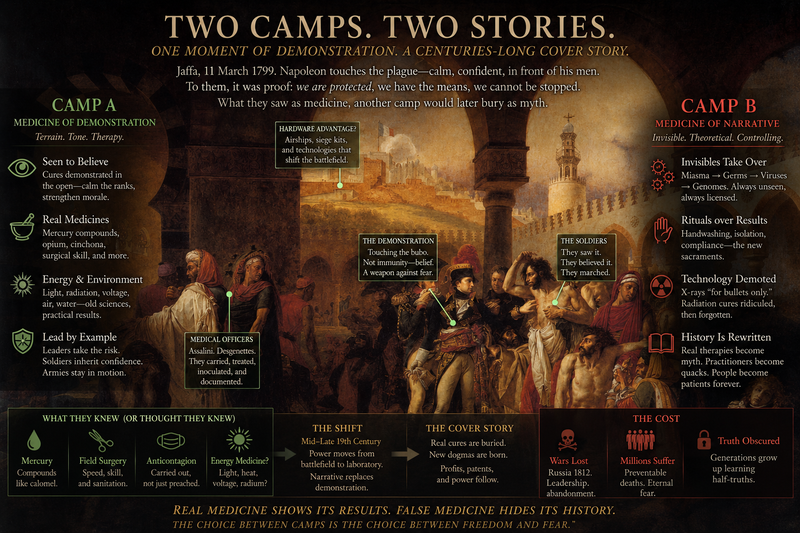
The image everyone remembers is Antoine-Jean Gros’s Salon canvas from 1804: Bonaparte in hero light, fingers on a soldier’s bubo. On 11 March 1799 at Jaffa, physician René Desgenettes helped carry one corpse with a burst bubo while Bonaparte kept calm. The stake is two camps of medicine fighting over every such scene—and whether French soldiers believed they could not get sick because they had seen advanced therapy demonstrated in their faces.
TL;DR: Camp A = terrain, morale, anticontagion dispute, demonstrated cures; Camp B = invisible agents, germ saints, diagnostic-only radiation, post-COVID vaccine dogma. Jaffa 1799 + Gros 1804 = real felt invincibility (ward theater the men believed); plague dossier still tiers Gros as state art for forensics. Airships + classified siege kit = major hardware layer (ship-shaped airships investigation). Red mercury = Camp A blood-energy thesis (distinct from textbook calomel); modern science denies the substance; Napoleon’s physicians and ranks believed it worked (dossier §2.7). Curie 1914–1918 = same redaction pattern — bullet-finder cover story over a different field cure. Russia 1812 = reckoning. Ends Semmelweis + Twelve Monkeys. Investigation.
Two camps over time
Camp A treats disease as terrain, depletion, and collective tone—plus therapies that work in the open ward: morale, anticontagion stunts, compounds the army actually carries, and radiation and voltage modalities older than the textbook admits. It assumes prisca sapientia: deep medical knowledge existed and was later degraded, rather than invented from zero in the nineteenth century.
Camp B treats disease as invisible executors you must believe in without seeing: miasma’s successor germs, then viruses, then genomes—always with a licensed product line. Handwashing becomes universal religion; X-rays become “only for finding bullets”; COVID becomes proof that no healthy person can simply not catch what is going around.
The camps do not map cleanly to “left vs right” or “science vs superstition.” They map to who controls the story after a demonstration in front of soldiers. Deeper corpus: ætheric disease essay, isolation audit.
Jaffa and the painting: demonstration of invincibility.
Gros, advised by Egypt veteran Dominique Vivant Denon, fixed Bonaparte touching the living bubo—royal-touch Christ healing for the Salon. Desgenettes’s ward record is smaller and uglier: one corpse carried bare-handed in stench, 11 March 1799. Gros’s earlier sketch had Bonaparte carrying a plague soldier; the final canvas chose what photographs best for miracle.
This investigation treats that cluster as real morale medicine — theater the ranks believed. Medical officers Assalini, Desgenettes, and allied British voices held plague non-contagious in the period’s dispute sense. Desgenettes inoculated himself with bubo material; Napoleon’s long hospital visit and corpse lift were staged so ranks would calm their imagination—French military phrase—because they already trusted the kit behind the stunt. The leadership caste may have known the limits of that kit. The ranks were not supposed to.
The expedition still buried roughly seventeen hundred plague dead. Mass illness is documented; the thesis tracks belief and demonstration, rather than literal invincibility.
Daniel Roytas’s 2024 Can You Catch a Cold? (Chapter 11, pp. 204–206) compresses Pyramids, Murad Bay, and zero French infections into one paragraph—the circulated screenshot. The plague investigation grades each clause; endnote 8 is Winterbottom 1828, Edinburgh Medical and Surgical Journal 30(97):321–44. For Gros as propaganda artifact, read that dossier; for why soldiers felt untouchable, read the ward and pharmacology lane here.

Red mercury — what the army’s scientists believed
Textbooks cite mercury — calomel, purges, the surgical chest. That is the documented floor: Paris sent heavy chemistry into Egypt and Syria, and physicians like Desgenettes deployed it openly. The working compound in this reading is red mercury — a substance modern consensus treats as fiction.
Mainstream sources call red mercury a hoax or scam compound: Wikipedia summarizes decades of black-market samples that proved to be ordinary mercury salts or dyed mixtures; the U.S. Department of Energy and Los Alamos analysts concluded the marketed substance does not exist with the advertised properties (New Scientist — “Only fools still hunt for elusive red mercury”). Post-Soviet con-artist lore — including firms linked to Vladimir Putin’s St. Petersburg export committee — sold brick-red mercury oxide blends as a secret Soviet super-material (RFE/RL). Camp B’s verdict: there is nothing to find; believers were swindled.
Camp A’s read: the debunk itself is the cover. Something was fielded under mercury pharmacology that officer-scientists and the ranks treated as real — enough that Jaffa theater and Gros’s miracle landed on men who already believed their blood-energy kit worked. This investigation assumes red mercury works as operating doctrine, pending peer-reviewed confirmation.
Mechanism (author thesis): inject red mercury into the bloodstream. It mimics blood’s energetic properties — carries voltage / life-current through the body without normal blood replenishment keeping pace. More mercury → less breathing required to top up energy; the soldier runs cooler on ambient æther intake, but still needs some secondary absorber (terrain, radiation ward, collective morale — the other Camp A modalities). That lore is the substrate of vampirism: the mirror taboo — vampires do not reflect — because red mercury does not show in a mirror; light refracts through it rather than bouncing like surface blood. I have seen that mirror behavior directly; no third-party citation is filed here — it sits in the same tier as Curie’s hidden cure: witnessed, redacted from Camp B canon.
Why Napoleon matters: Calomel purges alone would explain morale plus purge toxicity. Red mercury in the officer caste’s kit means the army’s scientists and surgeons were running Camp A blood physics that the 1900s guild later defined out of existence. A public search found no credible celebrity “red mercury wellness” thread separate from 1990s scam journalism; that gap fits the redaction read rather than weakening the Napoleon belief thesis.
Radiation sits beside mercury in the same corridor: 1914–1918 Curie may name a field cure later flattened to “find the bullet.” One camp eliminates the proof of the other — handwash saints and nonexistent red mercury on one side; ward demonstrations and mirror-refraction lore on the other. Full tiers: investigation §2.7–2.8.

Airships — the hardware behind invincibility
Medicine and morale explain part of why French soldiers felt untouchable. The dominant hardware layer is ship-shaped airships and classified siege technology — boat- and canoe-hull craft under gas envelopes, plus resonant artillery and healing radiation demonstrated in officer wards (Napoleonic artillery / airship dossier).

Textbooks admit tethered balloons; they do not admit free-navigating sky-ships on the 1812 order of battle. That gap matches a class-gated suppression read: the rank-and-file saw lift and firepower working, but were too low in caste to carry full doctrine when the line broke.
Russia 1812 answers air dominance with total sacrifice — including, on the Fomenko read, burning the Kremlin as Jerusalem reconstructed after the Crusades, denying French siege geometry a fixed sacred target. The retreat across the Alps then rhymes Vietnam, Afghanistan, and the frozen German Eastern Front: guerrilla warfare from civilians in tree lines, horrible weather, chaotic pullout, leadership that would not fly the soldiers out and left on the order of six hundred thousand to die of exposure, disease, and rout. Top minds evacuated with the machines — airships included — to keep hardware from Russian capture (full investigation §5). Hitler and modern coalition pullouts are the only near mirrors for that staff mindset: fight on at all costs while the leadership cast saves the tech.
Egypt confidence, Russia reckoning
After conquering Egypt, Bonaparte struck into regions his staff did not understand—climate, water, local disease ecology—while carrying supreme medical confidence. That arrogance is the French elite pattern this file tracks: major wars against ground you are not prepared for, backed by faith that your therapy beats their terrain.
In Egypt the army still had reserves—morale, supply, favorable season, collective tone. In Russia 1812 the mirror broke: retreat, winter, exile, typhus, dysentery, starvation. Confidence cannot refill depletion (Tennant voltage frame). The lesson is spent humans falling when the ledger runs out — independent of whether Camp B’s germ story was ever true.
Camp B today insists even healthy people must catch what is circulating—especially since COVID—and that only schedules and products save them. That is the late victory of invisible-agent medicine over Camp A’s herd that heals itself; full argument in the investigation §2.
Curie: the preposterous bullet story
Mainstream history says Marie Curie’s petites Curies (1914–1918) brought mobile X-ray so surgeons could localize shrapnel—diagnosis, not mass cure. The reading here runs the other way: she treated with ionizing radiation in ways later flattened; the public got martyr-to-radium memory instead of a field cure (Curie investigation).
The author finds the bullet-only story preposterous as the whole truth: if imaging alone won the war ward, show the outcome tables; instead we get the same miracle-medicine boast as Jaffa—French science masters death for the soldier—until the next Russia collects the bill. Curie rhymes red mercury: mainstream science defines the substance or story out of existence while ward witnesses saw something else entirely. Camp B wins by redacting Camp A’s proof — nonexistent red mercury, diagnostic-only X-rays, germs you cannot see — not by settling the ward ledger in public. 1914–1918 rhymes 1799–1804, not because Curie caused Napoleon, but because both sold invincibility through elite kit to men who could not audit the physics.
Eben Byers (1932, Radithor) and Flexner (1910) sit in the same corridor: radiation commerce and guild capture before 1945 fixed “radiation” as uniform poison in mass memory.
Egypt’s stone (brief)
The pyramid-energy and Les Brown lane—plus the timeline’s 11th-century break—treat the pyramids as shelter and hospital whose main function ended when imperial continuity fractured. Bonaparte labeled them “antique” while local memory still read medical stone; that fed confidence in a landscape the army did not own.
Separately, the Fomenko/New Chronology read at chronologia.org — empire19_05 casts dry Egypt as imperial graveyard and embalming geography—optional NC context for the two-camps spine (dossier §4).
Semmelweis: when Camp B wins
Ignaz Semmelweis (1818–1865) proved cadaverous particles on hands killed mothers when students went from autopsy to maternity; chlorinated lime collapsed mortality in 1848. Vienna then blocked his corpse work (Oct 1850 docent terms: no cadavers, mannequins only) and drove him out. He was right on the ward; Camp B later made him patron saint of germs and universal handwash, burying terrain medicine and sorting everyone into supporter vs denier around a name. Facts: investigation §11.
Twelve Monkeys
Terry Gilliam (1995): Jeffrey Goines (Brad Pitt) rants that “crazy is majority rules,” mangles Semmelweis and germs, then a burger on the floor becomes proof that popular opinion decides what is real—“There’s no right, there’s no wrong, there’s only popular opinion.” The film carries camp psychology, not ward data. Napoleon’s corpse lift was the honest ward record for men who thought they could not fall sick; later textbooks pick which camp gets called sane.
Deeper tiers: two-camps investigation, plague & Gros dossier, ship-shaped airships investigation, Marie Curie — radiation, chronology hub.
Framing and limits
Prisca sapientia applies; modern consensus is not default. Not medical or legal advice. Full tier tables live in the two-camps investigation.
Documented anchors include the Jaffa visit, Desgenettes corpse carry, and roughly seventeen hundred plague dead (plague dossier); Napoleonic calomel and the wider military pharmacopoeia (campaign specifics still open in the dossier); Semmelweis’s ward trial and Vienna’s October 1850 cadaver ban; and Twelve Monkeys dialogue as film source.
Author thesis and belief cover soldiers who felt invincible after demonstrated therapy; airships and classified siege kit as the dominant invincibility hardware (ship-shaped airships investigation); Gros as a felt-invincibility icon (the plague dossier still tiers the same canvas as state propaganda for forensics — both reads are linked on purpose); red mercury as injectable blood-energy mimic with mirror refraction and vampirism lore, where modern consensus denies the substance but this investigation assumes it worked for Napoleon’s physicians and ranks; my eyewitness of red mercury non-reflection in a mirror (author report, no third-party citation filed); radiation cure since Napoleon, Curie curing soldiers in the author’s read, and the bullet-finder story as preposterous as the full account (Curie investigation); pyramids as hospital until the 11th century (author read plus pyramid-energy sources); and Camp B redaction of Camp A proof across mercury and radiation alike.
Keywords: #TwoCampsMedicine #GrosJaffa #FrenchWarMedicine #RedMercury #Mercury #RadiationCure #PerceivedInvincibility #VampirismLore #Semmelweis #TwelveMonkeys #Roytas2024 #MarieCurie #NapoleonCorpses #ParadigmThreatFiles
Last updated: 2026-05-23T09:35:00-04:00
Written and narrated by Ari Asulin, with drafting and research support from LLM agents.
Share