

Investigation: Pyramid “Energy” — Kerrell & Goggin (1977) and Large Stone Geometry
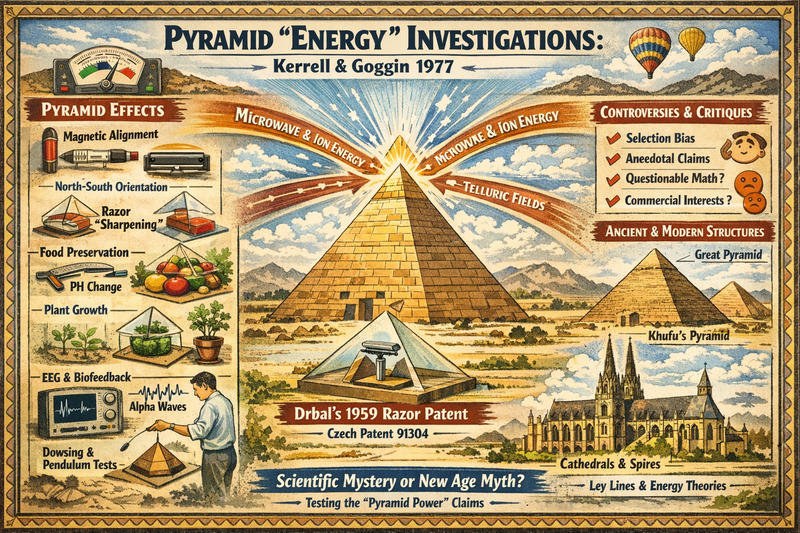
Book structure and per-chapter notes: pyramid-energy-kerrell-goggin-1977-chapter-summaries.md (same folder as this file).
Summary
What this timeline prioritizes in the book: Arguments for habitability-oriented design—especially in the Great Pyramid of Giza chapter—rather than razor tests, dowsing, or Mars photos. Kerrell and Goggin quote Paul Brunton’s “not a tomb” case, which turns on ventilation, access, and chamber layout inconsistent with a sealed burial only: long air channels linking the King’s Chamber complex to the outside (“the dead do not breathe”), an elevated King’s Chamber where pharaonic practice was usually subterranean, a Grand Gallery far larger than needed for a minimal passage, a second major chamber (Queen’s) without tomb trappings, and sealed air shafts at the Queen’s Chamber. They note the Great Pyramid’s internal chambers and passages above ground as unusual among Egyptian pyramids. Separately, Bovis is cited for small animals dying inside the monument without normal decay—an environmental preservation hint inside the volume. None of this requires the authors to date the structure; it supplies design-intent questions that align with reading pyramids as occupied, high-value shells rather than vanity tombs.
Other material in the book (secondary for us): The handbook’s bulk is small-scale models as accumulator/antenna (magnetic north, food, blades, sleep, plants, biofeedback). That layer is modern folk experiment—useful as weak analogy (people choosing to sleep and store food under a frame), not proof of Birkeland physics.
Relation to this project: Pyramids: Myths vs Reality treats 3147–670 BCE pyramids as civilizational technology: ley-node placement, cathodic / Faraday-like grounding when interplanetary arcs raged—safest built environments and effective centers of order in surface chaos. Habitability-oriented design arguments fit that reading without requiring Kerrell/Goggin to name the BCE Dark Ages: ventilated, monumental interior volume matches shelter for people and stores at the EM focal points that mattered for survival and command.
Status: Open. This file maps source arguments to site questions; it does not assert that all modern “pyramid power” effects are established physics.
1. What the book asserts (evidence classes)
| Area | Book’s main assertions | Notes for verification |
| Metallic / magnetic | Razor “sharpening,” N–S alignment, honey test, stronger signals with steel than aluminum, inverted pyramid “dead” | Requires blinded replication; magnetic anomalies could be real but tiny |
| Organic / microbial | Slowed spoilage, changed taste, insect avoidance anecdotes | Confounded by humidity, season, EM noise; few controlled studies cited |
| Water | “Pyramid water” retains qualities; changed pH in some tests | Classic placebo / expectation issue for human subjects |
| Living systems | EEG Alpha/Theta amplification; pet/healer anecdotes | EEG claims need independent lab protocol |
| Dowsing / subtle fields | Verne Cameron / Bill Cox pendulum and rods over apex | Not reproducible under typical skeptical lab conditions |
| Great Pyramid | π, precession, Earth dimensions encoded; Siemens static-electricity story; Alvarez cosmic-ray “anomalies” | Mix of pyramidology (disputed) and named historical episodes worth checking against primary literature |
Historical anchor they emphasize: Karl Drbal’s Czechoslovak patent (1959) for pyramid razor treatment—used to argue that a state body demanded working proof. Independent confirmation of file contents is a TODO.
2. Habitability-oriented design → BCE Dark Ages thesis (timeline use)
| Source thread (via Kerrell/Goggin / Brunton) | Why the timeline cares |
| Air channels to outer air from chambers described as tombs | Ventilation implies breathable interior use or at least non-sealed design; inconsistent with “seal forever and forget.” |
| King’s Chamber high in masonry vs underground royal burial norm | Suggests priority for volume and access in the stack, not only a hole in rock. |
| Grand Gallery as large works vs narrow ascending passage | Suggests processional or service access at scale—infrastructure, not minimal interment. |
| Two major chambers without tomb iconography | Undercuts single-interment reading; room for operation, ritual, or residence in the model they summarize. |
| Great Pyramid as the Egyptian pyramid with major above-ground internal works (per their contrast to others) | Supports functional interior as a design exception worth explaining. |
| Bovis animals inside: dehydration / no rot | Points to a strong interior environment (whatever mechanism)—habitability-adjacent for organic preservation. |
Synthesis (this site): During the Dark Ages BCE, pyramids sit at electromagnetic nodes; the chronology holds them as engineered shells—most defensible built form when plasma weather and arcs made open settlements lethal or unstable. Habitability-oriented massing (chambers, air, vertical access) reads as civilizational headquarters: stores, personnel, and continuity at the safest locations, not optional mausolea. Kerrell/Goggin do not spell out that history; they still preserve tomb-inadequacy arguments that converge with this functional reading.
3. Fit with Paradigm Threat chronology (other notes)
Pyramidal Empire / gates: Pyramids: Myths vs Reality — ley-line portals / quantum tunnels and imperial logistics. Small models in the book are not proof of gates; shared geometry remains a separate, instrumented question.
Dark Ages (BCE vs medieval): The book’s Part II intro uses post-Rome “Dark Ages” (medieval Europe). Ignore for BCE; the habitability material is structure-level, not period-labeled.
Exodus / collapse (~1492 BCE in site theory): Not in this handbook.
Fomenko dating: The book assumes conventional Khufu framing in places. Fomenko and the Pyramid Question separates dating from function; habitability arguments apply to whoever built the interior layout.
4. Cathedrals and other large stone structures
The authors do not develop Gothic cathedral physics. They quote comparative statistics: the Great Pyramid contains more stone than all English cathedrals combined since Christ (a scale comparison). They include a photograph of a United Methodist church built in a pyramidal floor plan (late 20th c. California context).
Investigative hook for this site: If pyramids couple to Earth–ionosphere cavity modes, tall nave + spire + oriented footprint cathedrals may act as imperfect resonators or field concentrators in the same very speculative class. That is not demonstrated in Kerrell/Goggin; it is a hypothesis to test against MFEE buried-spire evidence and EM surveys.
5. Strengths of the source
- Wide inventory of testable kitchen-scale protocols (alignment, base completeness, EM hygiene).
- Honest debunking chapter on fraudulent meters and exaggerated yields.
- Snapshot of 1970s American “pyramid power” culture tied to commercial apparatus (Pyramid Power V, Inc.).
- Bibliography pointing to Tompkins, Michell (View over Atlantis), von Däniken, Cayce, Reich/orgone literature—useful for tracing meme lineages.
6. Secret box scam and controlled opposition (investigation framing)
Kerrell and Goggin document a concrete grift: “pyramid energy meters” that are empty theater—either non-functional panels or, in one case they dissected, a thermistor (temperature sensor) reboxed as a secret instrument and sold at a huge markup, useless for the claimed effect. Honest debunkers in the book use this to warn buyers.
Controlled-opposition reading (this project): The same class of device serves several obvious institutional goals if seeded or tolerated at scale:
- Guilt by association — Anyone who later argues for any anomalous coupling through pyramid geometry can be lumped with hucksters and thermistor boxes.
- Topic poisoning — One exposed scam becomes “proof” that pyramid energy is nonsense in toto, so serious EM / telluric / historical questions never get funded or replicated.
- Attention capture — Money and credibility flow to gadgets instead of shielded replication, magnetometry, or structure-scale work on real monuments.
- Dismissal shortcut — “They already debunked pyramid energy” (meaning: debunked fraudulent meters), used to close inquiry on large-stone function and Pyramidal Empire logistics.
This does not require believing every scam was run by a single agency; it only notes that the scam’s structure matches controlled opposition outcomes whether or not intent was centralized. Kerrell/Goggin’s own chapter is still evidence that some sellers were knowingly selling junk.
7. Weaknesses and red flags
- Selection bias and commerce: Authors ran a pyramid products company; conflicts of interest are inherent.
- Mariner “pyramids” / lunar “runways”: Presented as NASA fact; later research and image analysis dispute artificiality. Treat as historical curiosity, not settled proof.
- Great Pyramid metrology: Many π / Earth / Sun claims are disputed by skeptics and some Egyptologists; cite specialist sources before relying on any single ratio list.
- Medical outcomes: Anecdotes (autistic child, healers) are not clinical evidence.
8. Open questions
- Locate primary documents for Drbal patent 91304 (Czech archives / patent database).
- Literature review: peer-reviewed attempts to replicate razor, milk, or seed studies under shielded and unshielded conditions.
- Instrumented studies: magnetometers, wideband EM, Schumann resonance probes, and control shapes (non-pyramidal frames) at matched mass/conductivity.
- Cathedral / pyramid scale EM modeling (finite-element or cavity mode) tied to orientation and groundwater columns.
9. Related site and timeline material
- Pyramids: Myths vs Reality
- Pyramids: Myths vs Evidence (appendix)
- Fomenko and the Pyramid Question
- Bill Kerrell & Kathy Goggin (author appendix)
- 3147 BCE — The Dark Ages
- Suppressed energy technology cross-reference (appendix pointer)
- Mud flood / buried monuments: MudFlood page (pyramids and cathedrals in energetic-event discussion)
10. Local working copy (author workspace)
PDF scan and exported illustration PNGs from the digitized book live under ~/dev/wget/pyramids/ (not part of this repo): guide-to-pyramid-energy-kerrell-goggin-1977.pdf, extracted-images/*.png. The chapter summary for the repo lives next to this file: pyramid-energy-kerrell-goggin-1977-chapter-summaries.md.
Catalog: OCLC 1035147634 — Kerrell, Bill; Goggin, Kathy. The Guide to Pyramid Energy. Forces, Santa Monica, Calif., 1977.
Keywords: #Pyramid #Energy #Kerrell #Goggin #1977 #Habitability #GreatPyramid #DarkAges #Investigation
Share