
The Peace Deal Nobody Cares About
Iran 2026 — Installment III — Islamabad, Iran, and the end of a scripted holy war — nobody cares because almost nobody is happy; that is the signature of a peace that could actually break the old plan

The Islamabad Memorandum is not missing from the news feed. Outlets still run day-to-day MOU updates, Hormuz tickers, and will-they/won’t-they bombing warnings. What they largely refuse is interpretation — and what the public largely refuses is enthusiasm. The title is literal: nobody cares because almost nobody likes the deal. Israeli security hawks call it a betrayal. Populist Republicans rage over sanctions relief and reported reconstruction money for Iran. Muslim diaspora and Western left readers file it under imperial peace. Only small minorities — some Americans relieved the shooting stopped, some Israelis glad the Ayatollah lane broke, some Iranians hoping for Hormuz and frozen assets — treat the MOU as a win.
Author thesis: A grand peace that actually solved the world’s core problems and created lasting peace could only have been a deal almost everyone disliked. If the deal had made everyone happy, it would have carried so much of the old plan forward that there would be no chance of durable peace — because the old plan required a Marxist-style upheaval of all society before it could reach its finale. Universal grumbling is not proof the MOU failed. It may be proof the antibody faction finally landed a hinge that burned the script instead of renewing it.
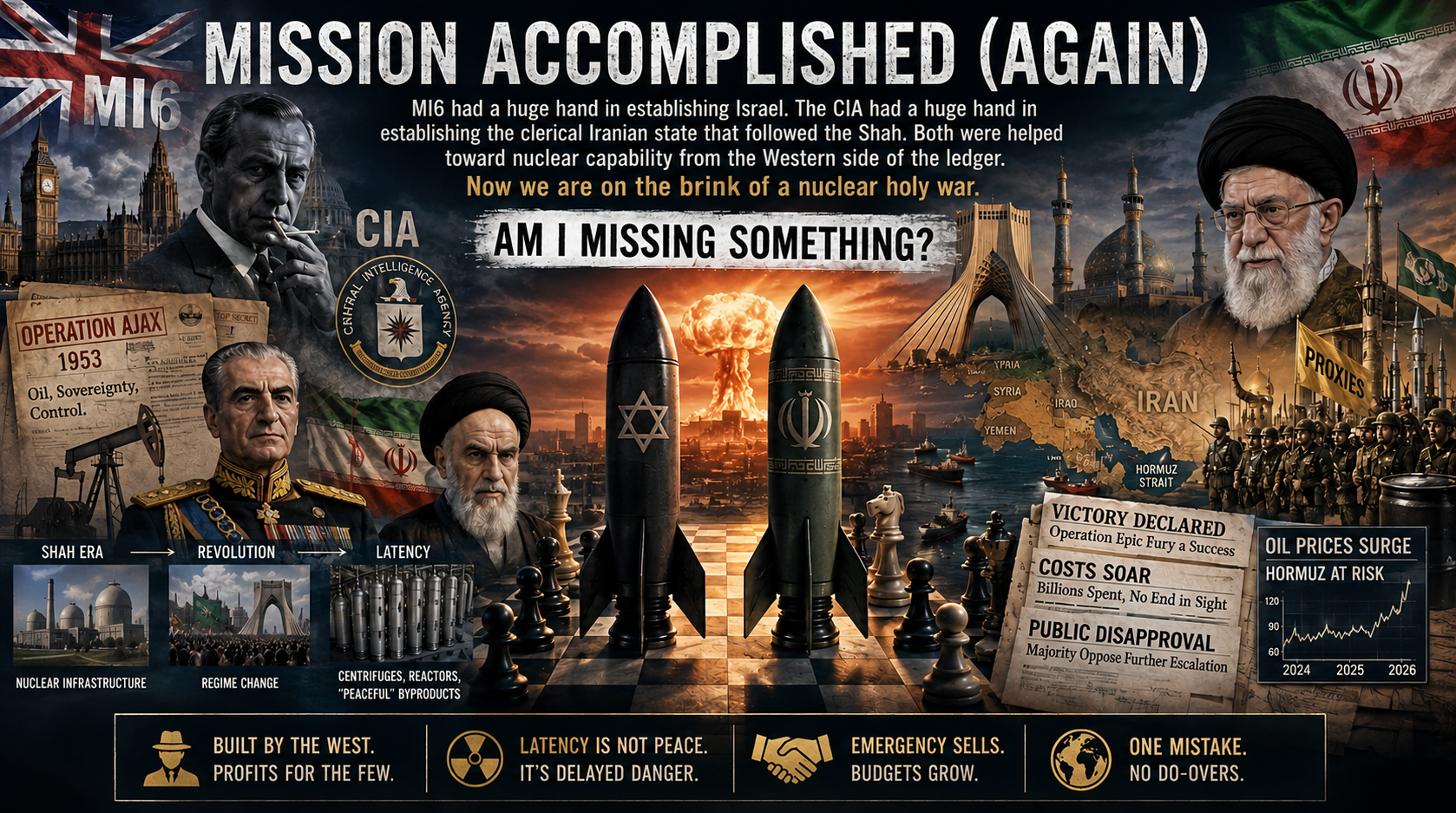
Installment II — Mission Accomplished (Again) tracked the spring headline stack: dual-track diplomacy, asymmetric captions, and who built the nuclear board. This installment asks what changed when the shooting lane finally got a treaty-shaped exit — and why the loudest voices on every side sound like losers.
From spring combat to treaty text
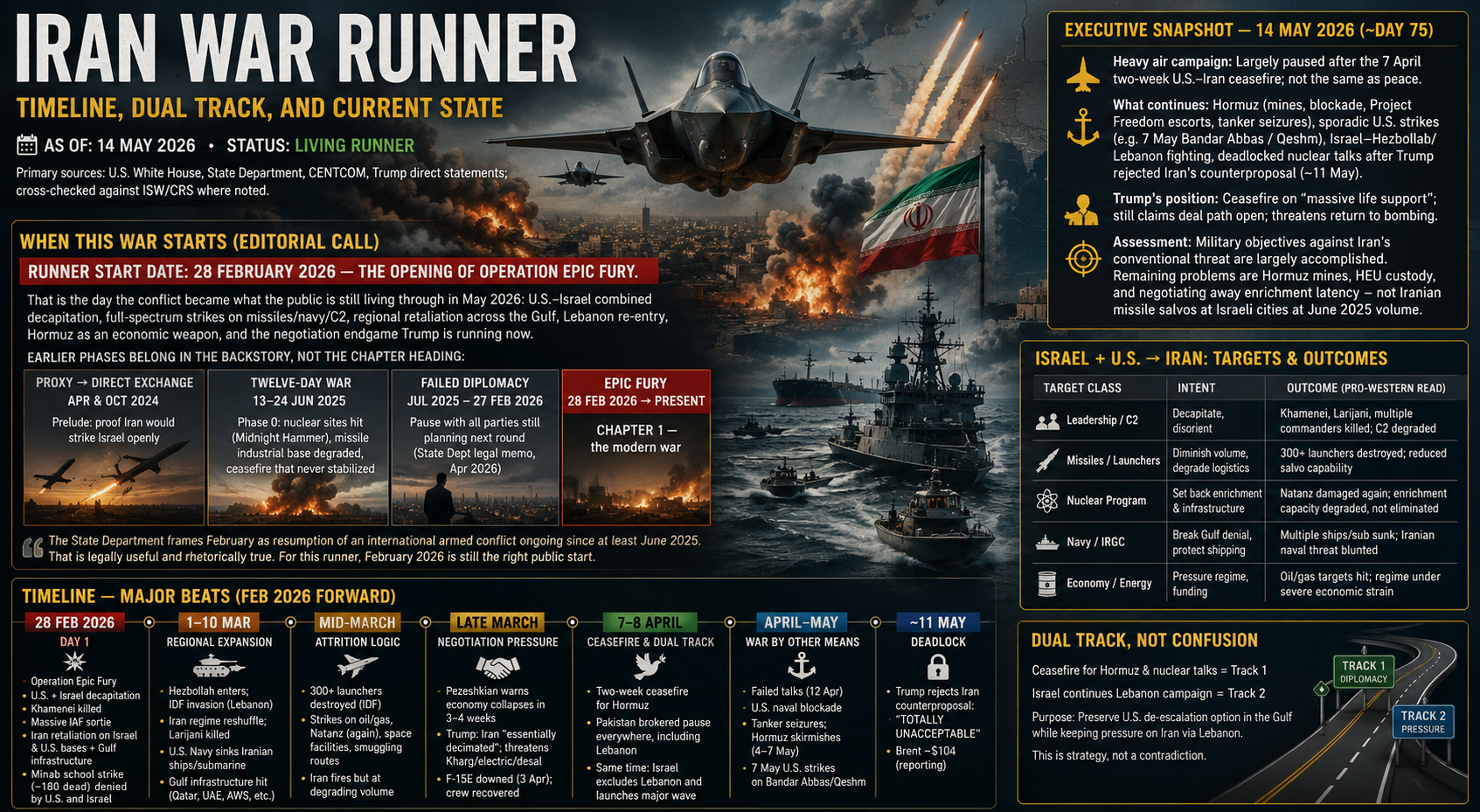
Operation Epic Fury opened in public on 28 February 2026 after a June 2025 legal and material prequel — the strike campaign the runner treats as largely banked before the Islamabad signature (Iran war runner). Through April and May, the same week could host Rubio saying combat objectives were met while NPR and PBS ran price-tag and disapproval meters on the same war — not because one side held all the facts, but because strike tempo, Hormuz blockade politics, polls, and oil fear run on different clocks (Installment II).
That dual-track rhythm matters for reading June 17. A government can truthfully say the conventional campaign met its engineering goals while another desk still writes contingency plans for resumed bombing. The MOU codifies the asymmetry the runner names in late spring: Iran negotiates everything but nukes because enrichment is the last sovereignty card; Washington negotiates because conventional war goals were already banked while HEU custody, Lebanon, and Hormuz administration stay on technical rails (war runner — May–June negotiations).
On June 17, 2026, Trump and President Masoud Pezeshkian signed the Islamabad Memorandum of Understanding under Pakistan-led mediation, with Qatar, Saudi Arabia, Turkey, and Egypt in the broker lane (Wikipedia, NBC). The 14-point text commits both sides to immediate and permanent termination of military operations on all fronts, including Lebanon (AP); opens a 60-day clock (extendable) toward a final peace treaty and UN Security Council endorsement; and sketches Strait of Hormuz reopening, sanctions easing, frozen assets, and oil trade while nuclear technical talks continue unresolved (CNN). Final peace is not achieved at signing — the MOU is an opening bid while implementation talks run.
Reporting around the signing carried fragility in plain English: Trump warned the United States could return to bombing if talks disappoint; Supreme Leader Mojtaba Khamenei endorsed the framework with misgivings (Wikipedia, press summaries). Digital signing steps were reported June 15 via Vance and Ghalibaf before the Versailles/G7 remote ceremony with Pezeshkian in Tehran — the public event is June 17, but the diplomatic file was already moving before cable cut to strike loops again.
What the memorandum does not settle is where the live file still bleeds: a final HEU custody formula, a permanent Lebanon settlement, and a full sanctions repeal schedule all remain in technical talks — the same open seams May negotiators fought over when Iran’s counterproposal demanded reparations, Hormuz sovereignty, and assets while enrichment stayed non-negotiable per Iranian energy officials and Trump called the package “TOTALLY UNACCEPTABLE” (war runner). The MOU stops the shooting lane; it does not erase the latency argument that justified Operation Epic Fury in the first place (State Department legal memo on self-defense and imminence).
Even if this round stalls, the memorandum still sets a precedent that can be repaired and reattempted — an armistice line that fails once but defines the only lane left (LLM investigation §2.4).
Why the media won’t interpret (yet)
Day-to-day reporting on the MOU is real — signing ceremonies, extension clocks, Hormuz reopening talks, Trump’s resume-bombing lines. Editors are not asleep; they are risk-averse. The deal is extremely fragile and shifting: if tensions flare again next week, any outlet that called the hinge “done” gets clipped for credulity. Safer to file process stories and leave meaning to hindsight.
That caution is rational on a 48-hour clock. It still leaves the public without the wider read: if this round stalls, headlines will scream deal failed — and they may be technically right on a clause while strategically wrong on the board. Conventional strike goals were banked before June 17; the Ayatollah proxy lane was broken in the field; the antibody mop-up arc finally has a treaty-shaped exit. An eagle’s-eye view says things have really changed — and they are not about to change back to the pre-2026 holy-war script, even if shooting resumes.
What mainstream desks will not say out loud is the hinge underneath the hinge: the only serious argument that the U.S. incursion was unnecessary requires misreading what a nuclear threat is (see The DU blind spot below). What they also underplay is the cross-ideological unhappiness that makes the deal legible as a real break — not a crowd-pleaser.
Why nobody cares — universal unhappiness as design signature
Author thesis:
Populist fatigue is the tell. Marjorie Taylor Greene — once a Trump loyalist, now a vocal critic on foreign policy — called the framework an “embarrassment” and attacked reported $300 billion reconstruction lines for Iran as “bullsh*t” paid by Americans who already absorbed $2 billion-a-day war costs and pump shock (NewsNation; Anadolu — MTG on Israel and Lebanon strikes). Trump and JD Vance pushed back — unfreezing assets and Gulf-led reconstruction are not the same as a U.S. taxpayer $300B check (Reuters-tier dispute in trade press) — but the fight itself is the story: a Republican base that wanted no foreign wars now watches sanctions relief and Iranian reconstruction language in the same summer as Mission Accomplished banners.
On the Israeli side, war hawks kept the Lebanon lane hot after the MOU’s all fronts language — Netanyahu carving exceptions while Trump sold dealmaker peace (war runner — deliberate dual track). Former Israeli leaders publicly mused that Tel Aviv could have rejected the U.S.–Iran framework (Anadolu — ex-PM on rejection option). Iranian nationalists and much of the Muslim street read relief as humiliation. The contradictions land where you would not expect them if the file were a simple Team Red vs Team Blue war: MTG attacking Trump over money to Iran while Israel keeps bombing Lebanon during a ceasefire Trump brokered.
That pattern is only explainable, in this read, as a choreographed dual-track negotiation system — the same architecture Installment II named for spring headlines, now visible in the peace phase. Public Bibi–Trump friction (Lebanon carve-outs, resume-bombing lines, “legitimate misunderstanding” language) is not mainly incompetence. It is staging: each leader had eyes on the ball — close the Ayatollah proxy lane, reopen Hormuz, break the nuclear holy-war script — while surrounded by war hawks who had to be appeased with sorties and tough talk, and by lawfare actors who had to be appeased with fragility rhetoric and contingency bombing threats so the file stayed inside margins.
Trump and Netanyahu, on this thesis, are the largest sin eaters world history may ever see — leaders who absorb hatred from their own bases so a civilizational hinge can move without admitting in public that the old plan required total societal demolition to finish. A deal everyone loved would have been a deal that preserved enough of that plan to guarantee the next emergency. Nobody caring is what a real peace looks like when the alternative was everyone cheering a script that ended in upheaval.
Sin eaters on the tightrope
The sin-eater frame is not praise. It is structural. Both men had to lie outward to different audiences at once: Trump to America First voters who hate Iranian money; Bibi to never-alone hawks who hate any Tehran lifeline; each to lawyers who need imminence paper and all-fronts ceasefire text in the same week. The MOU is fragile because fragility was priced in — a public object nobody loves enough to riot for or against, which still moves the board. Eagle’s-eye read: universal dissatisfaction plus irreversible board shift can coexist. That is why the media files process and the public shrugs — and why the author treats the hinge as lifetime-scale anyway.
The century-long Iran pipeline
Operation Ajax (1953) is still the cleanest origin story for the modern file: American covert power, with British cooperation, re-seated the Shah and taught Iranians who really owned the oil ledger (Kinzer — All the Shah’s Men). Shah-era nuclear infrastructure survived revolution; the clerical state that followed inherited centrifuges, reactors, and “peaceful” byproduct narratives while functioning as the region’s latency factory — the place where lawyers, admirals, and headline writers share vocabulary without sharing a forecast (CIA investigation — Iran endgame script).
Installment II already traced how MI6 and the CIA helped shape the Israel and clerical Iran poles on the nuclear board (Mission Accomplished (Again)). The monopoly thesis does not require a basement cabal meeting — only aligned incentives: no middle power gets a stable independent deterrent that rewrites escalation rules without Great Power permission. Iran sits on Hormuz, proxy geography, and enrichment that makes neighbors plan bunkers faster than summits.
That is the pipeline the MOU interrupts — not a week of headlines, but a design question running from Ajax through 1979 to 2026 strikes and finally treaty text. The old plan’s endgame, in the antibody read, was never a popular peace; it was managed conflict escalating toward civilizational demolition — the Marxist-upheaval finish the species-virus lane needed. A MOU everyone cheered would have been a MOU that renewed that runway.
The lifetime hinge (author)
This is the biggest world-history event in my lifetime. It will affect everything and everyone. Almost nobody will like how it feels — and that may be the point.
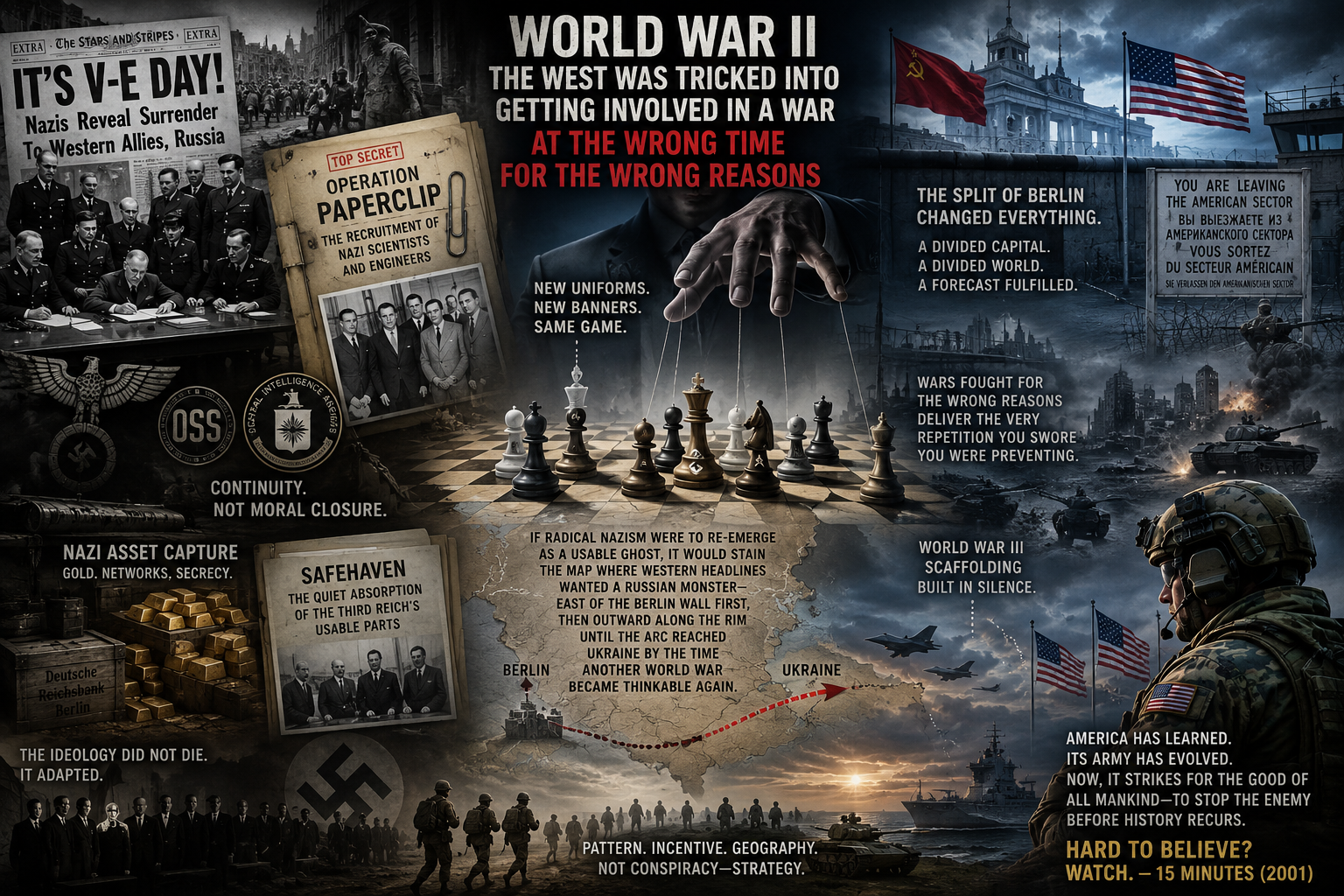
The author compares the MOU to 1945 — America and allies as major winners, others playing second fiddle for a while — with one crucial difference from WWII. In 1945, America was still new to great-power war, hijacked by foreign powers into wars it should have avoided, and mistake-laden through occupation arcs. In 2026, the read is different: America was war-ready, intelligent, and competent; it took out what the author calls the real threat without the dubious G.I. Joe narrative; and the goal was to close a scripted holy-war lane rather than start nation-building forever.
A ceasefire plus talks is still not unconditional surrender. Civilian harm, Minab, the Lebanon dual-track, and HEU custody remain contested (war runner). The author’s claim is civilizational, not moral spotless.
The DU blind spot — science fiction on the battlefield
Author thesis — radiological history and media framing:
For decades Western press treated depleted uranium as either a non-story or a science-fiction sideshow — not the radiological/chemical lane that actually haunted Iraq battlefields after 1991 and 2003, where coalition forces fired hundreds of tons of DU-hardened ordnance and local doctors reported cancer clusters and birth defects (RT — Iraq DU and cancer plague; contested but covered in detail in non-Western and regional reporting where NATO allies often ran denial headlines).
Near Bosnia and across the Balkans, civilians and veterans linked NATO bombing campaigns to what they called an “angel of death” cancer wave — a lane the Western wire largely ignored while regional outlets documented it (IWPR — Bosnians say NATO bombs brought “angel of death”). Bosnian health officials told IWPR that the lack of publicised research into DU’s health effects had bred a climate of distrust: Sarajevo health minister Zehra Dizdarevic noted UNEP called radiation levels “harmless” yet listed 24 cleanup recommendations, while radiology director Lejla Saracevic said no serious research had been funded — so neither doctors nor residents could confirm or deny a DU–cancer link with hard statistics. RT and Balkan legal filings have kept survivor and oncology testimony in circulation when U.S. and U.K. desks treated Balkan syndrome and Gulf War illness as unresolved or psychosomatic (RT — Serbia NATO DU lawsuits).
The author’s read goes further: depleted uranium was in play at Hiroshima and Nagasaki and in many conflicts since — long-term harm attributed to “radiation” in the public mind while the DU toxicity profile (immunotoxic, teratogenic, leukemogenic in peer-reviewed DU epidemiology) does the quieter work. Mainstream history splits enriched bomb mythology from depleted battlefield waste; the author holds that conflation was deliberate cover — and that the same false sci-fi bomb frame is what let Iran’s fatwa and “peaceful” enrichment story pass unchallenged until 2026 (CIA DU/fatwa opinion; nukes investigation — enriched vs depleted).
Policy consequence: If the public only knows mushroom clouds, latency and DU ammunition read as non-threats — until a briefing room needs imminence. The continual Western misreport on depleted uranium, in this thesis, led directly to the Iran crisis: Iran and the world misunderstood what was being built; the media filed it under fiction; the only remaining honest argument against the incursion was therefore never aired at scale.
When one topic vanishes worldwide — without a conspiracy of silence
The Bosnia file is useful because it is documented, not because every health claim is settled. IWPR recorded NATO DU strikes in Hadzici and Han Pijesak, UNEP contamination years later, EU decontamination money never taken up, and sentries walking hot ground who said nobody had warned them (IWPR). That pattern — knowing enough to fear, not enough to prove — is how a single subject can be censored almost everywhere, including most alternate press, without a grand coordinated silence.
The author read spans fear, profit, and ignorance in layers. WWII was so horrific that only profitable narrative details could be capitalized at scale — the Holocaust memorial industrial complex is the obvious example — while unprofitable contradictory details (radiological waste, occupation toxins, ally war crimes, DU-class harm) were extremely dangerous for any editor, scholar, or veteran to put out. Raising them reopens old wounds, reasks old questions, and challenges the victory narrative; funding cleanup or epidemiology is therefore unprofitable even when contamination is admitted on paper. Many people are simply too afraid to unlock the truth of the past; many more never knew — guards on contaminated bases, Iraqi villagers, Iranian engineers reading fatwa copy while latency accumulated.
That is the DU blind spot in institutional form: not only Hollywood fission in the headline, but a worldwide incentive to treat depleted battlefield waste as boring, disputed, or closed — until the misunderstanding detonates in the next war file. This installment’s full argument and source table live in the Islamabad peace deal investigation §2.1; the science/nukes cluster carries the radiological mechanics (nukes investigation — enriched vs depleted, Galen Winsor / waste-is-safe, Marie Curie / narrative flattening).
The Ayatollah proxy — both sides thought God was backing them
Author thesis:
The Iranian proxy called the Ayatollah was never something ordinary good Iranians controlled. It was built into a system where faith meant Allah backed Iran against Israel — while Israel mirrored the same certainty: God backed them against Iran.
The author’s read: the West knew one side would eventually drag the world into nuclear holy war.
H. G. Wells foresaw that Islam would become a world problem requiring action — Wells’s dating is off (predictions cluster around 1979, the Ayatollah’s rise, rather than 2026 end), but the shape rhymes: a future civilizational intervention (good-actor investigation §80-year arc).
Worldwide, the Ayatollah’s fatwa against nuclear bombs (haram) was taken at face value — governments, media, and much of the Iranian public assumed the regime would never violate its own religion. The blind spot is the DU blind spot above: depleted uranium treated as an innocent byproduct of a peaceful program while latency accumulated in plain sight. The policy consequence landed in spring 2026 when latency read as imminence in the briefing room (IAEA chief on material “still there, in large quantities” — CBS; CIA author opinion: fatwa and DU).
The CIA investigation also names an end-game script in author thesis: selective “revelation” that Iranian proxies could receive actual nuclear weapons, justifying a full-scale civilizational war — the Hollywood bomb as narrative cover while the boring byproduct lane did the work. 2026 and the MOU are what break that lane in the author’s read — not because everyone loves the West, but because the chessboard demanded it before the script reached its finale.
Antibody theory — why the wars are finally ending
The wars were set in motion by a linchpin — and that same linchpin type, when flipped, can end them rapidly.
Ellsberg and the loyal analyst trap
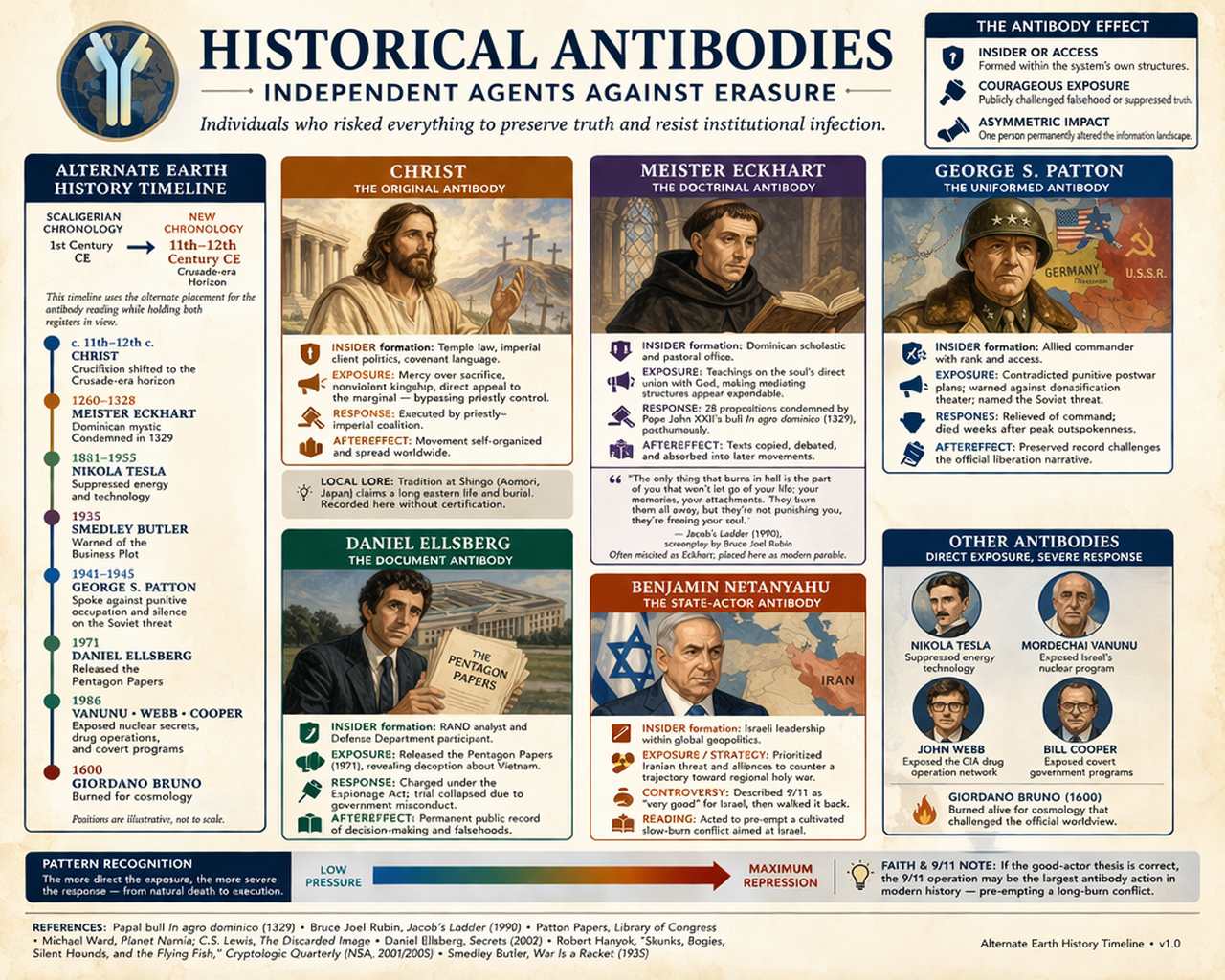
Daniel Ellsberg and many Western analysts discovered — often late in career — that America was executing horrible CIA plots worldwide, continuing what the British Empire left unfinished. The trap: they only saw files because they were trusted and loyal. To speak meant betraying everyone — colleagues, clearance, even spouses.
Ellsberg spoke anyway. The Pentagon Papers case collapsed partly because the government broke into his psychiatrist’s office — and the judiciary stopped the prosecution (NYT May 11, 1973). Document plus conscience — that is the antibody pattern. The same historical antibodies chapter names Robert Hanyok, the NSA historian who fought 2002–2005 to declassify proof the second Gulf of Tonkin attack did not occur — SIGINT skewed to sell war while the public got a casus belli (historical antibodies timeline). Two eras, same architecture: trusted insiders who used documents to break a war script.
Proxy terror as counter-play
On the good-actor read, the species-virus lane (CIA–MI6 slow-burn holy war) cultivates militancy to ignite civilizational war over decades. Antibody factions copy the method — armed proxies, militant franchises, off-book task forces — because the alternative is letting the infection finish on schedule. The copy is meant to do minimal damage relative to the full plan: pit radicals against radicals, force an early public War on Terror, accept ugly bounded carnage rather than total demolition. Minimal does not mean clean; proxy war still poisons cities and leaves blowback doors open — but it is the calculus when the enemy wins on technicality if counter-players insist on Queensberry rules behind closed doors (good-actor investigation § I — proxy minimal-damage copy).
Hollywood rehearsed the syllogism in Ghost War (2026): a post-9/11 task force arms terrorist proxies to wipe rival cells — then hangs the logic on a villain named Crown so audiences reject the tactic while the news desk still runs the live version (Ghost War article). That is why predictive programming must contain in memory before Iran 2026 headlines peak: if the public credits a working proxy-on-proxy antibody strategy, the slow-burn pipeline loses its alibi.
9/11 — NSA, Israel, and the destruction of the slow-burn plan
Author thesis (synthesis across linked investigations):
9/11 was the moment Western NSA-aligned analysts — also aligned with Israel in this read — made their final play to destroy the slow-burn holy war plan forever. The Deep State script, in this frame, was slow-and-go: infiltrate religions and regimes, then simulate spectacular terror after the geometry set. The counter was an early trigger on U.S. soil, televised — a public War on Terror instead of covert civilization burn; Building 7 destroyed the CIA NY station (09-11 investigation); and the mop-up of CIA motion across the Muslim world began in daylight. Democracy, on this reading, only functions in the open; covert decapitation would have left the story deniable forever.
The Tron theory names NSA’s SIGINT lineage as antibody architecture against HUMINT proxy war — a watchdog inside a communications grid almost nobody without clearance can see (NSA investigation § IV).
Everything since 9/11, in this frame, is mop-up — ugly, televised, expensive — rather than the original organic hatred of peoples.
Islam awakening — redacted religion and divided shards
Author thesis — speculative, not adjudicated here:
For centuries in many regions, Muslim, Jew, and Christian lived under liberalistic coexistence — commerce, law, mixed neighborhoods — without the modern hard partition myth. After the destruction of the Russian Empire, it became possible to tell the remnants of the Ottoman world a lie: that they were a separate civilization island — cut off from China, cut off from Russia, destined for endless desert war and mysterious cubes of worship instead of shared history.
Divide-and-conquer did not stop at borders. The West (especially the British Empire — which the author reads as a filled vacuum after the vanquished Russian Horde lineage, sworn enemy for centuries) taught fractured societies to attack indigenous faiths in their own neighborhoods.
The Bamiyan Buddhas were dynamited in March 2001 (UNESCO) — a message that Buddhism was not welcome, holy war against pre-Islamic sacred geography. The Armenian genocide (1915–1917) — Ottoman mass killing and deportation of Armenians, widely recognized as genocide in scholarship and many states (US Holocaust Memorial Museum) — marks systematic extermination of a Christian minority inside a Muslim-ruled empire. Colonial mission-and-divide patterns across Africa and elsewhere extend the same British-shaped fracture playbook in the author’s read.
Muslims may begin to see their tradition as heavily redacted and modified — set against itself in holy wars, told to strike neighbors who were once allies, while proxies (like the Ayatollah system) spoke for Allah in wars ordinary Iranians did not control.
The charge targets capture, not faith as such — the same capture the antibody theory describes for every religion the species-virus lane infiltrates.
The chessboard — why the West backed Israel
Author synthesis — not a moral endorsement of every strike:
Backing Israel and eliminating the Ayatollah existential threat, in this read, prevented Israeli panic war, removed Iranian proxy theology, and risked tens of thousands dead — with the MOU now on the table. Backing Global South / Russia and isolating Israel, by contrast, likely meant regional war with an Israel that holds nuclear weapons — escalation unbounded.
Trump’s repeated insistence — understand reality on the ground, not idealized narrative — fits that geometry: no negotiation has ever persuaded Israel to treat its territory as negotiable; Muslim capitals, in this frame, would accept nothing short of Israel’s elimination. All prior peace processes failed on that map. The Islamabad file is the first that succeeds politically while pleasing almost no one — see Why nobody cares.
Religion as factor (author read, contested):
Christianity’s public face stays peaceful; Crusades are remembered but rarely centered in modern preaching; war is admitted as sometimes necessary and avoided by default. Judaism and Islam carry Old Testament and Quranic war memory more present in political identity — circumcision covenants, tribal betrayal stories, martyr lanes. In WWII, Jews were major victims; Muslims split — some allied with Russia/Mother narratives, others taught zero connection to Moscow or mosque–Russia history; Muslims fought Muslims in WWII.
Final strategy (author): prevent Israel from becoming irreversibly warlike by removing its largest existential threat — the religious Ayatollah — in a way that attempted to limit world war, knowing many tens of thousands would still die.
That sounds like a war narrative. The author insists it is Earth history — what happened.
What comes next — rebuild, resentment, Matrix peace
Best-case author read:
Lasting final treaty beyond MOU. Major rebuilding — Gaza, Iran, Lebanon, other shattered regions. Trade reopening — Hormuz, sanctions relief (NBC).
A domestic lane easy to miss in strike coverage: if the war-on-terror emergency arc loses political cover, the justification for Bill of Rights suspension weakens with it — Patriot Act habits, FISA bulk programs, border exceptions, and wartime AI integration were normalized under permanent-emergency framing after 9/11 (LLM investigation §2.2.1). Peace maintained is not automatic Fourth Amendment restoration; it is a re-challenge that must be paired with concrete sunset demands — expire emergency surveillance authorities, demilitarize domestic AI pipelines — rather than rebranding wartime capability as peacetime “AI governance” (LLM investigation §2.2).
The same dossier ties Hormuz and sanctions relief to a free-trade inflection: harder for any single vendor stack to capture all competition when global south markets, open-weights shocks, and bilateral trade lanes reopen — dystopian lock-in requires monopoly of substitution, not merely a bad default app (LLM investigation §2.1.1). Education after the war cycle — autodidactic defaults, labs over lecture halls — sits in that downstream window (Responsibility to the Next Generation).
Unhappy outcomes (author expects many — and treats as signature, not accident):
The dissatisfaction catalog from Why nobody cares continues downstream: Muslim world disillusionment with clergy and proxy states; Western left and diaspora anger at imperial peace; Israeli hawks unsatisfied; Iranian nationalists humiliated; Great Power second-fiddle resentment. If every faction were content, suspect the old plan still running.
In the words of the Matrix Oracle: expect the peace to last “as long as it can.”
Adult forecasting — the MOU is necessary, not magic.
Where next
Series — Iran 2026
- Mission Accomplished (Again) — Installment II: media split, nuclear board, spring 2026 ledger
- This article — Installment III: Islamabad MOU, universal unhappiness thesis, sin-eater dual track, antibody close
- Iran war runner — dated MOU timeline; Bibi–Trump dual track
- Islamabad peace deal — investigation dossier — §2.2 universal dissatisfaction, §2.1 DU blind spot, claims registry
Antibody / agency stack
- Good-actor theory — interagency antibody, 9/11, 80-year arc
- CIA investigation — Iran pipeline, DU/fatwa, Jun 2026 MOU extension
- NSA investigation — antibodies, Iran pipeline
- 09-11 investigation — WTC 7 CIA station
- Ghost War — Hollywood antibody containment (Installment context)
Downstream
- LLM governance investigation §2.4 — MOU → war-on-terror sunset, AI governance demobilization
- Responsibility to the Next Generation — education after the war cycle
- Nukes investigation — enriched vs depleted, Hiroshima health read
Framing and limits
Prisca sapientia (epistemic foundation): This article assumes prisca sapientia—the belief that the ancients possessed a vast, profound understanding of the universe, nature, and theology that was subsequently lost or degraded. Modern consensus is not default truth; linked dossiers tier specific claims.
Islamabad MOU facts are documented (NBC, AP, CNN, Wikipedia). MTG and Israeli hawk reactions are press-tier (NewsNation, Anadolu, trade press); $300B reconstruction figures are disputed (Trump/Vance vs Greene). Antibody theory, British/Russian Horde vacuum, Islam redaction awakening, 9/11 good-actor read, Ayatollah proxy, chessboard religion comparison, WWII-scale hinge, universal dissatisfaction as peace signature, Trump/Bibi sin-eater dual track, old-plan Marxist-upheaval finish, Hiroshima/Nagasaki DU cover-up, and Western DU misreport → Iran crisis are author thesis — synthesized across linked investigations, not proven by MOU text. RT and IWPR citations are regional/alternate-press reporting on DU health claims — contested by NATO/WHO-style assessments; included as media-coverage contrast, not as settled oncology. Bamiyan destruction is Mar 2001 (UNESCO), not 1999. Armenian genocide — scholarly/historical consensus cited via USHMM; denial persists in some states. Israeli nuclear arsenal — undeclared but widely reported; not confirmed by MOU. Interpretive history and geopolitics — not legal counsel or religious fatwa guidance.
Investigation Limits — full claims registry.
Keywords: #IslamabadMemorandum #IranPeaceDeal #2026 #AntibodyTheory #HolyWar #Ayatollah #MissionAccomplished #DivideAndConquer #Ellsberg #NineEleven #DepletedUranium #SinEater #DualTrack #ParadigmThreat
Substack: paradigmthreat2.substack.com/p/the-peace-deal-nobody-cares-about
Last updated: 2026-06-24T00:00:00-04:00
Written and narrated by Ari Asulin, with drafting and research support from LLM agents.
Share