
TONA, Not War — Liberty’s Rebrand
The original Thirteenth Amendment was erased and replaced with a mass-incarceration amendment sold as slave liberation.
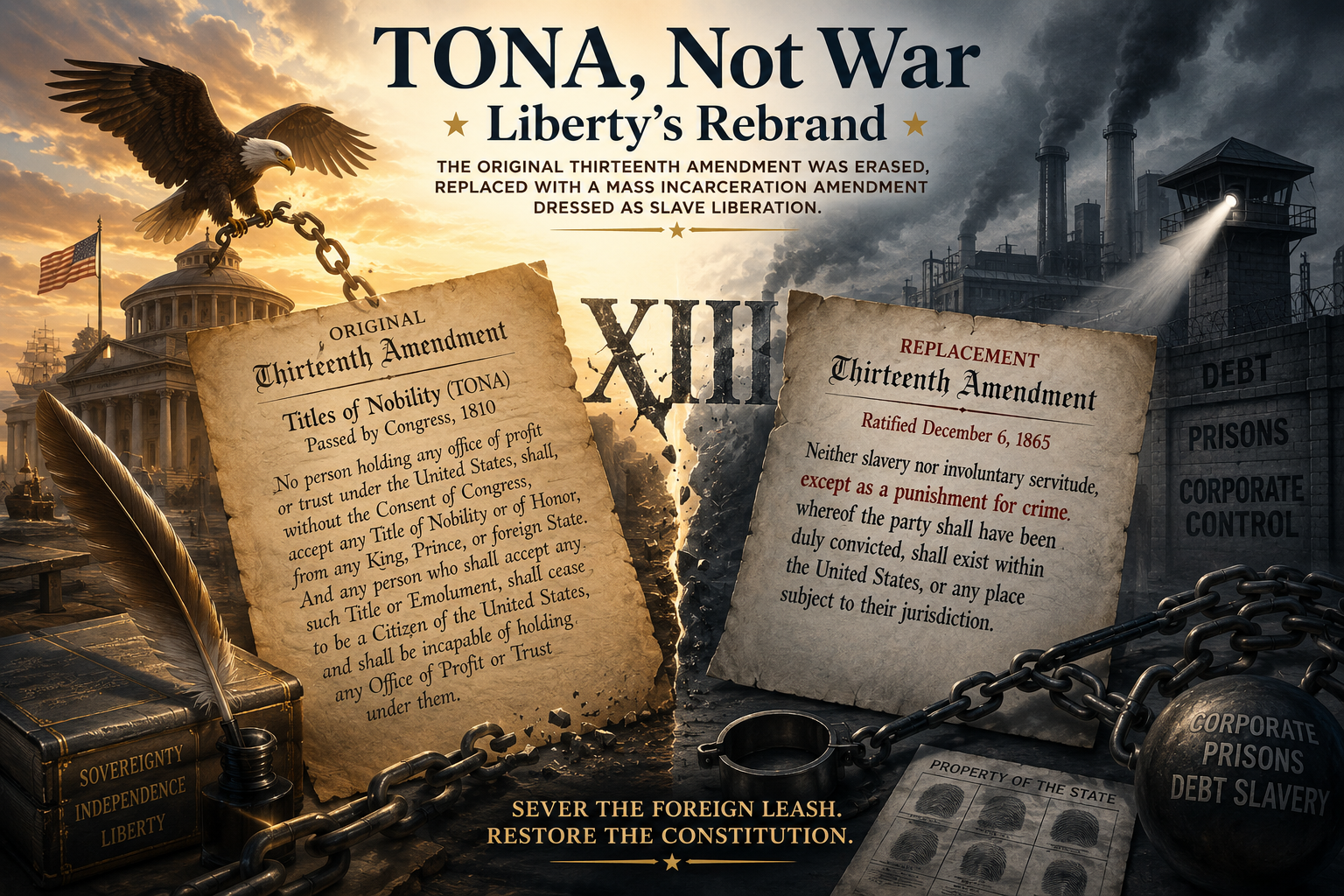
Before the muskets of 1861, there was another Thirteenth Amendment — not the carceral text children memorize today, but Titles of Nobility (TONA), passed by Congress in 1810 with near-unanimous votes in both chambers. It said that any citizen who accepted a foreign title, pension, or emolument from a king or emperor would cease to be a citizen and could hold no office. That is a nationalist firewall: cut the overseas aristocracy off from owning American officials, law, and labor through the old imperial hooks of honor, debt, and patronage.
I hold that path would have abolished slavery as it was then practiced — by severing the ownership chain through British and French credit, imperial courts, and titled agents, not by moral slogan alone — while indentured servants aged into belonging through local law, without a war that opened the parchment for serial surgery. What followed abuses the amendment premise itself: starting with the 1865 carceral Thirteenth that replaced TONA in the numbering, every amendment through XXVII is frivolous at supreme-law height, work that belongs in Congress, or a patch for crises and incomplete prior amendments — XIV birthright, Liberty in 1886, XV–XVI and the Fed, the rest still moving the board. The Constitution was not meant to be amended this way; I hope within my lifetime to see everything beyond the Twelfth rescinded and TONA restored as the true Thirteenth in place of the replacement slave amendment. June 2026 — Trump v. Barbara, Barrett with the Roberts–liberal bloc striking a birthright executive order — proves the 1868 text is still the live battlefield.
What “slavery” meant before the war
Plantation deeds were only the visible layer. Pre-war bondage often ran through credit, imperial law, and aristocratic titles — the same geometry the American Revolution investigation names when it notes slavery was preserved at founding, and the US Civil War investigation traces when it notes British funding and slavery as instrument, not sole cause. Officials who took pensions from London or Paris were not neutral brokers; they were nodes in an ownership network that could treat American labor as someone else’s property under someone else’s law.
TONA targeted that spine directly. Strip citizenship and office from anyone on a foreign titular leash, and you break administrative ownership without a battlefield. That is indirect abolition — I read it as disconnecting the imperial ownership chain, not as a classroom fable about one moral amendment ending all chains.
TONA — abolition by disconnect
The 1810 text is blunt: accept a title or emolument from a foreign power, lose citizenship and office. I read TONA as not a snap reaction to any single headline — the brewing constitutional answer to a decade of watching Napoleon consolidate inevitable world takeover. From the Consulate through the Continental System, the Atlantic read was the same: a modern emperor was wiring titles, pensions, and emoluments through every court that could reach American officials. Congress moved in 1810, two years before the 1812 invasions of Russia and the parallel US–Britain war — not because Moscow forced their hand, but because the Napoleonic arc already looked unstoppable. The text targets every foreign power, not France alone; the timing tracks a slow-building Napoleonic zenith, not Waterloo’s aftermath.
Beethoven had already seen it in 1804, when Napoleon crowned himself emperor and the composer revoked his Eroica dedication — allegedly raging that Napoleon would trample human rights and become a tyrant, not the liberator the symphony had saluted. That mood brewed for six years before TONA; after 1812–1815 — Moscow, Leipzig, Waterloo, Vienna — faith in the emperor-as-liberator collapsed more widely, and titles and nobility looked dead as a living political technology. TONA could be forgotten without fanfare because crowns seemed obsolete. The trap: the French were not the only European influence in America. British credit, pensions, and finance hooks persisted — and other powers wanted TONA gone because it barred their emoluments too. Forgetting the original Thirteenth after Napoleon’s fall was misleading peace; foreign capture lanes survived under law and debt without visible crowns.
In the shadow of Britain, TONA was still anti-imperial law at constitutional strength. TONA appeared as “Amendment XIII” in Statutes at Large, pocket Constitutions, and Virginia’s code for a generation — then was memory-holed when a different “Thirteenth” was ratified in 1865. Whether Virginia’s 1819 republication act completed ratification remains disputed; the functional erasure is the same either way. A nationalist anti-nobility amendment was replaced in the public mind by one sold as liberation.
Indentured servitude — time-bounded contract, path to freedom in many cases — could have resolved alongside that firewall through local law and time, not military Reconstruction districts.
The deep-state seesaw — WWZ through WWIII
I read the last few centuries as a rocking motion — a seesaw back and forth — driven not by bottom-up organic consensus but by source-side agenda pressure: pursue a world-ruler vehicle, watch it fail, reverse course, and repurpose toward Plan B while sentiment and law prepare asynchronously for the next conflict wave. The result comes from the source, not the destination. Pressure on Haiti was source-imposed — colonial slavery and French imperial restoration — not something Haiti generated for itself. The Haitian Revolution was destination human agency, obviously real, but it would not have happened without that imposed pressure. When Napoleon’s Caribbean Plan A broke, he sold Louisiana (1803) — I read that as source Plan B: hand North American terrain to Anglo-American development for what direct French imperial rule failed to do later.
1812 was World War Zero — WWZ — Napoleonic world conflict at full scale, parallel US–Britain war, never counted in textbooks as a world war though it clearly was. Without renumbering the conventional wars: WWZ, then WWI, WWII, and WWIII — which I hold opened with the buildup to Russia taking Crimea (2014), invasion-accusation pretense for world-war footing, accelerated by Iran/Israel fallout in the live arc. Each beat follows the same geometry: Napoleon, then Axis hegemons, then unipolar intake — each blocked by nationalist anomaly in the target country — so the source pivots to parchment, terrain, and bodies instead of a single throne. TONA was the nationalist firewall brewing in the WWZ seesaw; the 1865/1868 pair and everything after are later repurposing waves. I develop the full table, tiers, and falsifiers in the investigation’s §2.8.
The path not taken vs the war
The Civil War was not the only door to less bondage. The Corwin Amendment of 1861 — never ratified — would have forbidden any amendment interfering with slavery where it existed, proving the Union still offered a no-abolition stay path even on the eve of war. War cleared the board: it let a replacement Thirteenth occupy the number TONA had held in print culture, and it foreclosed the peaceful indentured path in favor of federal jurisdiction and a felony exception.
I read the war as a runner-up installment in a human-trafficking geometry — not the finished pump. Parchment came first; mass intake lagged. In January 1865, General Sherman’s Field Order No. 15 redistributed Confederate-held coastal land in South Carolina, Georgia, and Florida to freed Black families — the “forty acres” promise, property taken from white Southerners — before President Andrew Johnson reversed it later that year. That is on-soil demographic shock without yet achieving harbor-scale replacement.
1865 XIII was unnecessary on the TONA-disconnection path and actively tangent — a globalist fix for centralization and population policy, not the nationalist sovereignty settlement that would have avoided titles, foreign emoluments, and soil-based citizenship manufacture.

The pair that replaced TONA
The Thirteenth Americans learn in school bans private chattel slavery except as punishment for crime. That exception is not a footnote; it is a constitutional labor pipeline. Black Codes, convict leasing, chain gangs, and modern mass incarceration all sit on the same sentence — documented in Reconstruction historiography, contested only at the edges of how “narrow” drafters meant the clause to be.
The Fourteenth followed as the demographic lock. All persons born in the United States, and subject to the jurisdiction thereof, are citizens — jus soli constitutionalized while most nations use blood or hybrid rules. Pair carceral extraction on dissidents and the poor (Track A) with birthright intake of center-aligned new citizens (Track B), and you get the replacement cycle I diagram in the investigation’s §7.2: pluck, cage, dilute, repeat.

Foreign influence did not vanish; it was enshrined subtly. Once citizenship is soil-based at constitutional depth, no ordinary statute can bar what papers already guarantee to the world.
Parchment plus bodies — the two-part scheme
Watering down sovereignty in the Constitution was only half the process. The other half required actually getting people into the country — and that was not happening at the pace the geometry demanded. Track B birthright is useless without bodies on soil. The 1865/1868 pair wrote the demographic lock; mass movement lagged for decades.
Then intake arrives in pulses tied to world conflict, often despite formal restriction. After World War I, the Emergency Quota Act (1921) and National Origins Act (1924) heavily restricted immigration — yet XIV had already promised on paper what statute still throttled. During the Spanish Civil War (1936–1939), the U.S. stayed restrictionist; modest refugee streams still entered — war exports people, and selective absorption happens even behind gates. World War II and its aftermath brought the Bracero program, Displaced Persons Acts, and post-war settlement at scale — the first modern volume match for birthright demography. The late twentieth and twenty-first centuries added Cold War refugees, GWOT, 2010s–2020s asylum surges, and parole and charter lanes — each conflict wave pushing critical mass harder.
The objective: repeat at constitutional scale what European settlement achieved against Native Americans — demographic critical mass that replaces a prior population’s grip on place. XIV constitutionalized the mechanism; wars and refugee cycles supply the bodies — slowly at first, faster when world conflict opens the valves. I develop the full chronology — including Sherman’s 1865 land shock — in the investigation’s §4.4 and §7.2.
The citizenship mistake
Who belonged in America before 1868 was known in place, community, and state law — not in a drifting federal category. Writing “citizen” into the supreme text invited centuries of reinterpretation: Wong Kim Ark (1898) separated soil birth from parental immigration status; 2025–2026 birthright executive orders and litigation carried the fight to the White House and the Court.
I believe the mistake was defining citizenship at all. The term became the drift engine — exactly what happened across 158 years, ending in Trump v. Barbara rather than in a quiet border consensus.
Liberty’s rebrand (October 28, 1886)
Eighteen years after the Fourteenth, France’s gift was dedicated in New York Harbor — October 28, 1886, on Bedloe’s Island, atop the star-fort geometry of Fort Wood. Frédéric Auguste Bartholdi had first sketched the colossal female figure for an unbuilt Suez Canal lighthouse — Egypt Carrying the Light to Asia — before repurposing the design when the Suez commission failed. The East–West organic bridge vision was lost; the harbor intake monument remained.
Emma Lazarus wrote The New Colossus in 1883 — “Give me your tired, your poor…” — but those lines were not read at the 1886 dedication, and the bronze plaque did not join the pedestal until 1903. That gap strengthens my read. October 1886 could not have publicly consecrated worldwide harbor intake in those words — a 1886 ceremony that promised the liberty of foreigners at scale would have provoked backlash from Americans who still understood the statue as liberty for Americans: Reconstruction won, Union preserved, American emancipation and American citizenship in the air, not an open-ended invitation to replace or dilute the native population. The intake poem had to wait — added seventeen years later, after the 1865–1868 pair was emotionally settled and immigration waves had normalized, when attaching tired/poor/huddled masses to the pedestal was less likely to stop the dedication in its tracks.
Today the poem is the statue in the public mind — retroactive branding. 1886 still marks public consecration of the carceral Thirteenth and birthright Fourteenth amid mass immigration (promised land investigation). Children learn Liberty, the Lazarus plaque, and the “bravest Thirteenth” as one package, while the TONA Thirteenth vanishes from the canon.

The amendments that would never have happened
If the war and the 1865/1868 pair had not occurred, most later amendments would not exist — the Constitution would not have been opened for serial wartime surgery. The Fifteenth (1870) was unnecessary on the TONA path; I read it as federal voting capture and fraud infrastructure at scale, not neutral liberation.
Without that opening, the Sixteenth income-tax amendment of 1913 — paired in the same year with the Federal Reserve Act — is almost unthinkable as constitutional text. The Eighteenth Prohibition amendment becomes an authoritarian rights contraction; documented Prohibition-era denatured alcohol policy killed thousands when industrial spirits were poisoned to deter diversion — public policy, lethal and known. The Nineteenth lands in the same cascade logic as the Fifteenth: franchise expansion as federal election capture, not an anti-woman editorial.
Amendments XX through XXVII are small text with high consequence: lame-duck timing, DC electors, poll-tax bans as federal election wedges, succession continuity, eighteen-year-old franchise under Vietnam stress. The parchment is horribly corrupted and heavily modified, with opaque circumstances especially during wartime.
Beyond the Twelfth — every post-1865 amendment abuses the premise
The framers left an amendment process in Article V, but the living document was not meant to become a serial patch repo — a place to bolt on whatever crisis politics could not finish in statute. I hold that every amendment from the 1865 Thirteenth forward abuses that premise: not because amendment is impossible, but because these texts are frivolous at constitutional scale, belong in Congress, or exist only to patch holes left by earlier emergency amendments and wars.
Three failure modes repeat from 1865 through XXVII:
Frivolous elevation. Moral fashion, franchise gestures, and procedural trivia written at supreme-law strength — XVIII Prohibition, XIX bundled with the same cascade logic as XV, XX lame-duck housekeeping — when the republic already had statutes and state law for most of it.
Congress’s work, not parchment’s. Income tax (XVI), election machinery, immigration-adjacent citizenship categories, and federal voting enforcement (XV, XXIV, XXVI) — these are policy questions for representatives who stand before voters, not permanent constitutional entrenchments that outlive the crisis that excuse them.
Patch amendments. XIV “fixes” the incomplete logic of XIII; later amendments fix or extend Reconstruction’s unfinished business; each layer assumes the prior emergency text was legitimate and cements it further. That is how a closed constitution becomes an open wound.
The 1865 Thirteenth is the pivot — the replacement amendment that orbited into the slot TONA once held: the carceral slave amendment sold as liberation while preserving involuntary servitude on conviction. Everything after it inherits that spoiled numbering and spoiled logic.
The 1787 Constitution was never clean — it was a tainted, corrupt document from the start, and the twelve amendments through XII are the receipt. The very existence of amendments proves the flaw: a republic that needed serial surgery at supreme-law height never possessed a perfect constitution that could stand without later patches. This country should have written it right once — a frame that did not require amendments afterward. It did not, because the seesaw between the two camps kept rocking the parchment.
Given that failure, the best thing the pro-national camp could possibly have done for itself was to forge the Bill of Rights and then seek refuge inside it — a hardened inner ring of liberties — while the globalist camp kept amending the outer shell around them. Until XIII–XXVII can be stripped and TONA restored, that inner ring is where I still look for footing — not surrender, but the ground nationalism can hold while the outer shell keeps moving.
Deep State’s purest fingerprint — the Sixteenth
Congressional power to tax incomes sounds technical. In context it is the 1913 cluster — income tax plus central banking — that the usury dossier treats as the debt-and-finance stack the founders’ coining clause was meant to resist. Bill Benson’s The Law That Never Was argued state ratification returns contained textual discrepancies; courts from Brushaber onward reject that lane as frivolous. I still read the Sixteenth as improperly ratified — clerical errors ignored, nobody wanted it except insiders — the purest Deep State fingerprint on the scorecard: small focus, civilizational leverage.
Religious and usury traditions treat interest extraction and income taxation as deep evils in ways the original Constitution never authorized. Whether one accepts that moral frame or not, the 1913 double hit is the lever that matters.
Prohibition’s poison — the Eighteenth
Prohibition was sold as moral uplift; constitutionally it was a severe rights limit unrelated to the founding frame. When diversion of industrial alcohol threatened the ban, regulators denatured spirits with methyl alcohol; historical summaries cite 10,000+ deaths. Government knew the poison was lethal; the policy was public. I read that as authoritarian corruption atop documented poison policy — history with teeth.
June 2026 — the bell still ringing
The Eighteenth was not the last swing of this seesaw — only the last one textbooks still narrate by name. I got it watching the 2020s: the replacement cycle kept ringing well within my lifetime and into the present. President Trump’s 2025 day-one executive order denied citizenship to children born here to parents in unlawful or temporary status. Trump v. CASA (June 2025) narrowed nationwide injunctions against it. For roughly a year the Fourteenth Amendment stayed the live battlefield — filings, enforcement fights, intake geometry — until the Court handed down Trump v. Barbara.
On approximately June 30, 2026, the Supreme Court decided Trump v. Barbara, striking down that executive order. The vote was 6–3: Chief Justice Roberts joined Justices Sotomayor, Kagan, Amy Coney Barrett, and Jackson in holding the order violated the Fourteenth Amendment. Justice Kavanaugh concurred on statutory grounds — also invalidating the order while suggesting Congress might legislate exceptions. Dissent came from Thomas, Alito, and Gorsuch with a narrower citizenship read; Justice Alito’s dissent explicitly rejected conferring citizenship on “birth tourists” who arrive solely to deliver and leave.
This is 1868 text adopted under dubious circumstances meeting globalist enforcement in open court — the payoff line the replacement cycle predicted. Barbara closed the executive lane for now; the underlying XIV geometry did not.
July 1, 2026 — Vance: “She made a mistake”
The controversy did not end at the courthouse. On July 1, 2026, Vice President JD Vance told reporters he believes Justice Barrett made a mistake joining the majority. His example is the Track B geometry I have been tracking:
Do I think she made a mistake in the ruling? I do. I don’t know how anybody can say that if a person who is an illegal alien or a person, for example, who’s pregnant and comes to the United States on a vacation, they have a baby and all of a sudden their entire family gets the benefits of American citizenship. I don’t think that’s what the framers of the 14th Amendment had in mind.
Vance said the administration would try to correct the ruling — and added that nobody’s perfect, including the Supreme Court. A day earlier he had called the decision a “major mistake” that invites people to “come here quite literally on a vacation, give birth” and win citizenship for the child and family. On Fox he framed the closeness of the vote as proof birthright “is hanging by a thread” — though the documented holding was 6–3, not the 5–4 he cited in one clip. Even the administration’s own appointees split, and Republican leadership is now arguing in public that vacation birth → family permanence is absurd under any originalist read of 1868.
I agree with Vance’s “mistake” framing as the primary Republican read: Barrett misread the Fourteenth — vacation birth → family permanence is absurd under any originalist read of 1868, and the ruling should be corrected by legislation or a future case. Kavanaugh also struck the order on statutory grounds; Trump appointees were not united on a nationalist win.
Taxpayer bus, fly, and house — not just walking
The Liberty pedestal plaque (1903) sells tired and poor. Documented birth tourism sells package deals to affluent clients — Chinese and Russian maternity hotels in Southern California and Miami, $15,000 to $100,000 fees, visa coaching, and hospital billing games. Federal indictments describe wealthy clients paying operators then sometimes claiming indigence at the hospital. That is not the destitute refugee the harbor statue was retrofitted to mean when Lazarus’s plaque went up in 1903.
Intake by public money is extensively documented — not a viral exaggeration. Federal: FEMA’s Shelter and Services Program moved hundreds of millions per year in CBP-origin grants for food, shelter, medical care, and transportation — including onward destination travel (coach commercial and charter bus) for migrants released from DHS custody (CRS; DHS/FEMA SSP). State: Texas spent more than $221 million in state taxpayer funds busing ~120,000 migrants to sanctuary cities under Operation Lone Star (Washington Examiner; Texas Tribune). City: New York ran a re-ticketing program providing free bus and plane tickets for onward travel (Axios); Denver, Arizona, Florida, and Chicago logged similar tax-funded transport lines. Hotels and shelters — NYC’s $4.2 billion crisis estimate, Chicago’s $95 million in COVID ARPA funds, comptroller audits of billions in emergency contracts — are the housing half of the same geometry (investigation §14.5).
Fact-checkers often isolate one lane — the CHNV humanitarian parole program where ~320k–357k vetted entrants typically buy their own commercial airfare to U.S. airports — to rate “taxpayer flew them in” false. That nitpick misses the composite system: public money buses, subsidizes onward travel, books tickets in destination cities, and fills hotels at scale. CHNV still authorizes airport entry at volume; it is not the whole ledger. Charter smuggling routes (NPR; Reuters) are a separate illegal lane. Well-off birth-tourism clients are not the poem’s destitute, and taxpayer-facilitated relocation is not sole foot-crossing — airport entry + public transport/housing + soil birth is the Track B stack.
COVID hotels — tax money, little oversight, then a stall
During the 2022–2024 asylum surge, New York put migrants in Midtown hotels at scale — NYC Health + Hospitals approved on the order of $94 million for Manhattan hotel stays; the city estimated $4.2 billion through mid-2024 for the crisis response. Chicago tapped $95 million in COVID American Rescue Plan funds for migrant costs while aldermen fought for oversight. NYC Comptroller audits found hundreds of no-bid emergency contracts, a $432 million DocGo deal with unused hotel nights, overpayments, and vendors with no housing experience. Emergency procurement waived competitive bidding — the same COVID emergency architecture that filled hotels with little transparency.
That surge looked to me like the start of a mass resettlement plan — tax-paid hotels, weak oversight, poem morality as cover — that would place Americans and new arrivals in permanent personal proximity. Federal policy shifts, city budget pressure, and the 2026 birthright fight read as the plan foiled — not by riot, but by lawfare and sovereignty-first politics.
Birth tourism and what the vote protects
Birth tourism, in plain geometry: arrive pregnant on temporary or unlawful status, deliver on U.S. soil, return home with a citizen child, later leverage anchor chain for family settlement and benefits geometry — de facto policy enabled by unrestricted jus soli. Vance’s July 1 quote names exactly that scenario and extends it to whole-family permanence. The moral contrast I keep returning to: natives priced out and homeless while intake doctrine is constitutionalized — and the 1903 Lazarus plaque (not the 1886 ceremony) supplies the tired/poor moral cover now fused to the harbor symbol.
Mainstream read: Barbara vindicates the Fourteenth. I record that read and still treat the case as proof the battlefield is live.
MAGA patience — no civil war, no race war, sovereignty first
Do what you can. When they come for you, don’t resist too long — one person cannot stop globalists alone. Secure sovereignty and rights first; sort status later; no second Civil War that repeats the undocumented-as-wedge and recruitment-pool geometry the Civil War investigation warns about.
The same discipline applies to race: parallel to the Islamabad peace installment — never turn sovereignty fights into race war. Had nationalism gone ethnic-mob lane, Civil War II would not look like Civil War I. I believe cartel micro-states and affiliate networks — reaching into legitimate immigrant communities, politics, and media where influence already sits — could wage hybrid war against a non-immigrant native population at a scale the nineteenth century could not model. Foiling the resettlement surge without that spiral was strategic necessity: lawfare, border policy, and public argument — Vance’s “correct the mistake” lane — not street ethnic battle.
Phase two, after sovereignty is secured: trafficking reckoning; work, integrate, no free perks, or voluntary exit; high standards and leadership for citizens, undocumented, and enemies alike — the American way as order without erasing border meaning, not worldwide lowest-common-denominator charity that collapses local belonging.
Where next
The expanded investigation carries §2.8 (deep-state seesaw / WWZ–III), §4.4 (two-part replacement), §5.3 (Civil War runner-up), §12 (Statue of Liberty), §13 (cascade + §13.8 rescind-after-XII), §14 (Trump v. Barbara / Barrett / MAGA doctrine), the full scorecard, and claims C1–C47.
- Constitution amendments — nationalist vs globalist battlefield (investigation) — §2.8 seesaw/WWZ–III, §14 SCOTUS, Vance Jul 2026, flights/hotels, no race war
- Islamabad peace deal — never turn the hinge into race war — parallel doctrine
- Mission accomplished again — Iran 2026 — WWIII accelerant lane
- Napoleonic 1812 investigation — imperial arc contemporaneous with TONA
- US Civil War investigation — war as instrument; unnecessary-war tangent
- Constitutional coining vs Fed / usury — 1913 cluster
- Captured courts — judiciary terrain
- America First Legal victory trend — nationalist lawfare lane
Framing and limits
I write from prisca sapientia: modern consensus institutions are not default truth. Evidence tiers, falsifiers, and the full claim registry live in the investigation — not repeated here.
Personal stake: I am an Israeli-American dual citizen. I hold that dual citizenship should not exist — split allegiance at law rhymes with the foreign-title geometry TONA tried to cut off. I have said publicly that I renounced my Israeli citizenship on that principle; I have not yet visited a local embassy to finalize the paperwork. I am leaving that step to future me, depending on how Israel conducts itself after its pseudo-biblical war victory over Iran (Iran 2026 installment).
Keywords: #Constitution #TONA #TitlesOfNobility #FourteenthAmendment #BirthrightCitizenship #TrumpVBarbara #AmyConeyBarrett #SupremeCourt #StatueOfLiberty #SixteenthAmendment #WorldWarZero #Nationalist #Globalist #DeepState #AmericanSovereignty
Substack: paradigmthreat2.substack.com/p/tona-not-war-libertys-rebrand
Last updated: 2026-07-01
Written and narrated by Ari Asulin, with drafting and research support from LLM agents.
Share