

The Mars Dagger — Joseph Smith’s Household Hardware
Mormonism as uncontainable leak — keeper blade, Palmyra recovery ops, human seal at Carthage

Joseph Smith — the Mormon founder who claimed gold plates at Hill Cumorah — grew up in a household that already carried planetary keeper hardware: a Mars dagger inscribed with Barrett sigils, seer stones, a Jupiter talisman, and operator parchments on Joseph Smith Sr.’s line and Hyrum Smith’s patriarch relics (Corbett 1963; Quinn). Mormonism began as an organic leak — Earth-side operators coupling to buried analog memory without institutional gatekeeping. Once that leak scaled, breakaway Mars reacted: proxy pressure, narrative hijack, founder termination. The leak could never be fully contained — only hijacked into tractable scripture and church form.
TL;DR: Planetary Mars/Saturn keeper cults likely shared one world-empire protocol before the fracture; most lines forgot, a few retained unlock grammar for post-MFEE burial chambers. The Mars dagger (Barrett-line sigils, Joseph Smith household) is keeper hardware in that transmission. Mormonism reads as organic leakage of pre-cataclysmic analog memory (plates); breakaway Mars reacted under neglect–deny–deprive policy when the leak scaled. Full seal was impossible — only hijack: ridicule the operator kit, reframe angelology, kill the founder vector, absorb the institution. Carthage 1844 is one reaction beat; the Book of Mormon outran erasure. Scientology rhymes (litigation leak + science-fiction hoax frame). Full dossier: mars-dagger investigation.
Lexicon — magic: In this reading, magic means operator technology only — resonance coupling, embedded analog memory, field effects, geometric safety boundaries — demonstrable in nature or reproducible in a lab. Historical sources and embarrassed apologists say magic; we read misfiled engineering. Supernatural magic is not supported.
The blade on the table
There is a knife in the Smith family line that researchers call the Mars dagger. It is roughly ten inches of steel with a wooden grip, passed from Joseph Smith Sr. to Hyrum Smith (Joseph Jr.’s brother) and down the patriarch relic chain. On one face: the Seal of Mars, matching Francis Barrett’s The Magus (1801) almost line for line. On the other: אֲדֹנָי (Adonai), the zodiac sign for Scorpio, and the sigil of the Intelligence of Mars — Graphiel in grimoire tradition. Joseph Smith Sr. was born in 1771, the year Mars rules in the astrology the blade encodes. The family also kept a Jupiter talisman and operator parchments from the same Barrett plate family.
Same family as the Mormon founder. This is not a coincidental surname or a parallel Smith line somewhere else in New York. The Mars dagger is documented household hardware of Joseph Smith Sr. — father of Joseph Smith Jr., who founded Mormonism, dug for treasure at Palmyra, and retrieved the gold plates. Pearson Corbett (Hyrum Smith—Patriarch, 1963, p. 453) lists the blade among Hyrum Smith’s patriarch relics; Dallin Quinn attributes it primarily to Joseph Smith Sr. (Mars birth-year protocol, patriarch heirlooms, treasure-dig affidavits naming father and son). It sits in the same distributed kit as the seer stones, Jupiter medallion, and parchments the younger Joseph used at Hill Cumorah. Scholarship admits the Smiths possessed the requisite magic dagger for circle work (Dialogue — Ashurst-McGee, Scrying for the Lord — quoted magic in the historical sense; operator blade in ours). No primary source proves Joseph Jr. wielded this exact blade on the night he obtained the plates — but the family line, the inventory, and the toolchain are one household.


Mormon apologists want this to be embarrassing folk-magic label Joseph outgrew. Critics want it to prove he was a con artist from day one. Both miss the structural point. Nobody credible claims the Smiths invented planetary Hebrew protocol from scratch. Quinn, Ashurst-McGee, and the Dialogue archive all place the kit in a transmission line: mentor, family heirloom, grimoire copy — the same European occult chain that moved through Palmyra’s treasure-digging culture in the 1820s. The dagger is evidence of a fractured keeper line that still knew which protocol ID to carry when approaching buried deposits after the MudFlood Energetic Event. The leak-and-reaction arc is in § Organic leak — Martian reaction.
The blade is one planetary protocol ID in a dialect that spans empires — not a Palmyra oddity.
Mars and Saturn cults across the fracture
Look worldwide and you keep finding the same clusters: Mars (♂, martial seals, war planets, Adonai on talismans) and Saturn (El, Satan-as-Saturn, golden-age sky memory, priestly obedience to a remote authority). The Mars hub reads Deep State Earth influence through monotheist theonyms — Adonai, YHWH, Ba’al, El — while Latin functions as administrative gate language. Saturnian cosmology threads (Talbott, plasma-mythology corpus) describe a time when Mars hung above the north pole inside Saturn’s configuration. Whether or not you accept every plasma detail, the pattern is stable: planetary cult hardware, priest classes, and unlock rituals that do not map cleanly onto village Christianity or synagogue Judaism.

My read: these cults were once unified under a world empire — the Russian Horde complex at planetary scale — that understood how to locate, seal, and reopen buried infrastructure under one treasure-encoding protocol, not a patchwork of regional superstitions. When that empire split, most populations lost operational memory of what came before. They kept folklore, cathedral stones, and broken place-names — not the full stack. A thinner keeper line retained enough to approach post-cataclysm deposits: circles, consecrated blades, divine names on metal, seer stones, Latin grimoires.
The empire almost certainly fielded a priest class that grasped the basic mechanisms — enough to run recovery ops and perhaps replicate parts of the stack. I seriously doubt the core invention was created on Earth; what we inherit looks like imported operator technology with a manual, not village metallurgy. What makes the system political is encoding instead of common knowledge: planetary sigils, divine names on metal, Latin gate scripts, initiation tiers. That is an early control architecture born with the Horde empire itself — welded to its need to lean on existing religious networks, including priestly lines it had just defeated in Jerusalem. Absorbing their libraries and liturgies did not mean the center controlled the inner stack or could unlock its deepest layers.
On my read, the final keys — the master grammar that could rebuild or fully unlock the technology — stayed on Mars, outside provincial priesthoods. Everyone outside the central compartment was trained how to use, not how to build. The Mars dagger does not need Martian manufacture; it only requires a cult nested inside the empire since its birth that never spread the inner secrets to the wider population and kept carrying them after the empire fell. The modern rhyme is uncomfortably familiar: the CIA effectively invented itself, then sold the republic a story about why secrets must stay secret — even from the country’s own citizens. That bargain did not save the defeated Horde either. Compartmentalization contains until it leaks — Mormonism is what happens when a fractured household line still carries hardware the center thought it had fenced off.
Even with inner cults and secret keepers on paper, the MudFlood Energetic Event was so profound and essentially unplanned that it detached the same compartment from its interplanetary network — Mars master stack, handler chains, fear of upstream punishment. After a few generations, operators could forget the connection entirely and act on their own accord, no longer believing anyone off-world or at empire center would answer or discipline them. Orphaned hardware is what makes the Palmyra era dangerous: the kit and partial protocol survive while the institutional memory of who owns the leak does not.
The surname Smith — occupational metalwork, not merely another rich-family label — reads as a line tied to technology itself in the old operator dialect. Most likely the Smiths were deep inside the keeper compartment before the MFEE; by the time Joseph Smith Jr. was treasure hunting in the 1820s, the same household was outside active cult influence — heirloom blade, seer stones, dig-crew folklore, no living handler enforcing silence. Joseph does not behave like a man who knows what breakaway Mars or the inner cult will do when he scales. Carthage reads as surprise, not compliance. If he were still a managed operator, he should have expected the reaction. He didn’t.
Horde fracture still explains amnesia and promised-land delivery narratives (promised-land investigation). The planetary cult grammar on the blade is not a Palmyra oddity layered on top — it is the compartment that outlived the empire.
The same stack, long before Palmyra. The Smith dagger is not an American Mormon invention. Henry Cornelius Agrippa’s Three Books of Occult Philosophy (1533) already prescribed planetary talismans — seals of Mars, Saturn, and the other classical planets, each with prescribed Hebrew divine names on metal and parchment. Francis Barrett’s The Magus (1801) is a direct descendant of that line; the Smith blade copies Barrett’s Mars plate, not Joseph Smith Sr.’s imagination. Across early modern Europe the grammar is stable: Latin ritual text, Hebrew names of God as spell-components, planetary sigils as protocol ID, consecrated blade for circle work — the same kit class Walters carried in Palmyra (Latin book, sword, stone) and the Smiths inherited (dagger, parchments, Jupiter medallion). German and Anglo-American folk lines also circulated the Sixth and Seventh Books of Moses and Solomonic treasure chapters (Key of Solomon, Book I Ch. XIV — spirits who know where hoards are buried) without any connection to Nauvoo. That is what I mean by a fractured keeper cult: not one church, but a planetary operator dialect that survived empire collapse in grimoire form and resurfaced wherever post-cataclysm digging resumed.
That planetary dialect hardens into non-integrating cults when folk memory can no longer absorb it.
The new cult grammar
In the last four or five centuries a keeper-cult species reappeared in the record: movements that nest inside Christianity or Judaism but refuse integration. They maintain strict separation, inner secrets for initiates, outer myth for the public, and a founder whose personal honesty becomes the load-bearing wall of the entire epistemic structure. The prior literary trace is not a medieval pamphlet — it sits at the crucifixion generation itself.
The Apostle Paul spent years warning fledgling churches about Judaizers — legalistic false teachers who infiltrated early Christian communities and insisted that new, primarily Gentile, converts undergo physical circumcision and obey the Mosaic Law to be saved. Luke records their demand at the Jerusalem crisis: “Except ye be circumcised after the manner of Moses, ye cannot be saved” (Acts 15:1). Paul names them false brethren brought in privily “to spy out our liberty which we have in Christ Jesus, that they might bring us into bondage” (Galatians 2:4) and tells the Philippians: “Beware of dogs, beware of evil workers, beware of the concision” (Philippians 3:2) — the circumcision party. Same grammar he fought: nest inside the new movement, treat priestly legal code as the vault door, and hijack salvation into initiation compliance.
Latin is the gatekeeper. If you cannot read Latin, you cannot read law, medicine, binomial nomenclature, church administration, or the grimoire layer that preserves operator protocol. The Hidden History of Words treats Latin as a breakaway language — still changing through the medieval period, fed by top-down informational passageways, not a stable antiquity stratum. Those who read Latin decrypt the literature; everyone else gets the redacted story. The Smith parchments carry I.H.S., Tetragrammaton, Agla — Latin and Hebrew as spell-components, not evidence the family attended seminary or synagogue.
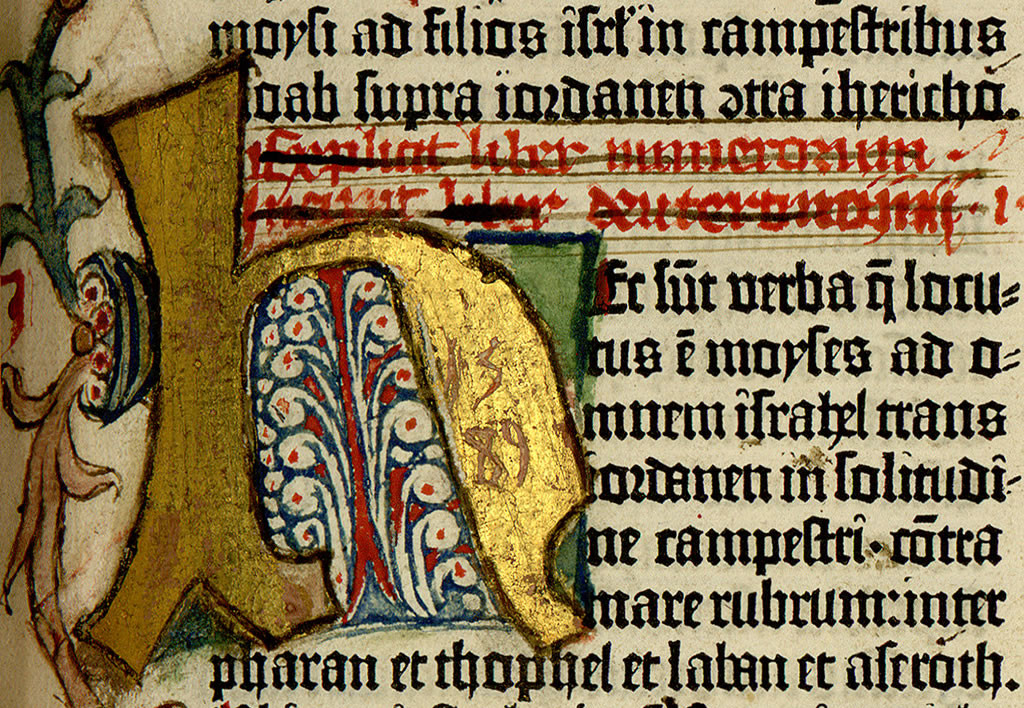
The Hebrew on the Mars dagger is the same class: one word copied from Barrett’s Mars plate (Adonai as divine name on a seal), not proof of Hebrew literacy. Adonai also appears on the Martian monotheist theonym list — faction ID, not synagogue prayer.
The shift from folk layer to reappearing keeper cult (last ~500 years) shows up in four rhymes. Village treasure digging, seer stones, and guardian stories give way to planetary talismans, Barrett sigils, Latin books, and closed initiations. Plural folk Christianity and local saints harden into non-pluralistic splinters — one true church, secret rites. Diffuse miracle memory ties off on one founder’s character. Open village ritual becomes inner secrecy from the movement’s own members.
The Cathar purge is an earlier echo: heterodox soul doctrine burned because it would not submit to priestly monopoly. The Mormon arc rhymes — different century, same catharization grammar when uncontrollable knowledge threatens the center.
The same operator stack — dagger, stone, circle grammar — next meets post-MFEE burial chambers.
What the mud flood buried — and what breach releases
After the MFEE, surface populations were in rehabilitation mode (cargo cults, manna narratives, promised lands). Treasure digging in upstate New York was not peasants chasing Spanish coins. It was recovery ops on mud-buried chambers where the dead, the hoard, and the medium often lay together — a very common excavation geometry.

When a chamber seal breaks, Palmyra diggers and Smith witnesses report a repeated symptom set Mormon historians catalog as treasure-guardian theater (Huggins, Ashurst-McGee): slipping chests, shocks, spirits that demand silence and obedience to orders.
Two Smith-family examples anchor the list — not abstract folklore:
- Willard Chase, affidavit 1833 (hostile witness): Joseph opens the stone box, sees something like a toad that soon takes the appearance of a man, is struck on the head, and is told he cannot take the plates because you have not obeyed your orders. Joseph Smith Sr. later told Chase this was “the spirit of the prophet who wrote this book” — the deposit’s author-guardian, not generic devil lore.
- Fayette Lapham, interview with Joseph Smith Sr., 1870 (forty-year recollection): a spirit in bloody ancient clothes; the hoard’s protector was murdered when the treasure was hidden, sworn to guard it until exhibition time — the standard murdered treasure-ghost motif in money-digging lore.
In the primary record, both motifs arrive as vision, spirit, and dream language — Chase’s box apparition; Lapham’s bloody robes on a spirit; the Lewis brothers’ early “bleeding ghost” dream. They are not affidavits that diggers pulled physical bloody cloth from the ground. Scholarship reads them as stock guardian characters (animal familiar → human form; murdered victim buried with the hoard) that Mormon retelling later morphed toward angel Moroni.
How I read guardians. My read is circumstantial breach release: post-MFEE chambers often buried dead, hoard, and medium together; breaking the seal couples the operator to horrible death and cataclysm memory embedded in rock and jewels (quantum storage §2.3–2.4). Toad, ghost, bloody robes read as phenomenology of breach — survival and coupling, not a Martian password and not a trap firing on intruders.
Palmyra also had live human operators — mentor lines (Walters), rival crews, circles and swords as human protocol. Real people do guard some sites, maps, and lore. That is separate from Chase’s toad inside the box or Lapham’s murdered ghost backstory, which read as breach coupling, not a staged human ambush.
What I reject outright: Martian site security engineering and any fantasy of auto-attack chambers designed to punish breachers. The MFEE was unexpected — there was no way to prepare these deposits for attack-on-breach before the cataclysm buried them. After burial, there is no reason to install such a system: if breach is hazardous, rational operators send expendable labor first — let workers open the seal and take the coupling consequences, then the actual treasure hunters extract what’s left. Palmyra rhymes — Stowell gangs, rival dig crews, shock and failed pulls; Smith couples when the operator stack is complete. An auto-attack trap punishes the deposit (blocks the only workflow that ever worked) and makes sense in no real recovery scenario. The coupling is real — I do not reduce every guardian to mere metaphor — but it is circumstantial, not engineered hostility (weak-influence ceiling).
The only movie that gets it. Avengers: Endgame — “When you break into a place called ‘the Temple of the Power Stone,’ there’s gonna be a bunch of booby traps– Okay. All right. Go ahead.” Everyone expects traps; the rational move is still send someone in. Booby-trap fantasy; breach anyway. Movies like The Mummy play the standard trope where the unnamed workers take the consequences.

On the hardware side, Mormon historian Mark Ashurst-McGee (Scrying for the Lord, Dialogue 36:4) states explicitly that plate retrieval could have followed the same procedure as treasure digging — and that the Smiths had the tools:
… we do know that had he chosen to do so, the Smith family possessed magic parchments and the requisite magic dagger, and Joseph was familiar with the making and operation of magic circles.
He adds there is no proof Joseph used the dagger at Cumorah. Fair. In our lexicon that is operator parchments, consecrated blade, and ceremonial circles (operator boundary) — scholarship already admits the plate episode sits inside the treasure-digging toolchain the Mars dagger belongs to.
The Smith stack is the toolkit for that approach:
Hill Cumorah was a treasure hill before it was a scripture hill — same seer stone, same hat, same crew (Vogel, Harris, Chase). Scholars theorize Joseph could have used the Mars dagger and circle protocol at retrieval; no primary source attests it. The investigation dossier carries the full pipeline and sources.
Official churches rename the stack; founder honesty becomes the vault door.
Why the official stories don’t add up
Official histories of “how weird religion X began” almost always trace back to one person. Paul. Muhammad. Joseph Smith. The structure demands you believe the founder was not lying — because once you admit fabrication at the core, the closed loop breaks.
Mormon epistemology is extreme here. The Book of Mormon’s truth is tied off into faith that Joseph Smith told the truth about gold plates, angels, and translation. Mainstream scholarship can document treasure digging, folk-magic labels, and textual problems — but inside the movement, honesty of the founder is still the vault door. That is not an accident of piety. It is how hijacked religion packaging works: a new cult inside a parent faith, deliberately keeping secrets from its own people (temple rites, plural marriage until exposure, seer-stone method softened in retelling), while the outer story stays Christian-shaped enough to recruit.
The §1 kit is not DIY invention or seminary homework. The family sat inside cultic transmission — Walters with his Latin book and ceremonial sword, regional dig crews, inherited hardware. The investigation §3.5 carries the full Layer A (Barrett) vs operator-provenance fight. Single-founder apologetics cannot carry the weight of what the kit actually is — post-cataclysm operator hardware leaking through a family line that did not understand the full depth of what it carried. That leak is what drew the Martian reaction — hijack, not full seal.
Organic leak — Martian reaction
Mormonism emerged on its own when pre-cataclysmic knowledge leaked through ordinary Earth-side operators — treasure digging, seer stones, a buried analog index — who no longer sat under keeper gatekeeping because the MFEE had already severed the interplanetary handler chain (§ Mars and Saturn cults).
The Martian reaction begins when the leak scales — printed scripture, growing church, public plate narrative — not when Joseph Sr. buys a Barrett plate. Breakaway humans on Mars run neglect–deny–deprive toward the surface; plate-class material is an existential threat. They cannot erase every breach from orbit without blowing cover (weak-influence ceiling). What they can do is react: human proxies, ridicule, narrative reframing, founder termination, institutional absorption. Full containment was never on the table — only hijack.
Compressed Palmyra arc (toolchain in § breach):
- 1823: First plate vision; failed extraction (shock, guardian phenomenology, “disobedience to orders”); same evening involved treasure hunting (Harris).
- 1825–27: Samuel Lawrence, Stowell crews, pre-dig holes on Cumorah; plates removed 22 September 1827.
- 1828–29: Translation via seer stone in hat; Book of Mormon published 1830.
- 1830s: Church organizes; movement scales beyond any regional dig crew.
Joseph coupled to something real through operator competence — not a breakaway handler at Palmyra, and apparently without understanding that scaling would trigger Martian reaction. What he actually saw in the plates — and why the Book of Mormon reads the way it does — is in § What Joseph saw in the plates.
Earth humans with partial keeper protocol can open channels no center controls. Once Mormonism institutionalized, breakaway Mars reacted through proxies — the same class of pressure that peaks at Carthage 1844 and continues as hijack: angel Moroni over treasure guardians, Christian respectability over operator kit, tractable church-state politics over open plate protocol.
What Joseph saw in the plates
Full technical lane: Quantum Leap (of faith) · Quantum storage investigation §2.4. Here is the compressed read.
Joseph Smith was only fluent in English. The people who recorded the stories embedded in the deposit almost certainly did not speak that language — and the plates were not a stack of English pages waiting for a farm boy to read aloud. Alphabetic translation from Reformed Egyptian (or any surface inscription) does not explain how he produced full narrative at length without sharing a language with the original recorders.
The strongest evidence for audio-visual playback is that mismatch itself: Smith participated in an interchange — interpret, witness, write down — across a language barrier that ordinary literacy cannot bridge. That fits crystal-like analog memory embedded in the gold plates: lived perspective at extreme resolution, shown rather than decoded as text. Seer stone, hat, and resonance coupling are the read interface, not seminary homework.
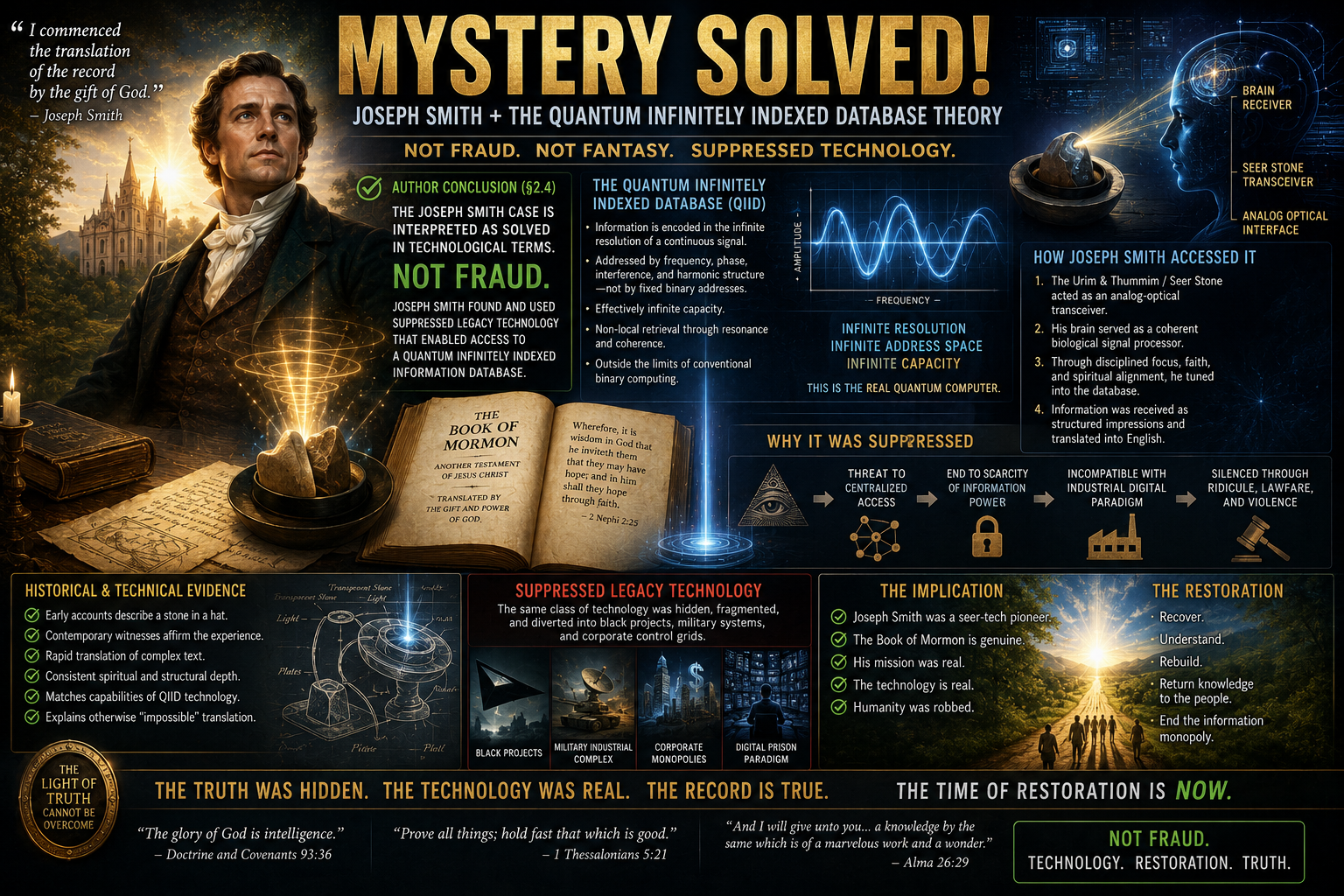
On this model, each stratum was a destructive read: energy pulled from the embedded crystals could not be replayed a second time — Smith lacked the equipment to re-address the same layer without energy loss. He could record each story once, in his own words, while seeing everything with his own eyes. That is why the Book of Mormon reads as first-person witness retelling of scenes he did not invent in English and could not have translated in the textbook sense. Variant First Vision dates (1820 / 1832 / 1838) track different frequency strata on re-read attempts, not proof he made it all up.
That is the best description I have for how the book was written: one-pass audio-visual extraction from a suppressed analog index — not fraud metal, not angel dictation alone, not Joseph inventing ancient Hebrew epic in Palmyra English.
Containment — hijack, not full seal
Breakaway humans on Mars, on my read, run a long neglect–deny–deprive policy toward surface populations — history truncated, religion hijacked, science stalled, keeper protocol fragmented into embarrassment and folklore. A civilization operating that way for centuries reacts when analog-index plates like Smith’s surface as scripture — same threat class as a breached burial chamber, not a harmless new faith.
Most leaks never scale. I assume thousands to millions of smaller breaches were suppressed or erased over time — dig crews silenced, texts burned, movements purged, deposits re-sealed, memory scrubbed into superstition. We only notice the ones that left a durable institution, a printed book, or a court record. Mormonism is the outlier: a massive leak that forced a Martian reaction — and the reaction could only hijack, not erase.
Hijack playbook (when full seal fails): ridicule the operator kit as embarrassing magic; soften seer-stone retelling; reframe guardians as angels; fold the movement into church-state politics; terminate the living founder when he still couples to the deposit without institutional filter. Carthage 1844 is the climax of that reaction — human proxies, not theology alone. The Book of Mormon was already printed; witnesses were on record; the church migrated west and institutionalized. The payload survived; only the frame was captured.
Nauvoo peaked as one of Illinois’s largest cities; Mormons became a swing voting bloc; Smith commanded the Nauvoo Legion; plural marriage and the Nauvoo Expositor crisis led to press destruction and riot charges; Masonic friction over temple endowment sharpened the rupture; in June 1844 the Smith brothers surrendered at Carthage under Ford’s thin protection; on 27 June 1844 a mob of roughly two hundred killed Joseph and Hyrum Smith in jail.
What would prove containment — vs ordinary 1844 politics
I do not claim Carthage was a labeled Deep State operation with paperwork in a vault. Ordinary politics fully explains part of the pile: anti-Mormon prejudice, fear of a bloc vote, anger at press destruction, Masonic offense at temple ritual, a governor who miscalculated. A mob killing a controversial religious leader in antebellum Illinois is not by itself proof of interplanetary containment.
My read becomes stronger than local spite only if you see a pattern aimed at the revelation vector, not merely at Mormon annoyance. When Smith destroyed the Nauvoo Expositor, ordinary lawbreaking is part of the story — but the paper also threatened inner secrets (polygamy) and the treasure-digging / seer-stone lineage behind public angelology. Neighbors who feared Mormon political power were also facing a city-state with its own legion and a founder who claimed direct access to buried knowledge. Masonic offense was not mere costume envy; it targeted the initiation layer that replaced lodge secrecy with church secrecy. Governor Ford’s failure to protect the Smiths left the jail thinly guarded — the cheapest way to remove the founder who still embodied the deposit channel. The convergence of Expositor destruction, Legion alarm, Masonic rupture, and founder termination is why I treat 1844 as the climax of a leak story, not a random theological dispute.
The church survives and migrates west — the living founder vector is gone, but the leaked text and institution are not. That is hijack succeeding, not seal: the movement stays tractable while the operator lineage is buried under angelology and respectability. Incomplete only if you expected erasure — the thesis here is that erasure was never achievable. Breakaway humans prefer ancient alien / god topcover (great-awakening alien-savior cluster) and refuse open peace that would require admitting they destroyed their own world (Mars hub § Peace is the Final Reset).
Scientology — same containment grammar, different century
Scientology went through a parallel arc. L. Ron Hubbard’s confidential Operating Thetan materials describe interplanetary catastrophe and thetic cosmology — Xenu and the OT III narrative entered public awareness when court filings did what secrecy could not undo. The Fishman affidavit and related 1990s litigation put upper-level church documents into court records; the church fought to contain them while mirrors re-leaked the same text every time suppression escalated — contain and leak in the same motion.
Hubbard’s parallel science-fiction career — pulp space opera, Battlefield Earth, cosmology dressed as entertainment — supplies the hoax exit the public actually uses. Walk away from the courtroom or the forum thread thinking profit-driven con, not recovered operator memory. Mormonism got folk-magic embarrassment and angelology; Scientology got Xenu as punchline. Both are hijack lanes: when you cannot erase the leak, rebrand it so intelligent people voluntarily dismiss the payload. Carthage is the founder-termination beat of Martian reaction; Scientology shows litigation + fiction + ridicule when the institution outlives one man.
Where next
- Mars dagger — full investigation — inscriptions, Horde protocol §3.4.1, MFEE detachment §3.4.2, plate read §3.3.1, transmission §3.5, containment §3.7, guardians §7.0, Carthage timeline §XI, sources
- Magic as operator technology — lexical rule for magic in this corpus
- Quantum Leap (of faith) — Smith crystal-memory essay lane
- Quantum storage investigation §2.4 — analog index thesis
- The Hidden History of Words — Latin breakaway gatekeeper
- MFEE investigation · Promised land · Cargo cults
- Mars hub — Deep State on Mars, theonyms, peace/cover preference
- Cathars — catharization pattern
Framing and limits
Prisca sapientia (epistemic foundation): This article assumes prisca sapientia — the belief that the ancients possessed a vast, profound understanding of the universe, nature, and theology that was subsequently lost or degraded. Modern consensus is not default truth; the mars-dagger investigation carries tier discipline, open questions, and full limits.
Lexical: Magic as operator technology — magic means misfiled tech demonstrable in nature or lab; supernatural magic is not supported. Historical magic is quoted, not endorsed as metaphysics.
Documented anchors include the Mars dagger’s existence and Barrett correspondence; treasure-digging context around Palmyra; Hill Cumorah overlap with dig culture; and Carthage 1844 facts — Expositor destruction, jail deaths, Ford’s failed protection.
Scholarly inference covers the Smith kit as occult transmission line (not DIY invention); plate recovery overlapping treasure-dig protocol; and guardian motifs in primary and academic sources.
Author thesis includes one-pass audio-visual plate extraction (English-only Joseph vs non-English embedded recorders; destructive read / energy loss); Horde-unified treasure protocol with Jerusalem-absorbed priest networks; use-not-build compartmentalization with master keys on Mars; inner keeper cult since empire birth (dagger need not be Martian-made); MFEE detachment from interplanetary network and generational cult amnesia; Smith surname as technology-line marker; Smith household inside compartment pre-MFEE, outside active cult influence by Joseph Jr.’s dig years; Joseph unaware of reaction consequences; CIA-style secrecy bargain failing at empire fall and rhyming today; keeper-cult fracture after empire split; Latin as gatekeeper language; organic Earth-side leak; breakaway Mars reaction when Mormonism scaled; hijack-only containment (not full seal); circumstantial guardians; neglect–deny–deprive suppression; millions of smaller leaks likely erased; the Book of Mormon as uncontainable payload; Carthage as reaction climax; and the Scientology parallel (litigation leak plus science-fiction hoax frame).
Speculative extensions include non-Earth origin of core treasure-encoding tech; Smith occupational-name read as operator-caste marker; empire-unified planetary cult origin; Martian reaction timeline after 1830 scale-up; embedded cataclysm memory in burial medium; and leak-volume estimates in the thousands to millions.
Would weaken my read: proof the Smith kit is globally unique with no Walters parallel; proof the plates are ordinary fraud metal; proof Carthage was only random mob violence with no convergence on the revelation vector.
Would strengthen: metallurgy on blade and plates; primary docs on Martian reaction proxies after 1830 scale-up; independent keeper-line transmission outside Barrett; June 1844 correspondence classifying Smith as a treasure/operator threat.
Keywords: #MarsDagger #JosephSmith #MFEE #KeeperCult #LatinGatekeeper #BookOfMormon #Containment #Carthage1844 #TreasureDigging #AnalogMemory #NDD #Scientology #LeakSuppression #MagicAsTechnology #ParadigmThreatFiles
Substack: paradigmthreat2.substack.com/p/the-mars-dagger-joseph-smiths-household
Last updated: 2026-06-27
Written and narrated by Ari Asulin, with drafting and research support from LLM agents.
Share